Sunday, July 15, 2018

An Alabama Family in World War II, Part 39


Melton Pearson Holliman’s Difficult War
by Glenn N. Holliman

My Uncle Melton died early in 1958, age only 49, prematurely taken by heart disease.  He was a pharmaceutical salesman in 1943, having learned his craft while working in his Uncle Floyd Caine’s drug store in the late 1920s.  Melton was the first born of Ulyss and Pearl Caine Holliman’s seven children, and the first to pass away. 

Another three decades would elapse before another child of my grandparents would leave this world, this being my Uncle Euhal Holliman in 1989. According to his daughter Tommie Holliman Allen, Euhal also had heart issues, complicated by rheumatic fever contracted when a child.  This chronic condition, plus being the father of four children, kept Euhal from being drafted during World War II.

The draft by 1943 was reaching deeper and deeper into the available pool of able-bodied American males.  That August, Melton, age 35, was inducted into the Army at Ft. McClellan, Georgia and within a month was shipped to Camp Barkeley, Texas for basic and advanced training.  From September to February 1944, except for a six-day furlough in January 1944, he slogged through first the dust and then the mud of this hastily established military facility on the Texas plains. 

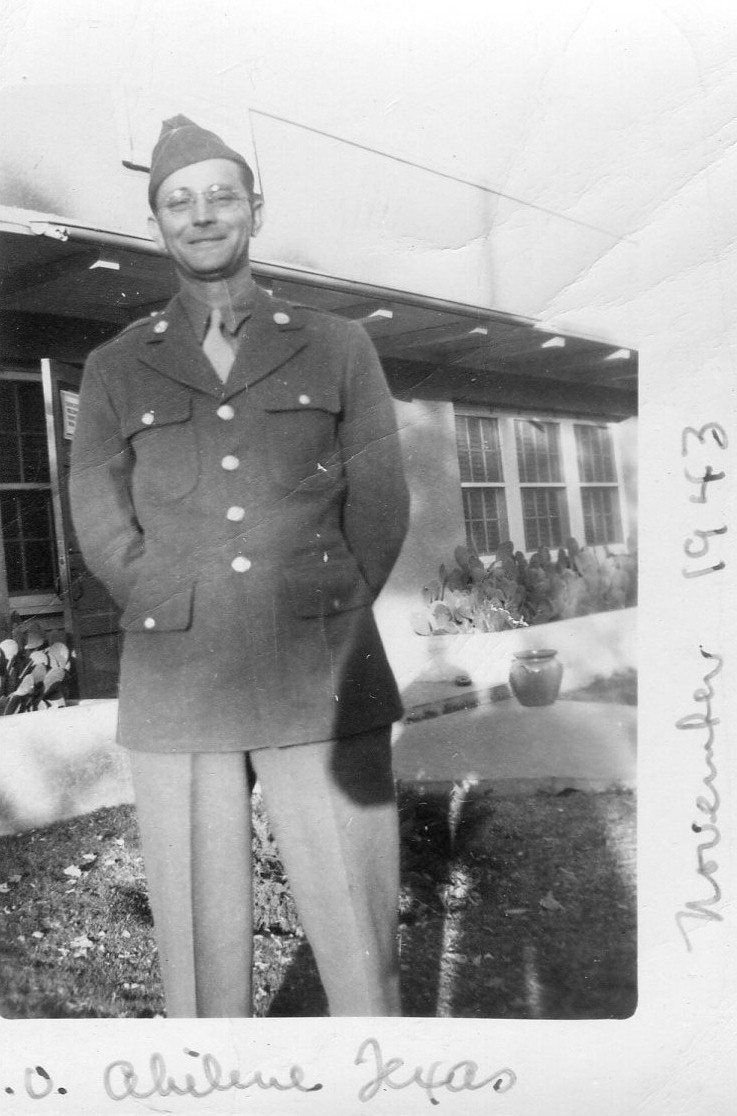
Left, Melton in uniform; note the medical corp insignia on his collar.  This picture suggests a physical resemblance to World War II swing band leader, Glenn Miller.

Melton’s letters home, which I have used to construct this narrative, are poignant, expressing the homesickness of almost every G.I. caught up in the maelstrom of World War II.  My uncle had additional reasons to pen moving words back to Alabama.  


He and his wife of eleven years, Ida Hughes Holliman, had adopted in April 1943, a curly haired, red-headed bundle of joy, an infant daughter, Patti (whom Melton called Patsy).  Melton was to miss the critical, unrecoverable months of Patti beginning to walk, talk and capture the hearts of the entire Holliman clan.

“Christmas Morning, December 25, 1943

My Dearest Precious Ones,

There is a lot I could write this morning, but it would make me bluer and I know you’d be blue when you read it….so I won’t do it.  Deep down in your heart you probably know how I feel.

I spent all of yesterday in the hut.  Did not even go to the PX after I called you.  It rained most of the day and the mud was awful.  We will have our Christmas dinner at 1 pm.  Will have turkey and all the trimmings.  The mess hall is gaily decorated in ‘Xmas’ tree and everything. 

Last night after we went to bed the choir from our chapel came through the company streets singing Christmas songs.  There were about 50 soldiers in the choir…the singing was beautiful.  Before we retired, all of us in the hut sang songs.  I was a half way leader of the singing.

Above, Melton, back row, second from right, and his fellow troops.  Note the tar paper huts, constructed in 1940.  The camp once held 50,000 trainees before closing in April 1945 near the end of the war.  No doubt these are the fellow homesick soldiers who joined in the singing on Christmas eve.

I heard this morning that we were to finish up here entirely January 15th.  I am still classified a pharmacist. 

I hope you enjoy your Christmas party at Moma’s.  I sure wish I could be there with you.  I am not on KP today.  The Jewish boys were put on; I think that was fair enough.  They don’t observe Christmas.  

Baby, my prayer is that next Christmas we can be together…so I hope you had a Merry Xmas and I love you very, very much.  Melton”

Left, Patti Holliman (Hairston) and her first cousin, John Melton Ferrell, third child of Charles and Loudelle Holliman Ferrell, 1943.

Sadly, Melton would not be home for Christmas in 1944. In late autumn, he was evacuated from his medical unit in France and  hospitalized in England for high blood pressure and other unspecified ailments  December 1944.  He later was shipped home and reunited with his wife and child in the winter 1945.  Apparently, this serious episode was the first manifestation of a heart condition that would later take his life prematurely.

Below, the training schedule for part of December 1943 at Camp Barkeley, near Abilene, Texas.
 

Living in the barracks required a strict regimen of tidiness and hygiene as the demerit list indicates!


Next posting more on an Alabama family engulfed in World War II and how their lives were forever changed.....

Friday, June 15, 2018

The Passing of a Generation, Part 1


The last child of Ulyss and Pearl Caine Holliman has Passed, and the Greatest Generation comes to an End
By Glenn N. Holliman


My father, Homer Bishop Holliman, left picture 2002, born December 17, 1919, breathed his last at 3:10 p.m. on Saturday, June 9, 2018.  He was surrounded at his Cookeville, Tennessee hospital bed by his three children – Becky, Alice and yours truly.  And my two children, Grace and Chris and Becky’s son, Bryan.  His last illness was only a few days and mercifully largely free of pain and discomfort.

My Dad lived through 40% of the history of the United States, his days largely spent in the 2oth Century America.  A prolific writer, he recorded stories of his family, his growing up in Alabama and his observations on the time and culture in which he moved and had his being.

His parents, Ulyss and Pearl, born respectively in 1884 and 1888 in rural Fayette County, Alabama, were descendants of 17th century immigrants from the British Isles.  In 1836, my branch of the Hollimans migrated to west Alabama from the Carolina's.

Dad’s grandfather, John Thomas Holliman, 1844-1930, photo right 1900, fought in seven major battles for the Confederacy in the 1860s serving under Braxton Bragg, James Longstreet and Robert E. Lee.  He returned home in 1865, became a ‘dirt farmer’, had six sons, the last being Ulyss.  My father knew his grandfather and remembered him as a tall ancient man, thin with a long white beard.  John Thomas Holliman was almost illiterate and died a year before his wife, Martha Jane Walker.  My great grandmother’s father, Samuel Walker, experienced the three days at Gettysburg and the siege of Petersburg, including the tragedy at the Crater.

Ulyss married Pearl Elmer Caine, a neighboring girl, when she was 18 around 1906.  (Pictured below in 1945.) He is listed in the 1910 census as a farmer.  Soon the children began to appear – Melton in 1908, Vena in 1909, Euhal in 1912 and Loudelle in 1914.  Some time in those years, the family left the farm and moved to the village of Fayette.  There Ulyss found employment in the local lumber mill.

Their world was rapidly changing – oil lamps were giving way to electric lights and horses to motorized carriages.  And 50 or so miles away by railroad, a ‘magic’ city, powered by coal, limestone, iron ore and northern capital, was growing rapidly offering economic opportunity and a way for a father to better support his four children.  So in 1917, this Holliman family moved to a suburb of Birmingham – Irondale -  a railroad switching yard for a growing number of freight and passenger trains that tied an emerging southern economy to a more financially robust America.

Before long, three additional children came along – Bishop in 1919, Virginia in 1922 and Ralph in 1925.  Pearl was 37 and Ulyss 41, when their family was complete.  Ulyss, good with his hands, took employment as a carpenter with the Birmingham Electric Company, a corporation which ran the municipal street car line.  When my grandfather was born, there were no street cars in Birmingham and when he died in 1965, there were no street cars.  But in between these technological eras, he worked 32 years repairing the wooden cars and supporting a family of nine persons.

That move from the land, where countless ancestors had toiled, to a newly industrialized urban area changed everything for my father’s generation.  As President Franklin Roosevelt remarked in the 1930s, this generation had a rendezvous with destiny, and so it was to be.

Continued soon to Part 2….


Saturday, April 28, 2018

An Alabama Family in World War II, Part 38

by Glenn N, Holliman


Letters of my Grandmother, Fall 1943

In August 1943, Ulyss and Pearl Caine Holliman, ages 59 and 55, of Irondale, Alabama saw their oldest son, Melton P. Holliman, b 1908, inducted in the U.S. Army. Two young sons, Bishop, b. 1919, U. S. Navy, and Ralph, b. 1925, U.S. Army, had been called to the colors earlier.  Now the fourth and last son, Euhal, b. 1914, and father of three pre-school children, had received notice.  

Son-in-law, Walter Cornelius was in training, but there are fewer letters to trace his war as he was state-side until 1945. His wife, Virginia, b 1922, was able to travel with him to several of his postings.


Left, Walter and Virginia, in California, a young couple a long way from Alabama.

Pearl wrote from September to November 1943 numerous letters.  Exerts are below.

“Well, I guess Euhal will have to go in a few months.  It looks like all the men will go up to (age) #38.  We are doing our part as best we can and looking forward to you boys all coming home soon.  May the Lord bless and keep you. Love, Mother H.

We had a bond rally in Irondale last nite and us women are to go from house to house to sell bonds.”


Above, forty years after the war, 1985, beginning with Vena on the far left, Loudelle, Bishop, Ralph, Virginia, Ida and Euhal, closest to the camera.

My father, Bishop, had just returned from the Mediterranean where his destroyer provided vital shell fire at the invasion beach in Gela, Sicily and experienced a Luftwaffe attack at Palermo.  The USS Butler returned to Brooklyn Navy Yard, and Bishop was sent for refresher code training at Cisco Bay, Maine before transfer to the USS Barker later that month.  June 1943 until June 1945, he would spend approximately 75% of his time at sea escorting convoys.

A great deal of my grandmother’s letters had to do with sharing changing address of her sons in training and assignments.  That month of September 1943, she wrote Bishop:

Ida (Melton’s wife) just called; she had just got a wire.  Melton is in Abilene, Texas at Camp Barkley.  He came through Irondale and Birmingham last Friday.  Too bad all of you have to come so close to home and can’t stop.  Be sure and write to him.  He will be lonely.”


Right, Melton in autumn, 1943, training as a medic in the Army.

Bishop, Ralph and Melton, all three, at one time during the war traveled by train through Irondale within sight of their grandmother Lula Caine’s house.

"Bishop called Saturday night, and Motie (Ralph’s wife) got a telegram from Ralph, both in New York (Bishop and Ralph).  Wouldn’t it be grand if they could have run into each other…Jr. Caine (a nephew of Pearl’s) came home last week.  He really is a good-looking man now, weight 174 pd.  He had not been home in over two years.


Ira and Patsy (Melton’s 1-year old daughter) came out last week.  Patsy is some smart girl.  Virginia, Mary and Vena say the new boy (Bob Daly, b. 10/1943) looks like me.  

I tell them it does not.  You know you can’t tell who they look like when so young.”


Right, 1952, Ulyss, Pearl and Bishop

Pearl wrote in October about Ralph who had been stationed in Reno, Nevada:

“We finally heard from Ralph.  He is somewhere in England. Motie got a cable from him.  I sure was glad to hear from him….They have just announced London was bombed last night and a dance hall bombed with lots of soldiers and girls killed. Ralph wrote he had not been to London yet so he must be close by. So he needs our prayers.

I hope he will never go near a dance hall.  If bombs don’t fall. They are loaded with sin bombs.”


My grandmother’s language is disjointed, but she believed dancing was sinful.  Her education ended in the 8th grade in a rural Fayette County, Alabama school.  Raised Methodist. she and Ulyss joined the evangelical Christian Alliance Gospel Tabernacle in Birmingham in the mid-1930s.  Their adult children remained Methodist or Baptist, and a mild rift occurred between the generations.

Left, Ulyss Holliman, second from the right, in a Birmingham News photograph, ca 1950, an elder in the Gospel Tabernacle Church.

Next posting, letters from Bishop at sea, Ralph in England and Melton in Texas.

Thursday, March 22, 2018

An Alabama Family in World War II, Part 37

by Glenn N. Holliman

A Letter from Robert W. Daly, Sr.

These exerts are from an October 2, 1943 letter which my Uncle Robert wrote in his humorous fashion to my father of the birth of  Robert W. Daly, Jr. on Sunday, October 3, 7:55 pm.  Robert (1901-1959) was a bank manager in Woodlawn, Alabama.  My Aunt Vena, cousin Mary and Robert lived on 3rd Avenue North, Irondale, next door to his father and mother-in-law, Ulyss and Pearl Caine Holliman, my grandparents. 

TO: H.B. Holliman, USS Bulter, Fleet Post Office, New York, New York
FROM: Bankers Boulevard, Irondale, Alabama

We are not looking for the baby before around the 15th of this month, but yesterday Vena broke water ...so we have been holding our breath every since, expecting any minute for the pains to start and then my pain starts trying to get her over to St. Vincent's before it is born on the road with me delivering with one hand and driving with the other one.  I do not know what the feet will be doing while all this is going on, driving I guess.

I may have to take over there any minute, so if it happens, before Monday a.m. I will add it on to this letter.  We have Martha Jane, Barbara Ann, and other names picked out but still can't decide on one, also Betty Daly.

Vena and daughter Mary
Daly Herrin, ca 1936
Vena insists if it is a boy that it be Robert William Daly Jr.; she says this is a refined name.  How's that for a break?  Can you believe it could come from your sister after living with the old boy for 15 years and still speaking to me.  Vena has been getting along pretty well except for losing some sleep. She has not been sick but a few times.

PS - Monday, October 4, 1943

Well, she started to hurt around 4 a.m. Sunday morning, so we got up and dressed and fixed a light breakfast.  She got easy, so I went back and lay down and slept until seven thirty.  About 4 pm she had two or three hard pains, and I called the doctor...so we started for St. Vincent's, all the way over I thought it would be born in the car, but finally we got there after some speeding.  The nurse told me when she examined her that I would not have to wait long, probably 2 hours.

                                                                       Robert William Daly with his curly black hair.

In a few minutes I saw the nurse rush up to the phone and I listened in to her conversation and she told the doctor to come on over at once the baby was about to be born.  Finally the doctor got there and went into deliver the baby.  In about 20 minutes I heard them patting the baby on the back or somewhere to help bring it to or get the throat clear....After about five minutes the nurse came by and told your Mother and myself it was a boy and it was fine.  After a little bit they brought Vena out and let us see the baby; it was wrinkled and looked old like all new born babies do when they first come out.  You know how your hands look some time when you wash them too much and they draw up after painting or something.  It weighted six pounds and five ounces and was perfect in other respects, no hair.  

We left her about 11 pm and came home, and this morning Vena was doing fine and not hurt but very little.  The baby has come out something wonderful over night and has a smooth complexion, Holliman features, Holliman nose, black curly hair which came out overnight, blue eyes. He seems to be perfect in every respect.  He is a very pretty baby, in fact about as pretty as I ever saw to be so young.  I think he will be an asset to the Holliman generation with a mixture of Daly and Holliman.  This should make him a very bright lad with two distinguished bloods mixed in one pot.  

The Daly family - Vena, Bob, Mary and Robert, Christmas 1943, Irondale, Alabama


Vena will probably be home in about five days if all goes well.  As you know she insisted on naming it Robt Wm Daly, Jr in honor of the old man.  I was not so hot on this, but she was the one to do all the suffering so let her have her way.  

If I have left out any details which you would like to know, just drop me a line and I will into details.  this may not be in detail enough for you.

Robert

My Uncle Robert included many additional details in this letter so his last sentence is a sample of his understated but every present Irish humor.  In time Robert ceased referring to his son as 'it" and nicknamed him affectionately as 'Bud'.  The 'bright lad' referred to in the letter became a Ph.D. in biological sciences and a college professor, thus fulfilling his proud father's prophecy! - GNH


Saturday, March 3, 2018

An Alabama Family in World War II, Part 36

by Glenn N. Holliman

News from the Home Front, as Summer turns to Autumn, 1943

Bishop Holliman's destroyer left the Battle of Sicily and the Mediterranean and arrived in New York City in the late summer of 1943.  Brothers Melton and Ralph were in the Army - Melton as a medic in training at Ft. Bradley, Texas and Ralph, a clerk assigned to Reno, Nevada.

Their Mother, Pearl Caine Holliman sent Melton a newsy letter proclaiming that Ed Fortenberry, the Irondale, Alabama grocer, was ready to adopt Melton and Ida's new vivacious daughter, Patsy, if ever they wanted to give her away!  "She seems to win everyone's heart wherever she goes."


 Left, Ulyss and Pearl Caine Holliman in Irondale with their grand daughter, Patsy (Patti), daughter of Melton and Ida Hughes Holliman.  

Pearl wrote "We had a bond rally in Irondale last night and us women had to go door to door to sell bonds." A week later she wrote Melton, of which I publish a part of the letter (see below).  This is my grandmother's own handwriting.

In the 4th line, she writes that Motie, Ralph's young wife, has returned from visiting him and now has a job in Birmingham, but if Ralph stays long in Reno, she is going to join him.

In the 8th line Pearl refers to Vena Holliman Daly's pregnancy, one in which she often had been sick.  The child, Bob, will be born safely in October 1943 and was named after his father, Robert William Daly, Sr.


Right, Vena, Ulyss, Pearl and Mary, daughter of Robert and Vena Holliman Daly in 1942.

In the 11th line, Bishop has been reassigned from the USS Butler to the USS Barker, but goes for more radio direction training in Maine before shipping out again into the North Atlantic.

His Mother is worried he will be sent back to Italy, where 'they are having some slauter (sic) over there.'  Here Pearl writes, as she did in most letters, of her deep Christian faith, a faith that through prayer all her boys would come home safely from the war.


Toward the end of this letter, Pearl expressed her concern that her sister, Vista Caine (1898-1986), had a new boy friend (Vista smoked, drank, was twice divorced and generally enjoyed life).  Pearl's strict religious beliefs and Vista's life style created stress between the two sisters throughout their lives.  Their Mother, Lula Hocutt Caine (1861-1957) had a more live and let live approach to life!         
                                                                                                                                       
Above, Fred Gumpp, Vista, Bishop and Gerry Holliman in 1974 at Vista's home in Indiana.  She married that 'rich man', Fred, and settled down to 40 years of marriage!

Next post, more letters from the home front in Alabama!


Saturday, November 25, 2017

An Alabama Family in World War II, Part 35

A Battle at Palermo, an Induction in Georgia and a Troop Train in Alabama - July 1943 
by Glenn N. Holliman

 By the summer of 1943 three of the four sons of Ulyss and Pearl Caine Holliman of Irondale, Alabama – Melton, Bishop and Ralph - were in military service, along with their daughter Virginia’s husband, Walter Cornelius.  Son Euhal, soon the father of four children, was deferred due to his large family responsibilities. 


 Left, in 1927, 2300 3rd Avenue, N. in Irondale, Alabama, Pearl Caine Holliman holds Ralph, her youngest child, flanked by Bishop and Virginia. Virignia's husband, Walter Cornelius, would serve in the Pacific during World War II, Bishop in the Navy in the Mediterranean and Ralph in France.

Bishop, b. 1919, my father, was on the USS Butler in Sicily July 1943.  After shelling the Herman Goring Panzer Division at Gela, Sicily and saving the 1st Infantry Division from annihilation, the Butler and other ships left Sicily and refueled and restocked in Algiers.  Shortly thereafter, Dad’s ship and other destroyers were directed to Palermo, the capital of Sicily.  The city had fallen to U.S. troops, and the Navy was to lend fire support along the coast.

A Sunday in July, 2 a.m. the German Air Force paid a visit, dropped flares over the harbor and then their high explosive bombs.  Bishop, a radioman, age 23, was at his battle station, the radio shack exposed on the aft of the 1,000-ton destroyer.  There he experienced the intensity of the air raid.  He wrote later:


“The ship immediately got under way and headed out of the harbor.  And the bombs started falling all around us.  We could not shoot back because we couldn’t see them.  We fellows in the shack didn’t know what was going on outside.  We could hear the bombs falling and feel the ship shake.  At times like that it is hard to sit there at a typewriter. Everyone remained calm though. However, I did not have to exert any pressure on my fingers. I just held them over my typewriter keys, and my hands shook so furiously that they pushed the keys down.  We sat there for 30 or 40 minutes wondering if they would get us….the raid lasted almost two hours.  Finally, our fighters arrived and shot down 4 or 5 planes.”

Two days later, the Luftwaffe returned, dropped more bombs and sank an adjacent ship to the Butler.  The ship escaped damaged, and later the destroyer picked up a downed German flyer who had been drifting for four days in the Mediterranean.   Finally, Bishop’s destroyer was released from duty, sailed to Oran, picked up a convoy and sailed home, arriving in late August 1943 in New York City.

While sailing home, Bishop typed up a 12-page letter about the events in Sicily, and as it was against regulations at that time to publish stories about the invasion, he went ashore in New York and posted the article to his niece Mary Daly in Irondale, Alabama.  A copy of this manuscript survives in the family to this day.


Left, one of the faded pages of Bishop's manuscript.

The military forces of the United States continued to expand in 1943, and older men with dependents were drafted to fly the airplanes and drive the tanks and ships coming off American assembly lines in greater and greater numbers. 

The oldest son of Ulyss and Pearl Caine Holliman, Melton, b. 1908, married and now with a child, Patti, was drafted August 4th into the U.S. Army at Mobile, Alabama and shipped by train to Atlanta, Ft. McPherson, Georgia, the reception station.  He wrote his first letter home on August 5th that the group of men he was with looked older than he (!) and all were married with children.


Melton, a pharmaceutical salesman in civilian life, was assigned to a medical training company 1,200 miles from Birmingham, as he wrote in ‘a God forsaken place’, Camp Barkley, Texas.  The letters home to his wife Ida, and newly adopted daughter, captured the home sickness and difficult adjustment to the regimen required of Army life.  My Uncle Melton’s sacrifices were only beginning that summer of 1943. 


Right, Melton in uniform in Texas, 1943

Ralph, who had been inducted in April of 1943 into the Army was shipped by train from basic training in Florida to Colorado in July 1943.  His train passed through Irondale and stopped in Birmingham.  For two hours Ralph nor any other soldier could leave the train to even make a telephone call.  Later his Mother, desperately worried about her three sons in the military, wrote these anguished words.  

“They moved him (Ralph) to Denver, Colorado. He came through Irondale and his train stayed in town for over two hours and we didn’t know it. He could not call.  I could hardly stand it.”

Left in 1952, Ralph with his two children, Pam and Kathy.  

The story of the sealed train has resonated in the extended Holliman family for generations, reflecting the worries of loved ones in those anxious years.


Next, more on the War that changed the lives of a close-knit Alabama family.


Tuesday, January 3, 2017

An Alabama Family in World War II, Part 34

by Glenn N. Holliman

Invasion Day at Gela Beach, Sicily - 10 July 1943

It was the greatest invasion fleet in world history - greater even than D-Day 1944.  More than 3,000 allied ships and boat of all sizes carried or escorted seven divisions of British and American troops.  These men stormed the beaches of Sicily and seized the first bit of European territory from Italian and German fascism.  

One of those ships, the USS Butler, a 1942 destroyer carrying submarine depth charges, torpedoes, 5 inch guns, and over 200 young sailors, one being my father, Bishop Holliman, provided anti-submarine and anti-aircraft protection for this massive fleet. The deck guns would be called upon to shell Herman Goring's crack German Division at Gela Beach. 

The Butler to the right.


For my father, and hundreds of thousands of others, it was a baptism of fire and fear. Here are more of his words written in August 1943 and mailed surreptitiously to avoid censorship to his niece, Mary Daly (Herrin) in Irondale, Alabama.  Caught up in describing those days in July 1943, he moves back and forth from past to present tense.  I have done some minor editing for clarification.


For historical background, I am using Rick Atkinson's excellent work, The Day of Battle, the War in Sicily and Italy, 1943-1944.  When appropriate, I add notes from this work in red amplifying my father's narrative.

H. Bishop Holliman, b 1919, writes:

"Arriving there (Bizerte), there seemed to be hundreds of ships - all kinds-transports, landing barges, British, American, etc. There were several sunken ships at the harbor entrance. There was hardly a building in the city that had not been damaged or totally destroyed. The city looked like a cyclone had swept through. Moreover there were many farm houses which seemed to escaped the bombs.  It was terribly hot (t)here."


Bizerte had been evacuated by the Germans in May 1943, but not before scuttling a dozen ships at the narrow neck of the Bizerti bay.  Navy divers had worked feverishly to clear the channel. What my father saw was 'a solid forest of masts, and many species of amphibious vessels ready to transport the 1st and 3rd Infantry Divisions to Sicily.

"On Monday night (5 July 1943) we fueled up from a tanker in the harbor and tied up there for the rest of the night.  All of us remarked how dangerous it would be to have an air raid while we were tied up there.  I went on watch at 2 a.m. the next morning (6 July 1943) and as fate would have it at 3:30 a.m. the Germans came over.  The shore batteries and guns of other ships started firing before we did. Simply because the officer on watch thought 'It was target practice', my job, during battle is the same as the other work I do, copying code. So I have to sit there at the  typewriter typing away as if nothing were happening.  There are about six others so we are able to relived each other from time to time.  The raid lasted about an hour.  But no bombs fell close to me.  There were hits on other ships.  Two fellows were killed on one, and a destroyer was hit. We not able to tell how many of the planes were shot down."

Atkinson writes "Luftwaffe raiders sometimes sneaked across the Sicilian Strait before dawn...alarms wailed, smoke generators churned out a thick gray blanket to hide the ships, and searchlight batteries impaled the planes on their beams as hundreds of antiaircraft guns threw up fountains of fire...."

"On Thursday morning (8 July 1943) we left for Sicily where the captain had told us the afternoon before we were to take. On Friday he gave out all the information - how many ships, time and place of the attack, who the leaders were, etc.

He also said he expected to fight the ship to the very last.  There would be no giving up or thoughts of abandoning ship!

Friday noon and night (9 July 1943) we were fed as much as we could eat, such as it was. There was very little concern or unnecessary excitement.  There were many ships in view, arranged in convoy units.

Early Friday afternoon the sea began to get rough, and I was off watch so I lay down part of the time. But the sea got rougher.  There were no clouds for rain, but the wind blew strong. Believe it or not this was the only rough weather we had encountered up to that time.  By supper time the ship was rolling and almost impossible to eat.  I went on watch at 5 pm and I got sick, and I mean sick.  There were many others in the same fix.  It was not a comforting thought to be going into battle so sick you could not raise a finger to protect yourself and furthermore you don't care."

Atkinson writes that a polar cold front briefly collided with a secondary cold wave over the Mediterranean hemmed in by a low mass of air over Yugoslavia.  The results were 37 knot winds and very heavy seas for over 12 hours.  The troops and sailors suffered mightily from the storm.  US Naval Vice Admiral Henry K. Hewitt on the flagship Monrovia even considered calling off the invasion during the height of the storm, but trusting his meteorologist continued on.  The storm abated around 2 a.m. on 10 July 1943, Invasion Day.

"My watch was over at 9:30 pm and we were scheduled to take our battle stations at 11 p.m. zero hour being 2:45 a.m. (Saturday, (10 July 1943) so I lay down on the deck in the radio shack where my station is and tried to sleep until then.  I blew up my life jacket and used it for a pillow.

I woke up a little before 11 and the captain was talking over the loud speaker.  We were approaching our place of rendezvous (that's the place where all the ships were to assemble, Vena). The captain was telling us of what he expected and the usual line of talk, also he read a few verses from the Bible, some religious poems and prayed the Lord's Prayer.  He had wanted to have a religious service that night, he said, but was impossible due to the rough sea."

Vena was Bishop's oldest sister, married to Robert W. Daly, Sr. and mother of Mary Daly Herrin and Robert W. Daly, Jr.  The rendezvous of hundreds of ships, sixty miles long and a mile wide,  took place just east of Malta before turning toward Sicily during the night.

The captain was Lt. Commander Michell Dudley Matthews (1903-1985) who retired in 1957 as a Rear Admiral.  It was a young man's war with many ships and too few trained officers.

"The rest of the night some of us would lie down on the deck and snooze while others would copy and then exchange.  The sea had become much smoother around 2 a.m. but I think the invasion was held up about an hour. There was very little action until 3 or 4 a.m. An officer from the deck describes what is going (on) through the loud speaker.  Otherwise the men below deck would not have any idea what is going on.

After the troop ships unloaded and landed, there was considerable firing on the beach. Many fires but no opposition to speak of. This is at Gela, Sicily where the American troops landed." 

Below, the US 7th Army landings under General George Patton at Gela Beaches.  The 1st Infantry landed on the middle beach on 10 July 1943 and overcame some Italian resistance. The next day and the arrival of German tanks would be another story.


Unloading the ships began at 3:30 a.m. at Gela with confusion and courage.  There was more opposition at Gela than my father, with his limited view at the time, knew. Mines were the major danger and some shore guns. The 1st Infantry secured the beach but with casualties. The Italian defenders soon were overcome.  The real test was on 11 July 1943 when German tanks moved on the beach head.

"No one was frightened and it seemed just like a drill. Our ship's job was to act as part of anti-submarine patrol. However, we got word we could expect an attack at dawn. Over thirty planes were supposed to be coming. At dawn everyone was tired and worn out.  Until the tension slacks off you do not realize the strain you have been under.  All we had for breakfast was orange juice and two boiled eggs.

All day Saturday I was at watch or at General Quarters (Battle Stations). There was firing from the beach and firing from some of the ships.  There was so much going on I was never able to remember just what all was taking place.  The only thing I remember doing that day was eating breakfast.

Early Saturday morning the captain announced the (censored)  had been sunk with only 69 survivors.  He seemed pretty shaken up about it and it made us all realize there had been more danger than we had suspected.  At that time no one knew what had sunk her."


The unfortunate ship was the USS Maddox, serving as a destroyer screen as was the USS Butler for German U-boats.  One German airplane dropped two bombs and within a few minutes the ship sank dragging down 212 men. A tug rescued only 74 survivors.

There were personal reasons for the young captain Matthews of the Butler to be upset.  Above left, the photograph taken from the USS Thorn (647) shows in the background the Butler  (636) right moored in Brooklyn harbor next to the USS Maddox (622), left in the fall of 1942.  The two captains would have known each other.  The Maddox captain went down with the ship. Above right, the USS Maddox on sea trials.


The Battle for Sicily against 300,000 Italians and a very determined two German divisions would continue until late August, and the USS Butler would face more enemy fire....to be continued.