Showing posts with label Virginia Cornelius. Show all posts

Tuesday, December 24, 2019

A Post WWII Christmas for an Alabama Family

by Glenn N. Holliman

Christmas 1946 - All Together Again

It was the first Christmas when all the sons who had gone to war - Melton, Bishop and Ralph - and a son-in-law, Walter Cornelius, could be together with the extended family.  This Birmingham/Irondale, Alabama nuclear family was reunited after the travail of war.  All the persons pictured above still lived near the childhood home of the seven siblings - Melton, Vena, Euhal, Loudelle, Bishop, Virginia and Ralph.  Euhal and family lived in Gadsden and Melton's branch in Mobile.  In a few years this would change.

And in a few years there would be many more children, the 'Baby Boomers'!


This is a photograph I have starred at many times in my now long life.  The names placed under the photograph are all correct except the name 'Susan' in Virginia's lap.  That is Carol Cornelius born 1944.  Her sister Susan would come along in 1949.  As Charles and Loudelle Ferrell are referred to as Dad and Mother, perhaps cousin Charles H. Ferrell labeled us.

While examining this picture and rearranging others a few weeks ago (I have hundreds of photographs of the Ulyss and Pearl Caine Holliman's descendants and happy to forward them to those requesting), I was amazed to discover a second photograph taken evidently right before or right after each other.  See if you spot the differences.  It took me a few minutes to do so.


Some eyes are open or now closed.  Grandpa Ulyss is closer to Pearl.  Patti is now on the front row, partially blocking Carolyn.  The bottom photograph is not as sharp; perhaps that is why a second was taken.

Mary, holding her brother Bob, is the oldest cousin and the remaining person who may remember the details of the pictures.  The rest of us were too young, and all the adults have passed away.

There are 12 grandchildren in this picture.  By 1956, there would be 19 grandchildren, but alas Grandmother Pearl had died in May 1955 and with that the Christmas reunions ceased to be.  Both Bishop and Ralph families had moved out of state for employment opportunities.

Who took the pictures?  I believe it was Virginia's good friend, Verlice Nichols, pictured below.  This picture was taken with the Robert and Vena Holliman Daly home in the background.  Many of the Holliman pictures were taken at this location adjacent to the Ulyss and Pearl home.  Why?  One the location of the sun, persons looking south and two, did the Daly family own the camera? 


After my father Bishop died in 2018, my sister Becky and I connected with Verlice, then in her late 90s living in an Arizona retirement home.  She telephoned us several times, and we talked of her memories of Irondale and growing up in the 1930s.  Sadly earlier this year we received a call that she had died suddenly.  Another chapter closed.

As I have reviewed hundreds of pictures the past month, I noticed that my grandfather often stared off into space when posing for pictures.  Notice in the two pictures above he does not look into the camera.


Above is the first known picture of Ulyss taken ca 1900.  The copy under the picture is by Rhodes B. Holliman (1928-2014), grandson of John Thomas Holliman (1844-1830), my generation's great grandfather.   From the beginning, Ulyss avoided a direct gaze at the camera.  Interesting.


Thanks for reading and hope this is helpful to those of new generations who wonder from whence they have come.


Saturday, November 25, 2017

An Alabama Family in World War II, Part 35

A Battle at Palermo, an Induction in Georgia and a Troop Train in Alabama - July 1943 
by Glenn N. Holliman

 By the summer of 1943 three of the four sons of Ulyss and Pearl Caine Holliman of Irondale, Alabama – Melton, Bishop and Ralph - were in military service, along with their daughter Virginia’s husband, Walter Cornelius.  Son Euhal, soon the father of four children, was deferred due to his large family responsibilities. 


 Left, in 1927, 2300 3rd Avenue, N. in Irondale, Alabama, Pearl Caine Holliman holds Ralph, her youngest child, flanked by Bishop and Virginia. Virignia's husband, Walter Cornelius, would serve in the Pacific during World War II, Bishop in the Navy in the Mediterranean and Ralph in France.

Bishop, b. 1919, my father, was on the USS Butler in Sicily July 1943.  After shelling the Herman Goring Panzer Division at Gela, Sicily and saving the 1st Infantry Division from annihilation, the Butler and other ships left Sicily and refueled and restocked in Algiers.  Shortly thereafter, Dad’s ship and other destroyers were directed to Palermo, the capital of Sicily.  The city had fallen to U.S. troops, and the Navy was to lend fire support along the coast.

A Sunday in July, 2 a.m. the German Air Force paid a visit, dropped flares over the harbor and then their high explosive bombs.  Bishop, a radioman, age 23, was at his battle station, the radio shack exposed on the aft of the 1,000-ton destroyer.  There he experienced the intensity of the air raid.  He wrote later:


“The ship immediately got under way and headed out of the harbor.  And the bombs started falling all around us.  We could not shoot back because we couldn’t see them.  We fellows in the shack didn’t know what was going on outside.  We could hear the bombs falling and feel the ship shake.  At times like that it is hard to sit there at a typewriter. Everyone remained calm though. However, I did not have to exert any pressure on my fingers. I just held them over my typewriter keys, and my hands shook so furiously that they pushed the keys down.  We sat there for 30 or 40 minutes wondering if they would get us….the raid lasted almost two hours.  Finally, our fighters arrived and shot down 4 or 5 planes.”

Two days later, the Luftwaffe returned, dropped more bombs and sank an adjacent ship to the Butler.  The ship escaped damaged, and later the destroyer picked up a downed German flyer who had been drifting for four days in the Mediterranean.   Finally, Bishop’s destroyer was released from duty, sailed to Oran, picked up a convoy and sailed home, arriving in late August 1943 in New York City.

While sailing home, Bishop typed up a 12-page letter about the events in Sicily, and as it was against regulations at that time to publish stories about the invasion, he went ashore in New York and posted the article to his niece Mary Daly in Irondale, Alabama.  A copy of this manuscript survives in the family to this day.


Left, one of the faded pages of Bishop's manuscript.

The military forces of the United States continued to expand in 1943, and older men with dependents were drafted to fly the airplanes and drive the tanks and ships coming off American assembly lines in greater and greater numbers. 

The oldest son of Ulyss and Pearl Caine Holliman, Melton, b. 1908, married and now with a child, Patti, was drafted August 4th into the U.S. Army at Mobile, Alabama and shipped by train to Atlanta, Ft. McPherson, Georgia, the reception station.  He wrote his first letter home on August 5th that the group of men he was with looked older than he (!) and all were married with children.


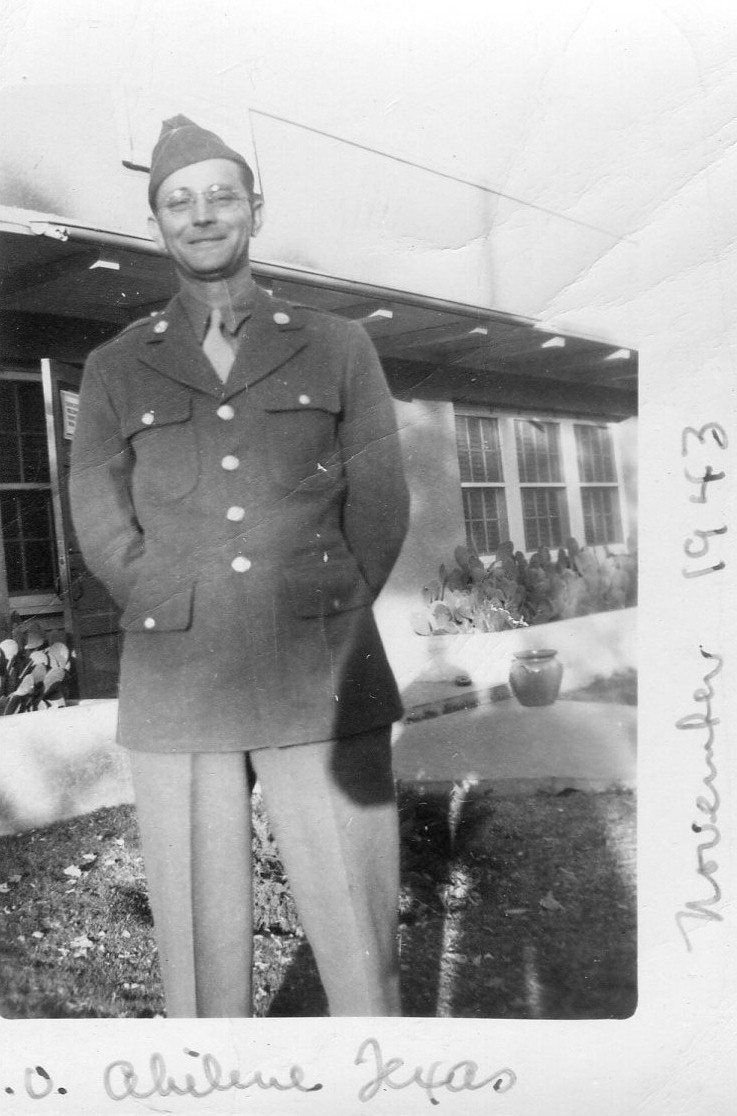
Melton, a pharmaceutical salesman in civilian life, was assigned to a medical training company 1,200 miles from Birmingham, as he wrote in ‘a God forsaken place’, Camp Barkley, Texas.  The letters home to his wife Ida, and newly adopted daughter, captured the home sickness and difficult adjustment to the regimen required of Army life.  My Uncle Melton’s sacrifices were only beginning that summer of 1943. 


Right, Melton in uniform in Texas, 1943

Ralph, who had been inducted in April of 1943 into the Army was shipped by train from basic training in Florida to Colorado in July 1943.  His train passed through Irondale and stopped in Birmingham.  For two hours Ralph nor any other soldier could leave the train to even make a telephone call.  Later his Mother, desperately worried about her three sons in the military, wrote these anguished words.  

“They moved him (Ralph) to Denver, Colorado. He came through Irondale and his train stayed in town for over two hours and we didn’t know it. He could not call.  I could hardly stand it.”

Left in 1952, Ralph with his two children, Pam and Kathy.  

The story of the sealed train has resonated in the extended Holliman family for generations, reflecting the worries of loved ones in those anxious years.


Next, more on the War that changed the lives of a close-knit Alabama family.


Sunday, July 5, 2015

From a Scrapbook of Hollimans

by Glenn N. Holliman

Last night my wife, Barb, and I celebrated the 4th of July with my second cousin, Dr. Jim Holliman and his wife, Karen, at their home here in Central Pennsylvania.  Last year, Jim's father, Dr. Rhodes Burns Holliman (1928-2014), the son of Cecil Rhodes Holliman (1901-1986) of Alabama, passed away and left numerous boxes of family memorabilia. Cecil was a son of James Monroe Holliman (1878-1938), a member of the Republican Party leadership in Alabama and an attorney.   Right, Jim Holliman, an Afghanistan War veteran.

Before sharing corn on the cob and steak, Karen opened a box and pulled out some of Cecil's scrapbooks.  One such book contained newspaper clippings  saved over the decades.  Cecil was the first cousin of my father, H. Bishop Holliman, who is still going strong at age 95.  Dad has always praised Rhodes as one who went far in life, becoming a lawyer in Birmingham, Alabama, who specialized in real estate.  Cecil also pursed genealogy, and it is to him that we are indebted for collecting so much information on the stories of Alabama Hollimans and associated families.


Left, Karen Holliman

A quick glance of one of the books produced by Karen revealed clippings of my father, an aunt, an uncle and another first cousin of my father's, all from the 1930s!  So with the magic of electronic scanning, let's go back to that time just before World War II in Alabama where my branch of the Hollimans lived.


Left, H. Bishop Holliman

Our first clipping is of my father, all of 18 years of age, a graduate of Shades Cahaba High School and a student at Birmingham Southern College.  He was the first child of the parents of Ulyss and Pearl Caine Holliman to tackle higher education.  Other siblings were to follow.

Evidently due to the influence of disaffected Confederate veteran, John Thomas Holliman (1844-1930), my great grandfather, our Hollimans in Fayette County, Alabama joined the Republican Party.  Fayette County adjoins Winston County, Alabama, a region of the state where the majority of voters did not wish to secede in 1861 from the Federal Union, and later produced recruits for the Federal armies.  During Reconstruction and into later decades this part of North Alabama and my branch of the Hollimans cast their votes Republican, and not Democratic as did most other voters in the south during that era.

Like his father, Cecil Holliman was very active in the Alabama Republican Party as was his brother, Charles Holliman, and their uncle, Ulyss Holliman (my grandfather, who in 1938 was a candidate for the Alabama State Legislature).  Ulyss's son Bishop helped the cause and himself by a public speaking contest touting the virtues of a smaller Federal government.  The above clipping from the Birmingham News announces that young Holliman came in second at a Republican speaking contest in Knoxville, Tennessee, then and now a bastion of the Republican Party.  Dad said that $100 in prize money enabled him to afford a year of college!

Below, one will find another clipping from the Birmingham paper in 1938.  Read closely and you will read the names both Virginia Holliman Cornelius (1922-2011) and her younger brother, Ralph Holliman (who celebrated his 91st birthday this past week!), both did well in a city wide oratory contest.  Virginia's picture is even included in the article.  Both Virginia and Ralph would use their communication skills in their later respective careers of banking and business.
                
There was one other clipping on the same page in Cecil's scrapbook, an article on Marguerite Holliman, elected Miss Athens College (Alabama) and president of the student body, evidently around 1941.

She was the daughter of Thomas Leland Holliman, one of the six brothers of John and Martha Walker Holliman (1845-1931) of Fayette County, Alabama.  Known as Leland, he was born in 1880 and died in 1970.  Marguerite exchanged letters with her other first cousin, my father, Bishop, during and after World War II.  She was born in 1919 and died in 2000 in Georgia.

So Karen and Jim, thanks for opening a scrapbook to the past and sharing memories of family on a 4th of July, 2015.

Next Posting, more of the Ulyss and Pearl Caine Family during World War II....
 Have questions about Holliman family history? You are invited to join the Hollyman Email List at Hollyman-Subscribe@yahoogroups.com and the Hollyman Family Facebook Page located on Facebook at "Hollyman Family". Post your questions and perhaps one of the dozens Holyman cousins on the list will have an answer. For more information contact Tina Peddie at desabla1@yahoo.com, the list and Facebook manager for Hollyman (and all our various spellings!).

There is also a massive Ancestry.com Holyman and Associated Families Tree available for review.  For an invitation to this collection of over 20,000 individuals, please write glennhistory@gmail.com.  

Also one will find additional Holliman history at http://hollimanfamilyhistory.blogspot.com/ .

I also have a collection of associated family manuscripts and research collected by the late Walt Holliman, Cecil Holliman and Rhodes Holliman.  Happy to send these materials by email and to insure their research is available.  The surnames: Alexander, Baldwin, Barham, Bass, Beall, Blakeney,  Baker, Bond, Bostick, Brewer, Bryan, Bryant, Bullock, Calvert, Carter, Champion, Chew,Cofer, Cole, Crafford, Crockett, Curtis, Dale, Daniel, Davidson, Davies, De Mallpas, Douglas, Duckett, Edwards, Edgerton, Emerson, Fitzhugh, Fowlehurst, Fox, Gains, Garrison, Gonson, Graves, Gray, Guyton, Guins, Hall, Hamby, Hawkins,Hendrix, Hill, Hogg, Holliman, Holt, Howard, Jackson, Jones, Judkins, Love, Lucas, Maget, Mansfield, Manwaring, McBee, McComas, McCurdy, McNewsome, Nicholson, Norsworthy, Noyall, O'dell, Oliver, Pearce, Peerce, Pettigrew, Petway, Pitman, Plow, Plyler, Porten, Prather, Petite, Ridgely, Riggan, Roberts, Smith, Spencer, Sprigg, Standley, Stanyard, Swan, Strother, Thompson, Thornton, Thrope, Trelawney, Turpin, Underhill, Underwood, Wallace, Walters, Weedon, Whitherspoon, Whitten,Williams,Wilmot,Wilson, Whitaker and Yerby.  These are mainly Alabama families and their ancestors from the Carolinas and Virginia. Materials vary from one page to 200. - GNH at glennhistory@gmail.com.


Friday, October 3, 2014

How a World War Changed an Alabama Family, Part 25

by Glenn N. Holliman


More Letters and News of the Home Front....


World War II finally ended the Great Depression of the 1930s.  Unemployment fell to record levels ending a decade of public assistance and public work programs.  By the fall of 1942, only 1.5 million out of a labor force of 54 million were unemployed, and many of these moving to other jobs or waiting to enter the armed services.  

The letters written by the Hollimans, an Irondale, Alabama family reflect the growing stresses and changes brought on by war time demands and the emerging role of women.  Men were being drafted, and more and more women took jobs men had held or went to work in war plants.  Older values and customs came under stress and anxieties and issues were often discussed in the home front letters. 

Stores remained opened later to deal with women shoppers, now workers, who could not visit stores during day time hours.  Pearl Caine Holliman (1887-1955), left, wrote to her son in the Navy, Bishop Holliman, that "The Dalys (her daughter, Vena, granddaughter Mary Daly Herrin  and son-in-law, Robert Daly, Sr.) and Ralph (Holliman, her youngest son) have gone shopping tonight.  You know the stores stay open till 9 o'clock (in Birmingham)."


Husband Ulyss S. Holliman (1884-1965), above, "has to work 6 days a week now and 9 hours per day.  He says they have more wrecked street cars than they have had since he has been with the B'ham  Electric Company."

One of the millions of women who went to work was Virginia Holliman Cornelius (1922-2011), Pearl's youngest daughter, a brilliant graduate of Shades-Cahaba High School, president of her 1940 class and yearbook editor.  She married Walter Cornelius (1922-2007) in late January 1942, and soon took a job in her brother-in-law's (Robert W. Daly, Sr.) Woodlawn, Alabama bank, taking the place of a drafted man. 

Robert Daly, Sr. at his death in 1959 was branch manager and assistant vice president of the First National Bank of Birmingham, later AmSouth.  Many years later, Robert's grandson, E. Clayton Herrin, would serve also as an assistant vice president and branch manager of the same bank and occupied the same office as that of his grandfather.

Below the new 1951 bank office of Robert's, which would in later decades be Clayton's!


Reflecting the scarcity of workers and ease of finding new employment, was a letter Pearl wrote in the fall of 1942. 


"Virginia has been offered a new job at the airport, more money.  She may take it.  Guess she will have to.  She won't be able to keep every thing going with what she makes at the bank."


Below an amazing picture from the 1940 Shades Cahaba yearbook.  Virginia sits in the center as yearbook editor and business manager, Walter Cornelius is on the left of her, a bit scrunched in this posed picture.  This photograph is almost a metaphor of their 30 years marriage, both career professionals. Virginia, the banker, was always a bit further ahead professionally than Walter, a lawyer.  She supported the family during his college and law school days, which perturbed more traditional members of the Holliman family.
 

Virginia wrote Bishop the following that same autumn.  "I had an offer to work at Eastern Air Lines for $100 a month.  But there would be some night work.  They gave me a $10 raise to stay at the bank with more the first of the year.  So I will stay here as transportation to and from the airport at night (would cost money so ) probably would make out as well."   

Virginia would stay in banking and after traveling with her husband to his training bases in 1944, returned to Irondale, re-entered banking and stayed with it until retirement in 1990.  She broke some glass ceilings along the way becoming the first woman senior vice president of AmSouth.

The oldest child, Melton Pearson Holliman (1908-1958), a pharmacy supply salesman, was anxious to get into the war, even though he was 34 years old and married.  Below are exerts from his fall 1942 letters reflecting his conflicting thoughts on the draft and entering the service.  (He would enter the U.S. Army, age 35, in August 1943.)

"I received a letter from my draft board yesterday wanting to know if my dependents or job had changed.  Guess I'll be in before long.  I'll be glad of it."

"I wrote my boss today that unless something happened I intended to enlist in the Navy November 15th.  I'll be glad when it is done as this uncertainty is bad on one's nerves."

"I suppose you have heard they are taking 18 and 19 year old boys now.  Say they don't want old men.  So...I suppose that means I won't get in until spring 1943.  I hope they don't consider me old."

As with his mother, Pearl, Melton was not pleased that his new brother-in-law stayed out of the Army and went to college while his wife, Virgina, worked.  One can detect differing attitudes of the role of wives and their husbands in Melton's scathing letter in October 1942. 

"I suppose you have heard about Virginia's husband going back to college and she is continuing work to pay his way through.  I have only utter contempt for anyone who would do this.  And the least I can say will be for the best."

The draft hung over all, especially for young 18 year old Ralph, who continued working in the fall of 1942, and calling on his girl friend, Motie Chism.   Another brother-in-law of Ralph's, The Rev. Charles Ferrell, pastor of the Jacksonville, Alabama Methodist Church penned these words to Bishop that stressful fall of 1942.

"Ralph spent the day with his girl friend.  From all accounts he has it pretty bad.  He doesn't believe it would do any good to go to school.  Of course, you can't tell him anything."  


Ralph's mother, Pearl, observed:  "Well, I guess Dad and I will soon be in this big old house by our selves.  It want be long before Ralph will be gone, and if he had started to school last fall it would not have helped him any for every one that was in his class that was in school, left last Saturday (for the service).  I know the Lord is able to take care of him just as He is taking care of you."

Below a 1984 picture of Motie, Ralph, Mary Daly Herrin and Bishop Holliman.

"Ralph goes to see his girl 3 or 4 times a week.  Ralph had Motie over here, first time I had seen her."  As noted in this space before, however young Ralph and Motie might have been, their 1943 marriage lasted sixty years until her death in 2003. 

Below, Charles and Loudelle Ferrell


Charles Ferrell's wife, Loudelle Holliman (1914-1998), by then the mother of three children, and a pastor's wife, did her bit to increase home food production.  She wrote: "We are getting eggs enough for our family now.  Day before yesterday we got 7; yesterday 5.  It surely is sweet music to hear those hens cackling.  I never would have thought I would ever enjoy such as that so much.  We also have 21 little ones that we are 'rearing' to eat." 

Housing was a premium during the War.  Widows such as Lula Hocutt Caine of Irondale, Pearl's mother (1861-1957) took in boarders and the behaviors of some renters left a lot to be desired.  Pearl reported in several letters: 

"Grandma is doing fine, except the renters have been on a spree.  Had a fight last nite, and broke out some of the windows."


"Mother is having a time with her roomers.  In fact they liked to killed each other this a.m., about 3 a.m. and called me.  Had to bring mother up here about 4:30 am.  They had him arrested last wed. nit, but he was out on bond.  They will have to go to court next week. Think we will get him out this time if he don't tear the house down.  I think the very devil has turned loose in him so that place will be to clean up and get new rents.  Mother said she wished Bishop was home to stay with her."


"I don't know what we will do with them.  Let them stay I guess.  Some of these times, they will kill one or both."   

Below Lula Hocutt Caine, born Fayette County, Alabama and whose father died in January 1863 as a result of the Battle of Stones River, Murfreesboro, Tennessee.  In this 1950 picture, she was 89 years old. 

Grandma Caine, as she was known to the family, needed the renter income.  William Lee Caine, born in 1862 died in 1938, worked as a guard for the railroad and evidently left no pension, and that in an era before Social Security.  The 1940 Census reported she earned no income although her son, Floyd Caine, age 54 in 1942 lived with her, at least for a while. Often relatives had to help financially. 

Pearl Caine Holliman usually closed her letters to her sons with a benediction.  Below are her words of faith, with a closing on movie and radio star of the time - Bob Hope! 

"May the Lord bless and keep you.  Write as often as you can.  Good nite and God bless you.  love Mother H.  PS Bob Hope is own (on)."


  Next, the first year of the war ends with a surprise visit home....