Showing posts with label 1st Infantry Division. Show all posts

Tuesday, January 3, 2017

An Alabama Family in World War II, Part 34

by Glenn N. Holliman

Invasion Day at Gela Beach, Sicily - 10 July 1943

It was the greatest invasion fleet in world history - greater even than D-Day 1944.  More than 3,000 allied ships and boat of all sizes carried or escorted seven divisions of British and American troops.  These men stormed the beaches of Sicily and seized the first bit of European territory from Italian and German fascism.  

One of those ships, the USS Butler, a 1942 destroyer carrying submarine depth charges, torpedoes, 5 inch guns, and over 200 young sailors, one being my father, Bishop Holliman, provided anti-submarine and anti-aircraft protection for this massive fleet. The deck guns would be called upon to shell Herman Goring's crack German Division at Gela Beach. 

The Butler to the right.


For my father, and hundreds of thousands of others, it was a baptism of fire and fear. Here are more of his words written in August 1943 and mailed surreptitiously to avoid censorship to his niece, Mary Daly (Herrin) in Irondale, Alabama.  Caught up in describing those days in July 1943, he moves back and forth from past to present tense.  I have done some minor editing for clarification.


For historical background, I am using Rick Atkinson's excellent work, The Day of Battle, the War in Sicily and Italy, 1943-1944.  When appropriate, I add notes from this work in red amplifying my father's narrative.

H. Bishop Holliman, b 1919, writes:

"Arriving there (Bizerte), there seemed to be hundreds of ships - all kinds-transports, landing barges, British, American, etc. There were several sunken ships at the harbor entrance. There was hardly a building in the city that had not been damaged or totally destroyed. The city looked like a cyclone had swept through. Moreover there were many farm houses which seemed to escaped the bombs.  It was terribly hot (t)here."


Bizerte had been evacuated by the Germans in May 1943, but not before scuttling a dozen ships at the narrow neck of the Bizerti bay.  Navy divers had worked feverishly to clear the channel. What my father saw was 'a solid forest of masts, and many species of amphibious vessels ready to transport the 1st and 3rd Infantry Divisions to Sicily.

"On Monday night (5 July 1943) we fueled up from a tanker in the harbor and tied up there for the rest of the night.  All of us remarked how dangerous it would be to have an air raid while we were tied up there.  I went on watch at 2 a.m. the next morning (6 July 1943) and as fate would have it at 3:30 a.m. the Germans came over.  The shore batteries and guns of other ships started firing before we did. Simply because the officer on watch thought 'It was target practice', my job, during battle is the same as the other work I do, copying code. So I have to sit there at the  typewriter typing away as if nothing were happening.  There are about six others so we are able to relived each other from time to time.  The raid lasted about an hour.  But no bombs fell close to me.  There were hits on other ships.  Two fellows were killed on one, and a destroyer was hit. We not able to tell how many of the planes were shot down."

Atkinson writes "Luftwaffe raiders sometimes sneaked across the Sicilian Strait before dawn...alarms wailed, smoke generators churned out a thick gray blanket to hide the ships, and searchlight batteries impaled the planes on their beams as hundreds of antiaircraft guns threw up fountains of fire...."

"On Thursday morning (8 July 1943) we left for Sicily where the captain had told us the afternoon before we were to take. On Friday he gave out all the information - how many ships, time and place of the attack, who the leaders were, etc.

He also said he expected to fight the ship to the very last.  There would be no giving up or thoughts of abandoning ship!

Friday noon and night (9 July 1943) we were fed as much as we could eat, such as it was. There was very little concern or unnecessary excitement.  There were many ships in view, arranged in convoy units.

Early Friday afternoon the sea began to get rough, and I was off watch so I lay down part of the time. But the sea got rougher.  There were no clouds for rain, but the wind blew strong. Believe it or not this was the only rough weather we had encountered up to that time.  By supper time the ship was rolling and almost impossible to eat.  I went on watch at 5 pm and I got sick, and I mean sick.  There were many others in the same fix.  It was not a comforting thought to be going into battle so sick you could not raise a finger to protect yourself and furthermore you don't care."

Atkinson writes that a polar cold front briefly collided with a secondary cold wave over the Mediterranean hemmed in by a low mass of air over Yugoslavia.  The results were 37 knot winds and very heavy seas for over 12 hours.  The troops and sailors suffered mightily from the storm.  US Naval Vice Admiral Henry K. Hewitt on the flagship Monrovia even considered calling off the invasion during the height of the storm, but trusting his meteorologist continued on.  The storm abated around 2 a.m. on 10 July 1943, Invasion Day.

"My watch was over at 9:30 pm and we were scheduled to take our battle stations at 11 p.m. zero hour being 2:45 a.m. (Saturday, (10 July 1943) so I lay down on the deck in the radio shack where my station is and tried to sleep until then.  I blew up my life jacket and used it for a pillow.

I woke up a little before 11 and the captain was talking over the loud speaker.  We were approaching our place of rendezvous (that's the place where all the ships were to assemble, Vena). The captain was telling us of what he expected and the usual line of talk, also he read a few verses from the Bible, some religious poems and prayed the Lord's Prayer.  He had wanted to have a religious service that night, he said, but was impossible due to the rough sea."

Vena was Bishop's oldest sister, married to Robert W. Daly, Sr. and mother of Mary Daly Herrin and Robert W. Daly, Jr.  The rendezvous of hundreds of ships, sixty miles long and a mile wide,  took place just east of Malta before turning toward Sicily during the night.

The captain was Lt. Commander Michell Dudley Matthews (1903-1985) who retired in 1957 as a Rear Admiral.  It was a young man's war with many ships and too few trained officers.

"The rest of the night some of us would lie down on the deck and snooze while others would copy and then exchange.  The sea had become much smoother around 2 a.m. but I think the invasion was held up about an hour. There was very little action until 3 or 4 a.m. An officer from the deck describes what is going (on) through the loud speaker.  Otherwise the men below deck would not have any idea what is going on.

After the troop ships unloaded and landed, there was considerable firing on the beach. Many fires but no opposition to speak of. This is at Gela, Sicily where the American troops landed." 

Below, the US 7th Army landings under General George Patton at Gela Beaches.  The 1st Infantry landed on the middle beach on 10 July 1943 and overcame some Italian resistance. The next day and the arrival of German tanks would be another story.


Unloading the ships began at 3:30 a.m. at Gela with confusion and courage.  There was more opposition at Gela than my father, with his limited view at the time, knew. Mines were the major danger and some shore guns. The 1st Infantry secured the beach but with casualties. The Italian defenders soon were overcome.  The real test was on 11 July 1943 when German tanks moved on the beach head.

"No one was frightened and it seemed just like a drill. Our ship's job was to act as part of anti-submarine patrol. However, we got word we could expect an attack at dawn. Over thirty planes were supposed to be coming. At dawn everyone was tired and worn out.  Until the tension slacks off you do not realize the strain you have been under.  All we had for breakfast was orange juice and two boiled eggs.

All day Saturday I was at watch or at General Quarters (Battle Stations). There was firing from the beach and firing from some of the ships.  There was so much going on I was never able to remember just what all was taking place.  The only thing I remember doing that day was eating breakfast.

Early Saturday morning the captain announced the (censored)  had been sunk with only 69 survivors.  He seemed pretty shaken up about it and it made us all realize there had been more danger than we had suspected.  At that time no one knew what had sunk her."


The unfortunate ship was the USS Maddox, serving as a destroyer screen as was the USS Butler for German U-boats.  One German airplane dropped two bombs and within a few minutes the ship sank dragging down 212 men. A tug rescued only 74 survivors.

There were personal reasons for the young captain Matthews of the Butler to be upset.  Above left, the photograph taken from the USS Thorn (647) shows in the background the Butler  (636) right moored in Brooklyn harbor next to the USS Maddox (622), left in the fall of 1942.  The two captains would have known each other.  The Maddox captain went down with the ship. Above right, the USS Maddox on sea trials.


The Battle for Sicily against 300,000 Italians and a very determined two German divisions would continue until late August, and the USS Butler would face more enemy fire....to be continued.

Monday, October 31, 2016

An Alabama Family during WW II, Part 33


by Glenn N. Holliman

My Father, Bishop Holliman, a young sailor from Irondale, Alabama, wrote a long document in August 1943 detailing his experiences in the Allied invasion of Sicily the previous month.  So fresh were his memories that he moves his writing back and forth from present to past tense.

Moving to the Front

June 1943, the USS Butler, a one year old destroyer crewed by freshmen sailors, joined a convoy of transports and warships in Hampton Roads, Virginia and crossed the Atlantic on a course to the Mediterranean.  The objective was to invade Italy's island of Sicily, a stepping stone to Adolph Hitler's Fortress Europe.  Under dictator Bineto Mussolini, Italy had allied itself with Nazi Germany, part of the famed Pact of Steel, the Axis of Germany, Italy and Japan.

Upper right, the port of Oran in 1943.  U.S. and British troops on November 8, 1942 invaded North Africa to engage Vichy French, Italian and German forces.  In May 1943 in Tunisia the last Axis forces surrendered to the British, USA and Free French.  North Africa, cleared of German power, became the staging point for the attack on Italy and additional German divisions.  Just like the USS Butler, the US Army and Navy were 'new', filled largely with troops and sailors who were serving in combat for the first time and commanders who were learning how to command massive numbers of men, war assets and supplies.  

Fresh from radio code school in Maine, Bishop Holliman's first war cruise was also his first trip across the Atlantic.  And it was a voyage into combat.  Below are his words from a letter he wrote in August 1943 after arriving back in the States.

"On June 22, we entered the Med. and saw land for the first time in two weeks. My greatest desire was to get a view of the Rock of Gibraltar, but unfortunately I was asleep or on watch when we went by.  However, we could get a view of the Spanish and African coasts.  We arrived in Oran (Algeria)...our stopover...for the purpose of refueling.  There was plenty of evidence of the USA there - army jeeps, guns, ships, etc." 

Below, a map of the western Mediterranean Sea during Operation Torch.  On November 8, 1942, USA and British forces invaded Morocco and Algeria, at that time French colonies.  Oran was taken by the American First Infantry Division which took casualties before subduing French forces who believed they were defending against hostile invaders. Oran became an important port for the clearing of North Africa in the winter and spring 1943 and the invasion of Sicily in July 1943.


"We proceeded on to Algiers, 24  hours away.  Upon arrival...we did not go into port immediately but spent another 24 hours on maneuvers with landing barges and other craft.  We knew then the time and place were drawing near.


The harbor was filled with Allied ships of all kinds.  It seems impossible that the Italians or Germans did not expect an invasion of some kind.  There was no reason whey they could not find out about the equipment and ships at these Med. ports.   

The first to do at Algiers was to get the mail off-and that we did-my first card had been mailed back at Oran.  We also had church services in the mess hall-on the way over too-conducted by one of the officers.


A couple of days after arriving, liberty was granted.  I went ashore on Sunday afternoon- the Sunday before the Fourth. There were many modern buildings in the city but most of the places were filthy and unattractive.  There was no place to buy any refreshments or food. The place was filled with army trucks, jeeps, cars and there were thousands of soldiers and sailors from every allied country including native Africans and Free French.
The only place Americans could go was to the Red Cross building where they were able to get ice cream at certain hours, and which wasn't any good. and something they called sandwiches.  They also have movies there, but the place is so crowded we can hardly move about.  It is the only place for the boys to go.  It is pitiful to see the boys walking around with nothing to do. 

I talked to one soldier from Iowa, who had been over there since November.  He said the mail was about the only thing they had to look forward to.  However, he seemed to be pretty well satisfied and not going hungry.  Probably getting better food than we were on the ship.  I told one fellow I had not tasted a Coca Cola in over a month.  He said he had not had one in a year.  So it isn't the service men who are getting all the drinks.

Up until about the 7th of July we did patrol work around the Algiers' area.  Each day we hoped that would be the day to get started to wherever we were to go.  During our stay here there were rumors to the effect that there had been air raids, but were not concerned. All this time weather was very hot in the day and cool at night.  In the crew quarters though it was always too hot to sleep."

Right, Algiers during a 1943 air raid.


"On Sunday afternoon, we left Algiers to move 'closer' to the front so the captain said...to Bizerte"...to be continued.


Friday, September 9, 2016

After 46 Years...a Trip Back in Time, Part 15

by Glenn N. Holliman

Grass by Carl Sandburg

“Pile the bodies high at Austerlitz and Waterloo.
Shovel them under and let me work.

I am grass; I cover all.

And pile them high at Gettysburg, and pile them high at Ypres and Verdun.

Shovel them under and let me work.

Two years, ten years, and passengers ask the conductor:

What place is this?  Where are we now?


I am the grass.  Let me work.”

My war time is long since over.  The grass has grown back in Vietnam.  But still the damage lingers in Southeast Asia and in the memories and wounds of aged service persons living. Unexploded weapons still pocket the fields of Vietnam, Laos and Cambodia.  Agent Orange, sprayed liberally over bush and forest, haunts the bodies of older Vietnamese and Americans.

Below, the tarmac of the Lai Khe,  Vietnam  US Army1st Infantry Division air field is still visible in the foreground.  On the edge of the field stand two  new schools, replacements for the Cobra, Huey and Chinook helicopters that once hovered and landed on these grounds.

Right, one of the few remaining concrete bunkers left intact.  My first night in Lai Khe, I was sent to guard the perimeter and spent the night (and numerous more) in a bunker like this.  During that February 12, 1969 night, the earth shook to the north as a massive B-52 raid saturated a suspected North Vietnamese placement.


Our group visited the Chu Chi Tunnels north of Ho Chi Minh City.  I discovered studying the map above that this complex was located 12 or so air miles from Lai Khe.  Now I realized where all those income missiles originated almost 50 years ago.

Below, my daughter, Grace, demonstrates how a thin person such as herself could hide in the  tunnels.


Meanwhile Saigon (Ho Chi Minh City) continues to grow and prosper.  I have left ghosts behind, as well as my youth.  My thanks to cousins Jim and Karen Holliman for making the travel possible, and my daughter for sharing the nostalgic adventure with me.


The young soldier below center, skinny, all my black hair, working with some orphans in Ben Cat April 1969.


Below, the old man, now 50 years on, at 3 score and ten.  Filled with memories and more than filled with the grace of life.  Here a new generation of children, untarnished by warfare, smile with the exuberance of youth.  May they forever be spared the pain of their grandparents.  This picture was made outside of the Presidential Palace in Ho Chi Minh City.

And in our bit of whimsy, my grand children's chicken, that traveled with us from Virginia to Asia and back, bids her own farewell to a Vietnamese replica of that fowl and beautiful species!


For additional reading on this tragic American and Southeast Asian war, read the former Secretary of Defense Robert McNamara's mea culpa and his conflicted emotions about championing the conflict in the middle 1960s.
May we as a nation learn from our mistakes!

Friday, June 3, 2016

After 46 Years...a Trip Back in Time, Part 14


by Glenn N. Holliman

A Last Look at the Battle Fields surrounding Lai Khe, Vietnam 1969....

 Photographs I took from 1969 of the young men of the the U.S. Army's famed 1st Infantry Division....filling sand bags
and patrol...day after day, each man counting off the days until his year was up.

Right, the men at a Fire Support Base shell suspected targets with 105s.  Below, a mortar platoon takes it ease at a Fire Support Base.  The sticks were for measuring ranges.

A  Protestant worship service interrupted by an air strike in 
the distance.

A Viet Cong ambush along Highway 13 north of Lai Khe, a typical hit and run event.  They would not stand in open battle.  The enemy never won a battle against the Americans, but by wearing down a nation's patience and making that nation waste its blood and treasure, the North Vietnamese won the war.  After all, it was their county....

A company moves out at Aachen II, through the wire and Claymore mines.
 The choppers arrive to pick up the troops and the Viet Cong notice.  Minutes later as the men prepare to board for a helicopter ride to a new battle field, mortar rounds start falling.
The Sergeant screams 'Get down'.  Unfortunately there are casualties.
 Troops injured and evacuated out..... 

For some it was a year out of our lives; for others it was a lot more.


The writer as a young man....time to move on.....

Tuesday, April 12, 2016

After 46 Years...a Trip Back in Time, Part 13

by Glenn N. Holliman

Memories continued of a war in 1969....

By 1969, the U.S. Army felt the strains of a war that was dividing America, a protracted struggle in Vietnam.  The year for my service, January 31, 1969 to January 30, 1970, was shared with over 540,000 other Americans.  My Army division, the famed 1st Infantry of World War I and II combat, was composed mainly of draftees and career officers serving a second tour of duty in country.


Right, 22 years old, skinny, a college graduate in Lai Khe, Vietnam.  I had most of my life yet to be lived....

I remember composing a letter while on day time guard duty in a tower over looking a portion of the perimeter of Lai Kai, headquarters for the Division and 3rd Brigade.  In that epistle I noted that for four years the Division had occupied territory 40 miles of so northwest of Saigon, pushing against the Cambodia border.  And for four years the same ground had been contested between the U.S. forces and Viet Cong and North Vietnam troops.

True, the U.S. never lost a full-blown battle, but the night belonged to the V.C. The mighty pay loads of our B-52 bombers could blow apart tunnel complexes of the enemy, when such could be found. Our technology was overwhelming when an adversary would stand and fight, but this was a different, confounding war.

A 1st Infantry bunker with action in the background outside the perimeter. 1969

The V.C. fought the war against American conventional might, not in stand up battles, but rather by controlling the villages in the dark, ambushing high value targets such as convoys and forever harassing the Army and then disappearing into the bush or jungle. 

The North Vietnamese took horrific casualties, but just as had George Washington with the British, they had only to remain a force in being, and to wait until the Americans tired of the loss in blood and treasure and went home.

And that is exactly what happened.

In 1969, moral among U.S. troops was slipping.  I remember one night in barracks hearing a loud explosion, not incoming mortars or rockets, but that of a grenade.  A young officer, overbearing with his enlisted men, had been 'fragged' by one of his troops, i.e. a live grenade rolled into his quarters.  Wounded, he lived.  

Drugs were becoming a problem.  I remember waking up in the middle of the night at a Fire Support Base by a young lieutenant rummaging through the medic's bag looking for pain killers.  Another night walking through the barracks, waking soldier's for guard duty, I stumbled across troops smoking dope.  

Another time I discussed with the enlisted men in the field what it was like to patrol in the bush. 

 "Our 2nd lieutenant said he had only one mission here and that was to keep us alive until we could all go home."  

The desire to engage and defeat an enemy was rare among the troops in 1969.   Being a senior enlisted man or conscientiousness officer was not easy with an army of draftees.  Not easy when the USA was torn apart by anti-war marches and race riots.  The 1960s were destructive for America.  Our nation had a lot of self-inflicted wounds.   

Above and below, a patrol on Thunder Road, aka Highway 13.  In 1969 a muddy track and conflicted.  By 2015, a paved highway was lined with apartment and business office complexes!


 The government in Saigon, propped up by U.S. monies and supplies, was wobbly and the Army of the Republic of Vietnam (ARVN) loath to expend itself.  The will to win lay with North Vietnam, fighting a classic war of independence and a perceived puppet government still control by westerners.  The South Vietnamese soldier above had his military intelligence office next to our chaplain's office in the 3rd Brigade Headquarters, Lai Khe.


 That Christmas of 1969 the famed quintessential comedian of the 20th century, Bob Hope, came to Lai Khe came to entertain us.  He brought some pretty girls and Neil Armstrong who had been the first man to step on the Moon five months before.  In was incongruous - one of human kind's greatest feats justipositioned with one of human kind's great tragedies - warfare.


Bob Hope, a conservative patriot, announced to us that President Richard Nixon had a plan to end the war.  Amazingly the troops - thousands of us - booed.  Hope was taken aback, confused and stuttered, 'Yes, he really has a plan.'  The writing was on the wall; the army of draftees had had it.  We just wanted to go home.  

Below, the Bob Hope field after the 1969 show before being 'policed'.  A mail transport lands on the Lai Khe airfield.  The company mess hall in the picture on the left.

In 2015, I walked the same ground, exactly where the above picture was taken in 1969.  Below are rubber trees that now cover the same field.  The mess hall long since gone.  Left to right Dr. Jim Holliman and his wife Karen and my daughter, Grace who accompanied me on this emotional journey.


Next posting, more as an aged veteran returns and reflects....

Monday, February 29, 2016

After 46 Years...a Trip Back in Time, Part 10

by Glenn N. Holliman

In this post, I record the sites and my feelings of returning to my 1969 base camp in Lai Khe, Vietnam.  As a young man, I served for a year as a chaplain's assistant with the 3rd Brigade, 1st Infantry Division, U.S. Army.  My duties involved pulling guard, time in the field at the Division's fire support artillery bases (FSBs) and night defensive positions (NDPs) and clerk of the office. I feared returning in 2015 would be emotional.  It was.


Below left in 1969, simple dirt roads en route to Lai Khe from Saigon.  Below right in 2015, a four lane highway with attractive middle division of flowers flanked by modern construction. 


 Left, 1969, the body of a North Vietnamese soldier killed in night action, left along the highway a few miles south of Ben Cat, which by 2015 was a four lane highway with flanking shops and residences.   As if a war had never passed that way.

Below right, the former Michelin rubber plantation of Lai Khe from the air in 1969.  Top of the photo shows the defoliated open country side.  Highway 13, then a dirt two lane road runs through the camp.  The open space top right is the air field.

Below left, the HQ of the 3rd Brigade, 
former French rubber plantation offices, in
1969 our office and barracks. In 2015 all had
been razed and replaced by a business park.


Above left, the perimeter of Lai Khe in 1969.  From time to time enemy rocket fire would descend on the base, several times while I was on guard in the night.  Above right in red, an old man of 68 years stand in the rubber of Lai Khe and remembers being 22.      

More in the next post on the return to youth and conflict.

Saturday, February 13, 2016

After 46 Years...a Trip Back in Time, Part 9

by Glenn N. Holliman


This memoir of a return to Vietnam after forty-six years had passed since a young soldier served with the 1st Infantry Division, US Army, continues with photos and thoughts of southern Viet Nam then and today....

  March 13, 2015, Friday, Saigon

Up early for a 6 am shuttle, three and half hours to Ha Noi airport.  Stop half way at a gift shop/café and have coffee strong enough to walk.  To modern airport and a snack.  Then emails and at 1:15 pm board Vietnamese Air to Saigon or Ho Chi Minh City.  Again a modern Viet Nam Airlines Airbus 320.  Two hours later we arrive, met by our Northfolk Hotel driver.  The Norfolk, a la 1991, an Australian owned hotel, only three blocks from the ornate Belle Epoch period, the Cathedral, 1880, dedicated to Mary, Mother of Jesus by the French colonialists.

I saw Saigon from the air before landing at Than San Nhah.  Incredible…it was Manhattan, Singapore, whatever –high rises, skyscrapers and apartment complexes.  Even a golf course.  This city is a combination of Paris and Miami.  Capitalism is every where – garish flashing neon signs, bank building, communication hubs, etc. and a nod or two to the liberation of 1975.  I am feeling very old.

Only when we checked in and looked at a map, and I asked the location of the former American embassy did the desk clerk ask me if I had been there in the war.  Yes, I said, a long time ago. 

Check in and cousins Karen, Jim and I walk around the Cathedral Square, taking our aim at an Asian open air restaurant.  I have again rice and prawns and half a bottle of French wine.  Back to my large, air conditioned room.  Caution in the bathroom – do not drink the tap water.  Ho Chi Minh City, not yet there.


Saigon Cathedral in 1969 and in 2015 with my daughter Grace and high rise buildings.


It was called Saigon in 1969, the mid point in America's ill-fated over reach to stem 'the tide of international communism'.  During my 365 day tour of what was then the Republic of South Viet Nam, over 500,000 troops from a USA population of perhaps 225,000,000 poured resources into what was a civil war among an ancient culture and nation.

Although stationed 40 miles or so north of Saigon in a rubber plantation called Lai Khe (just north of Ben Cat), as part of my duties, I visited the capitol city three or four times.  Below are some views of Saigon then and today.

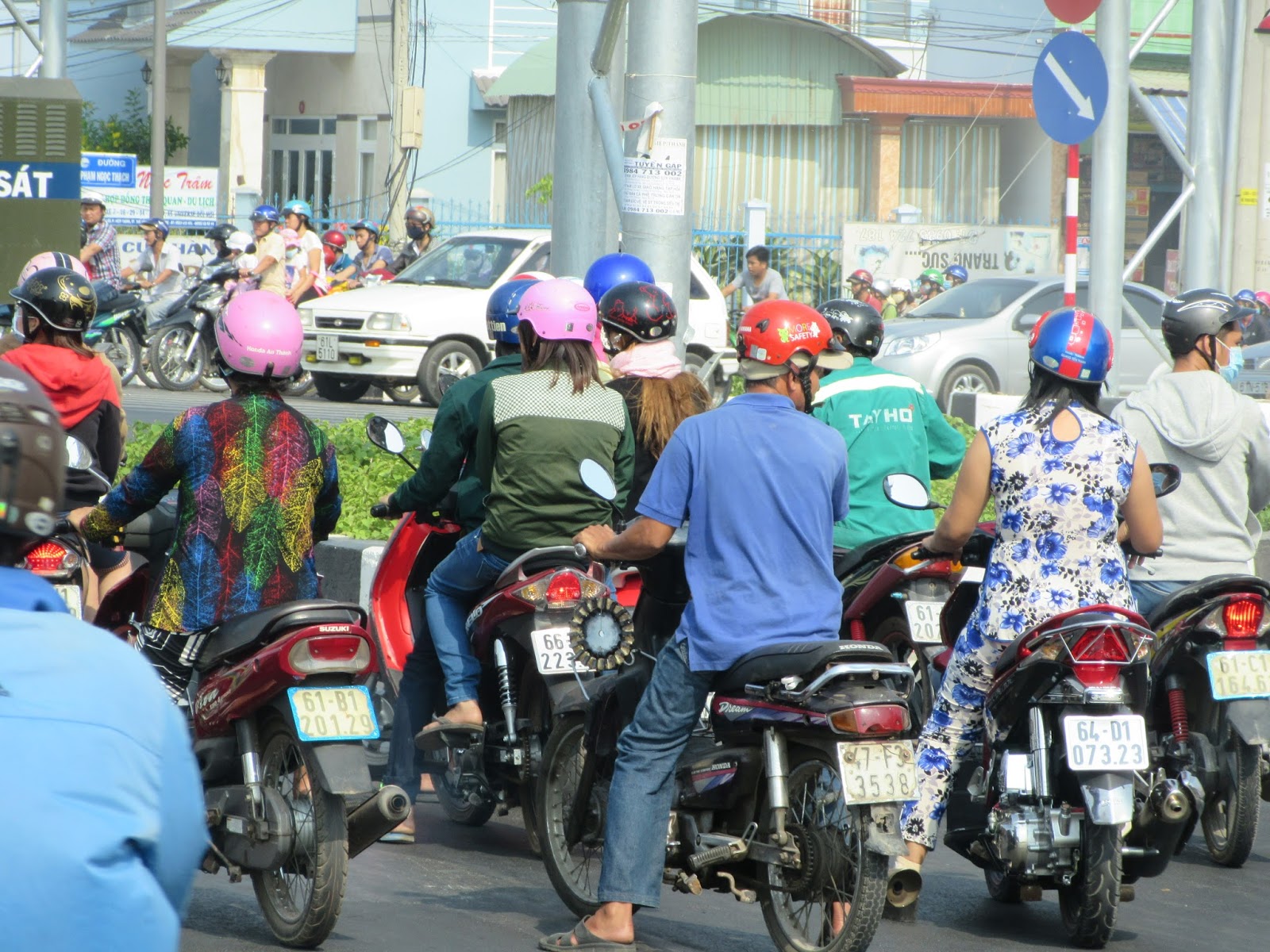
RightSaigon street scene in 1969; left crowded  streets and motor bikes in 2015.


The National Assembly building in 2015 and 1969.  Below, South Vietnam soldier guarding Saigon bridge in 1969, a city one year removed from the devastating Tet Offensive that soured America on the conflict. 


With cousin Karen and daughter Grace, 2015 and a warm March evening in Ho Chi Minh City.  Below right, passing a movie theatre in 1969.


Below, street scenes from 1969 including a young lady in blue in her ao dai, the Vietnamese formal and office wear for women.


En Route from Saigon to Long Binh, through Ben Cat and back to Lai Khe, one passed this haunting South Vietnamese military cemetery and statue in 1969.  The tragic war ended in 1975 with the collapse of the government once supported by the United States.  Over 55,000 Americans and an estimated one million Vietnamese died between 1962-1975.


Next post on this Viet Nam memory tour is the return to my Army base, 3rd Brigade, 1st Infantry, US Army, Lai Khe, SVN.