Showing posts with label World War II. Show all posts

Saturday, November 25, 2017

An Alabama Family in World War II, Part 35

A Battle at Palermo, an Induction in Georgia and a Troop Train in Alabama - July 1943 
by Glenn N. Holliman

 By the summer of 1943 three of the four sons of Ulyss and Pearl Caine Holliman of Irondale, Alabama – Melton, Bishop and Ralph - were in military service, along with their daughter Virginia’s husband, Walter Cornelius.  Son Euhal, soon the father of four children, was deferred due to his large family responsibilities. 


 Left, in 1927, 2300 3rd Avenue, N. in Irondale, Alabama, Pearl Caine Holliman holds Ralph, her youngest child, flanked by Bishop and Virginia. Virignia's husband, Walter Cornelius, would serve in the Pacific during World War II, Bishop in the Navy in the Mediterranean and Ralph in France.

Bishop, b. 1919, my father, was on the USS Butler in Sicily July 1943.  After shelling the Herman Goring Panzer Division at Gela, Sicily and saving the 1st Infantry Division from annihilation, the Butler and other ships left Sicily and refueled and restocked in Algiers.  Shortly thereafter, Dad’s ship and other destroyers were directed to Palermo, the capital of Sicily.  The city had fallen to U.S. troops, and the Navy was to lend fire support along the coast.

A Sunday in July, 2 a.m. the German Air Force paid a visit, dropped flares over the harbor and then their high explosive bombs.  Bishop, a radioman, age 23, was at his battle station, the radio shack exposed on the aft of the 1,000-ton destroyer.  There he experienced the intensity of the air raid.  He wrote later:


“The ship immediately got under way and headed out of the harbor.  And the bombs started falling all around us.  We could not shoot back because we couldn’t see them.  We fellows in the shack didn’t know what was going on outside.  We could hear the bombs falling and feel the ship shake.  At times like that it is hard to sit there at a typewriter. Everyone remained calm though. However, I did not have to exert any pressure on my fingers. I just held them over my typewriter keys, and my hands shook so furiously that they pushed the keys down.  We sat there for 30 or 40 minutes wondering if they would get us….the raid lasted almost two hours.  Finally, our fighters arrived and shot down 4 or 5 planes.”

Two days later, the Luftwaffe returned, dropped more bombs and sank an adjacent ship to the Butler.  The ship escaped damaged, and later the destroyer picked up a downed German flyer who had been drifting for four days in the Mediterranean.   Finally, Bishop’s destroyer was released from duty, sailed to Oran, picked up a convoy and sailed home, arriving in late August 1943 in New York City.

While sailing home, Bishop typed up a 12-page letter about the events in Sicily, and as it was against regulations at that time to publish stories about the invasion, he went ashore in New York and posted the article to his niece Mary Daly in Irondale, Alabama.  A copy of this manuscript survives in the family to this day.


Left, one of the faded pages of Bishop's manuscript.

The military forces of the United States continued to expand in 1943, and older men with dependents were drafted to fly the airplanes and drive the tanks and ships coming off American assembly lines in greater and greater numbers. 

The oldest son of Ulyss and Pearl Caine Holliman, Melton, b. 1908, married and now with a child, Patti, was drafted August 4th into the U.S. Army at Mobile, Alabama and shipped by train to Atlanta, Ft. McPherson, Georgia, the reception station.  He wrote his first letter home on August 5th that the group of men he was with looked older than he (!) and all were married with children.


Melton, a pharmaceutical salesman in civilian life, was assigned to a medical training company 1,200 miles from Birmingham, as he wrote in ‘a God forsaken place’, Camp Barkley, Texas.  The letters home to his wife Ida, and newly adopted daughter, captured the home sickness and difficult adjustment to the regimen required of Army life.  My Uncle Melton’s sacrifices were only beginning that summer of 1943. 
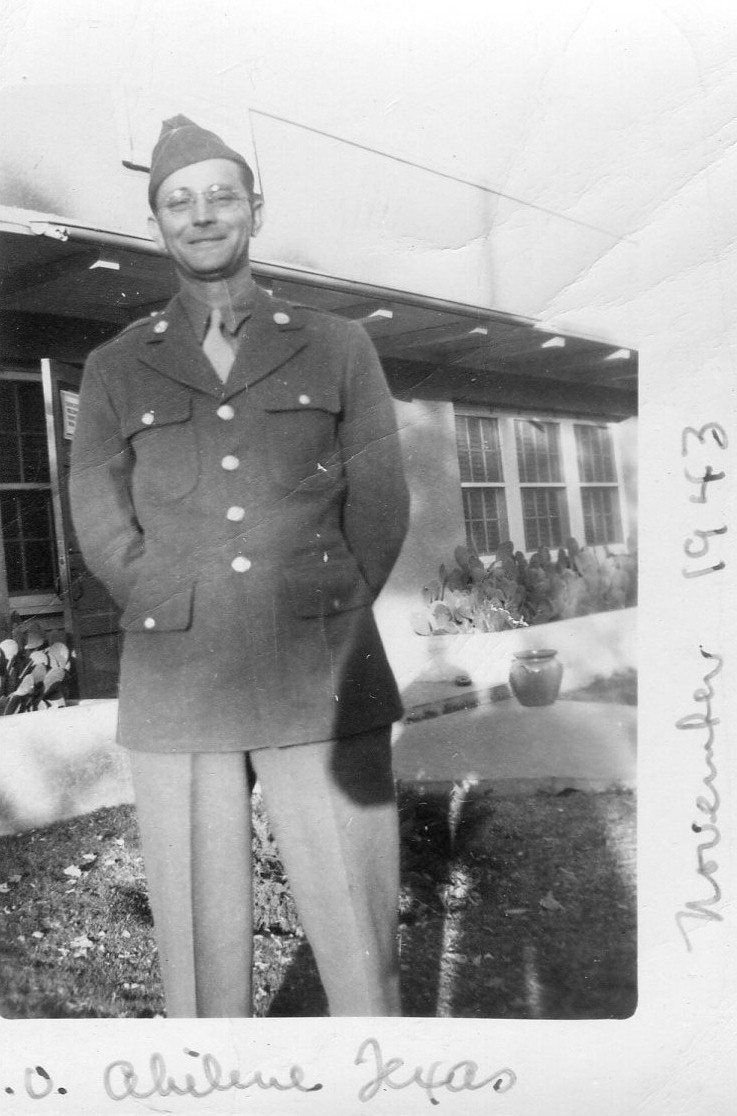


Right, Melton in uniform in Texas, 1943

Ralph, who had been inducted in April of 1943 into the Army was shipped by train from basic training in Florida to Colorado in July 1943.  His train passed through Irondale and stopped in Birmingham.  For two hours Ralph nor any other soldier could leave the train to even make a telephone call.  Later his Mother, desperately worried about her three sons in the military, wrote these anguished words.  

“They moved him (Ralph) to Denver, Colorado. He came through Irondale and his train stayed in town for over two hours and we didn’t know it. He could not call.  I could hardly stand it.”

Left in 1952, Ralph with his two children, Pam and Kathy.  

The story of the sealed train has resonated in the extended Holliman family for generations, reflecting the worries of loved ones in those anxious years.


Next, more on the War that changed the lives of a close-knit Alabama family.


Sunday, July 14, 2013

How a World War changed an Alabama Family, Part 5

by Glenn N. Holliman

Summer 1941

22 June 1941, full of hubris and more than mildly insane, Adolph Hitler launched his war machine east against the Soviet Union.  Earlier that spring, his Wehrmacht had swallowed the Balkans, Greece and Crete and joined the Italians in North Africa.  German foreign minister Von Ribbentrop wrapped Nazi arms around Hungary, Bulgaria, Romania and Finland.  Britain, supported by her dominions Canada, Australia, New Zealand and South Africa, stood on the continental fringes of Europe facing foes Italy and Germany. 
German Panzer IIIs invaded Russian in what most of the world thought would be an easy conquest.  It was not to be.
n Panzer III tanks close to a border battle near Brest-Litovsk on June 22
Mad with ambition, a loathing of communism, racial and religious hatred and swollen with excessive confidence in his armies, Hitler hurled over 3 million men against another sadist dictator, Joseph Stalin, the communist autocrat of the largest geographical nation on the planet.  The battle of two titans commenced, and the world held its breath.
In the United States the World War would soon reach out and engulf an Alabama family....
 
The year before, 1940, Walter Cornelius, second row, far left in coat and tie, graduated from Shades Cahaba High School in Homewood, Alabama.  His future brother-in-law, Ralph Holliman, Class of 1942, sat near him in the middle of this group picture in the white and black shirt with the collar.  In early February 1942, Walter married Virginia Holliman, also Class of 1940.  Both Walter and Ralph would serve in the U.S. Army during the war - Walter in Saipan and Ralph in France.


From the memoirs of Bishop Holliman of Irondale, Alabama - "In the summer of 1941, I went back to Lake Junaluska, attended the Methodist Youth Conference at Montevallo College (and was elected president and interesting to note, my opponent was Howell Heflin, later U.S. Senator from Alabama) and worked intermittently at Hill's Grocery in Irondale, Alabama.  I am afraid I did not dwell a great deal on the prospects of the U. S. entering the war even that terrible summer in Europe."

Below Bishop Holliman 'concentrating' on his religious duties at  the Methodist Conference Center of Lake Junaluska, North Carolina in 1941.
In August 1941, a letter from his draft board sent Bishop scurrying back from a vacation in Florida with the Daly and Ferrell families. Checking in, Bishop was told he would be called in the fall.  Not anxious to join the U.S. Army, Bishop enlisted in the U.S. Navy, ready to go at a later date.

In the meantime, a girl friend, Gloria Zackey, who was a secretary  for Sloss-Sheffield Steel and Iron Company on 1st Avenue in Birmingham, recommended him for a temporary job, filing in chronological order cancelled checks.  "I was paid 75 cents an hour and thought a $26 a week pay check was pretty good."

Above, ten year old Mary Daly (Herrin) in a bathing cap suits typical of the period holds hands at Daytona Beach, Florida, August 1941 with her cousins Carolyn (Tatum) and Charles Halford Ferrell. The war would soon bring such vacations to a screening halt for most Americans.  Vena Holliman Daly and Loudelle Holliman Ferrell were Bishop, Virginia, Euhal and Ralph Holliman's sisters.

That same August, President Franklin D. Roosevelt rendezvoused in Newfoundland by ship with Prime Minister Winston S. Churchill of the United Kingdom.  Their military leaders met, and from the meetings at sea, was issued the Atlantic Charter, a just vision of a post-war world, declared boldly before the U.S. was formally in the war. Below, Roosevelt, Churchill and their staffs on the deck of the HMS Prince of Wales.

And again that summer of 1941, generally not noticed by many Americans, the State Department, utterly disgusted with Japan's continued war and invasion of China, initiated an embargo of the selling of U. S. petroleum to Japan.  For the militaristic government of Japan without oil, the clock began to tick rapidly toward a decision either to seize supplies in the Dutch East Indies or acquiesce to U.S. demands to cease their four year invasion of China. 

The government of new Prime Minister Hideki Tojo, a Japanese army general, refused to consider a withdrawal from China, and began plans to confront the U.S. militarily. Japan would decide to secure by violence the resources needed to maintain their military and civilian economy.  Time was running out in the Pacific, while most U.S. eyes were focused on the North Atlantic and Europe.  Below the Prime Minister of Japan who authorized the attack on Pearl Harbor.

"For ten years, Japan had been front page news, but I was not cognizant of how big a threat she was and I know that in the summer of 1941, I did not view that country as an enemy we would soon fight.  I guess all our attention was on Europe and I simply did not foresee future conflict with the 'Rising Sun'.  In later years I wondered how I could have been so uninformed - or ignorant - about what was happening in the Pacific." - Bishop Holliman
Next Posting, a Holliman joins the Navy....

Have questions about Holliman family history and associated families? You are invited to join the Hollyman Email List at Hollyman-Subscribe@yahoogroups.com and the Hollyman Family Facebook Page located on Facebook at "Hollyman Family". Post your questions and perhaps one of the dozens Holyman cousins on the list will have an answer. For more information contact Tina Peddie at desabla1@yahoo.com, the list and Facebook manager for Hollyman (and all our various spellings!).

Since early 2010, I have been publishing research and stories on the broad spectrum of Holliman (Holyman) family history at http://hollimanfamilyhistory.blogspot.com/ . For stories on my more immediate family since the early 20th Century, I have been posting articles since early 2011 at http://ulyssholliman.blogspot.com/ .

If you have photographs, letters, memorabilia or research you wish to share, please contact me directly at glennhistory@gmail.com. Several of us have an on-going program of scanning and preserving Holyman and related family records. Thanks to the Internet, we are able to scan, upload to the web (with your permission) and return the materials to you.
Announcing also a "Seminar and Site" gathering October 18 and 19, 2013 in Fayette, Alabama for Hollimans and associated families whose ancestors are from that area. Space at the Rose House Inn is limited for the occasion due to a football weekend. For information, contact me at glennhistory@gmail.com. GNH