Showing posts with label Irondale Alabama. Show all posts

Tuesday, January 19, 2021

From My Sister's Attic, Part 2

 by Glenn N. Holliman

Letters from the Past

Recently my sister Becky Holliman Payne forwarded a box of letters, pictures and memorabilia saved by our late mother, Geraldine Stansbery Holliman Feick (1923-2015).  While I have a computer folder of letters from our Holliman grandmother, Pearl Elmer Caine Holliman (1887-1955), I found four not seen before.  Written between December 1944 and May 1945, they capture the feelings of a mother (Pearl) whose family has been in rapid transition since her third born son, Bishop (1919-2018), shipped off to the Navy in November 1941, a few weeks before Pearl Harbor.

There would be three war time marriages from her seven children - Virginia and Walter Cornelius (1942), Ralph and Motie Chism (1943) and Bishop and Gerry (1945).  

Between 1942 and 1945 additional grandchildren for Ulyss and Pearl joined the family, They were John Ferrell (1942), Patti Holliman (1942), Anne (1942) and Jean Holliman (1944), Robert W. Daly, Jr. (1943) and Carol Cornelius (1945). These offspring joined five earlier grandchildren, Mary Daly (1931), Charles H. Ferrell (1936), Carolyn Ferrell (1938) and Jerry and Terry Holliman (1940).  

Pearl did her best with letters to keep up with this expanding flock.  The one examined below and others in next posts welcomed my mother into the growing family.  The warmth, care and worries of a mother and grandmother come through to us again, more than 75 years after they were penned.


Ulyss S. (1884-1965) and Pearl Caine Holliman (1887-1955), Christmas 1946 at their home at 2300 3rd Avenue North, Irondale, Alabama.


Bishop and Melton Holliman, 1942.  Bishop Holliman,  a young seaman,  and Melton age 34, the year before he was drafted into the Army.
Page 1, December 3, 1944, Pearl Holliman to Geraldine Stanberry, fiancĂ©e of Bishop Holliman.

This letter contains additional information on my Uncle Melton Holliman's (1908-1958) sudden evacuation in November 1944 from a medical unit near Metz, France to England.  After finishing 17 weeks of training at Camp Barkeley, Texas in February 1944, it took until September 1944 before he reached his assignment with General George Patton's 3rd Army.  After only two months of duty as a medic, his health broke down. He left England and arrived at an Army hospital on Long Island, NY shortly after Christmas.  His wife Ida and daughter Patti joined him.  Later he transferred to light hospital duty in Jackson, Mississippi and returned to civilian life, a pharmaceutical salesman in the summer of 1945. 

Ralph Holliman (1924-2017) served as a clerk in the US Army Air Corp stationed first in England in late 1943 and later in France by the late summer of 1944 at a transport base near Paris.

Above Ralph and Motie (1925 - 2003)
Page 2 above contains information on Virginia (1922-2011), Loudelle Holliman Ferrell (1914-1998) and Robert W. Daly, Sr. (1903-1959).

 "Come one of these days all the boys will be home and we will be one big happy family again." 
- Pearl Caine Holliman, 1944


Sunday, December 20, 2020

Christmas Past - The WWII Generation at Christmas

 by Glenn N. Holliman

Christmas 2020, a Reflection on 70 Years Past

I have posted the below photographs in previous years, but as this Christmas season is a very different one for many of us, I feel moved to share for the younger folks reading this what a Christmas past was like for my generation.  Extended families will be separated due to the Covid-19 virus, an unexpected and deadly visitor to the Year 2020. 

So as my late father often did, I step back in time and through old photographs rekindle  warm feelings when families could gather and celebrate the rituals that sustain us as human beings.

Below is one of the last pictures of the complete family of Ulyss and Pearl Caine Holliman of 2300 Avenue North in Irondale, Alabama in December 1950. To my knowledge, never again would so many relations gather for a photograph with the grandparents present.

World War II had been over for five years but that winter America was in a new conflict known as the Korean War. We were living under the shadow of the new atomic bomb and experiencing a Cold War with the Soviet Union, a former ally, now an adversary. Four the men in picture, Melton, Bishop, Ralph and Walter, were veterans of WWII.  Uncle Sam did not call any of them back to service in Korea.  However, one of those pictured below, moi, did do service in a later war in the late 1960s.  Jerry and Terry Holliman were in the U.S. Army prior to the Viet Nam War.


Back row left to right: Euhal and Edna Holliman, Vena Holliman Daly, Mary Daly Herrin, Robert Daly, Charles Ferrell, Loudelle Holliman Ferrell, Ralph and in front wife, Motie Holliman, Melton and Ida Holliman, Gerry and Bishop Holliman, and in between them Walter Cornelius.  Middle row: Charles H. Ferrell, Susan Cornelius Williams in her mother, Virginia Holliman Cornelius' lap, Ulyss and Pearl Holliman holding Becky Holliman Payne, Carolyn Ferrell holding Pam Holliman, Patti Holliman, and John Ferrell. Front row: Bob Daly, Jerry and Terry Holliman, Anne and Jean Holliman, Nancy Carol Cornelius Morton and Glenn N. Holliman.  Yet to be born were Kathy Holliman, Tommie Holliman Allen and Bill Holliman and Alice Holliman Murphy.

Gathered above are the seven children of Ulyss and Pearl all with their spouses and their own children.  In this picture, there are 15 first cousins, which by 1956 would grow to 19 cousins.  

Remarkably eighteen cousins are still living, but we sadly lost Jerry Holliman in 2003 to heart disease.  Jerry is kneeling on the floor next to his identical twin, Terry.  I could never tell them apart.  Now all of the cousins are age 64 and older, most of us in our 70s, and several in their 80s.  Three of us are dressed as cowboys, the fad of the day for youngsters, most of us trying to look like Hopalong Cassidy or Roy Rogers. Bob Daly on the front row, far right, seemed to have come armed with a toy rifle!  

With the passing of my father, H. Bishop Holliman in 2018, the seven siblings and their partners now are gone.  My grandparents, Pearl and Ulyss died in 1955 and 1965.


I believe the hand written identification of the seven children and grandparents is that of cousin Charles Ferrell. This generation dressed formally for important family gathers.  The men are in suits and ties and the ladies dressed elegantly .  Note the large Christmas tree on the left.  As a child I was amazed by the then very modern electric lights, some that bubbled some type of oil.  Electric Christmas tree lights only appeared in the 1910s.

These Christmas gatherings at the Holliman household, I remember as very festive occasions when we children would play together and feverishly open our presents.  There were so many that the packages under the tree spilled over into the living room.  

Three new generations have appeared since this family gathered in what had been the childhood home of the seven siblings.  Seventy years on, these aunts, uncles and cousins still live in my memories of yesteryear Christmas's.  I suspect I am not the only cousin who cherishes the time past. - GNH

PS - Cousin Dr. Bob Daly, who has been experiencing health problems, would enjoy hearing from his cousins.  He asked me to pass along his email address which is humbander1943@yahoo.com.  Bob is Alabama's premier biologist on the plant life and birds of the Southeast United States.  Each summer over 400 hummingbirds are attracted to his feeder!


Sunday, April 19, 2020

A Visit Between Two Storms, Part 2

by Glenn N. Holliman

In this article, the story of the trip my two sisters, Becky and Alice, and I took to Alabama visiting cousins and old home places continues.  This excursion occurred the week before the explosion of the Covid 19 virus upon the American nation.  If we had waited another week, we would have had to cancel the visit.

On March 9, 2020 we rendezvoused with many cousins at the Whistle Stop Cafe in Irondale, the town where the seven children of Ulyss and Pearl Caine Holliman, came of age.  The seven children, now all passed away, are in order of birth Melton, Vena, Euhal, Loudell, Bishop, Virginia and Ralph.

While we cousins indulged in good southern comfort food and not yet knowing to practice social distancing, I snapped this picture of those who still live in the Birmingham area and who could make the lunch.

  Moving clockwise beginning from the left is Clayton Herrin, son of E.C. and Mary Daly Herrin, and grandson of Robert W. and Vena Holliman Daly.  Next is Alice Holliman Murphy, daughter of Bishop and Geraldine Stansbery Holliman.  Behind Alice are Charles and Nancy Ferrell.  Charles is the son of Charles and Loudelle Holliman Ferrell.  John Daly, son of Bob and Carol Daly and grandson of Robert W. and Vena Daly, peeks around Nancy, Charles' wife.  In the red jacket is David Herrin, Clayton's brother.

At the far end in black is my sister, Becky Holliman Payne and seated next to her is Mary Daly Herrin, mother of Clayton and David, and daughter of Robert W. and Vena Daly.  The gentleman is green is Wally Allen, husband of Tommie Holliman Allen.  The last two ladies are Jean Holliman and Tommie Holliman Allen, daughters of Euhal and Edna Holliman.


One of the pleasant ironies of this extended lunch was knowing we were sitting in the part of the restaurant that had been the hardware store owned by Robert W. and George Daly which operated from 1944 to 1960.

The Whistle Stop, formally the Irondale Cafe had been run in the 1930s by Bess Fortenberry.  The Holliman children were forbidden to eat there as the cafe sold beer!  It was Bess's niece, Fanny Flag, who inspired by the cafe and setting, wrote Fried Green Tomatoes which became a famous movie.  

Under later ownership, the cafe expanded into the Daly Hardware building and changed its name to the Whistle Stop and yes, serves fried green tomatoes as an entree.

Below from Mary Daly Herrin's scrapbook are some mementos from the business her father and uncle ran.


After catching up on family comings and goings, and discussing some hint of the coming pandemic (Charles was touching elbows rather than shaking hands, a foreshadowing of the coming turbulence), my sisters and I bade our cherished relatives goodbye, warmly remembering our father, aunts and uncles and many earlier times together.  


More on our visit in the next blog. - GNH

Wednesday, April 1, 2020

A Visit Between Two Storms

by Glenn N. Holliman

On March 3, 2020 a vicious late-winter tornado touched down in Nashville, Tennessee, hop-scotched along I-40 east and destroyed homes in the suburbs of Cookeville, Tennessee.  There 18 persons died in just a few minutes of horror.

Fortunately my sister Becky Holliman Payne and her family who live in that Cumberland Plateau community escaped the violence and quickly joined hundreds of others in providing relief to those afflicted.  A long scheduled trip to visit cousins and our old home places in Alabama had been planned with my sister, Alice Holliman Murphy and me.  We  were to fly from our domiciles in Texas and Pennsylvania respectively to Nashville on March 5th and then drive south.

As the Nashville airport was open and professional first responders were busy at work, we decided to go ahead with our plans.  We met that afternoon of the 5th, and the three of us drove  to Florence, Alabama.

Little did we know that one storm was behind us and another, more dangerous, approaching!

The next morning, we spent much of the day with our first cousin, Bob Daly, son of Robert W. Sr. and Vena Holliman Daly at his home north of Florence.  His home is really a nature conservancy where for decades Bob has nurtured his 40 acres as a wildlife park.

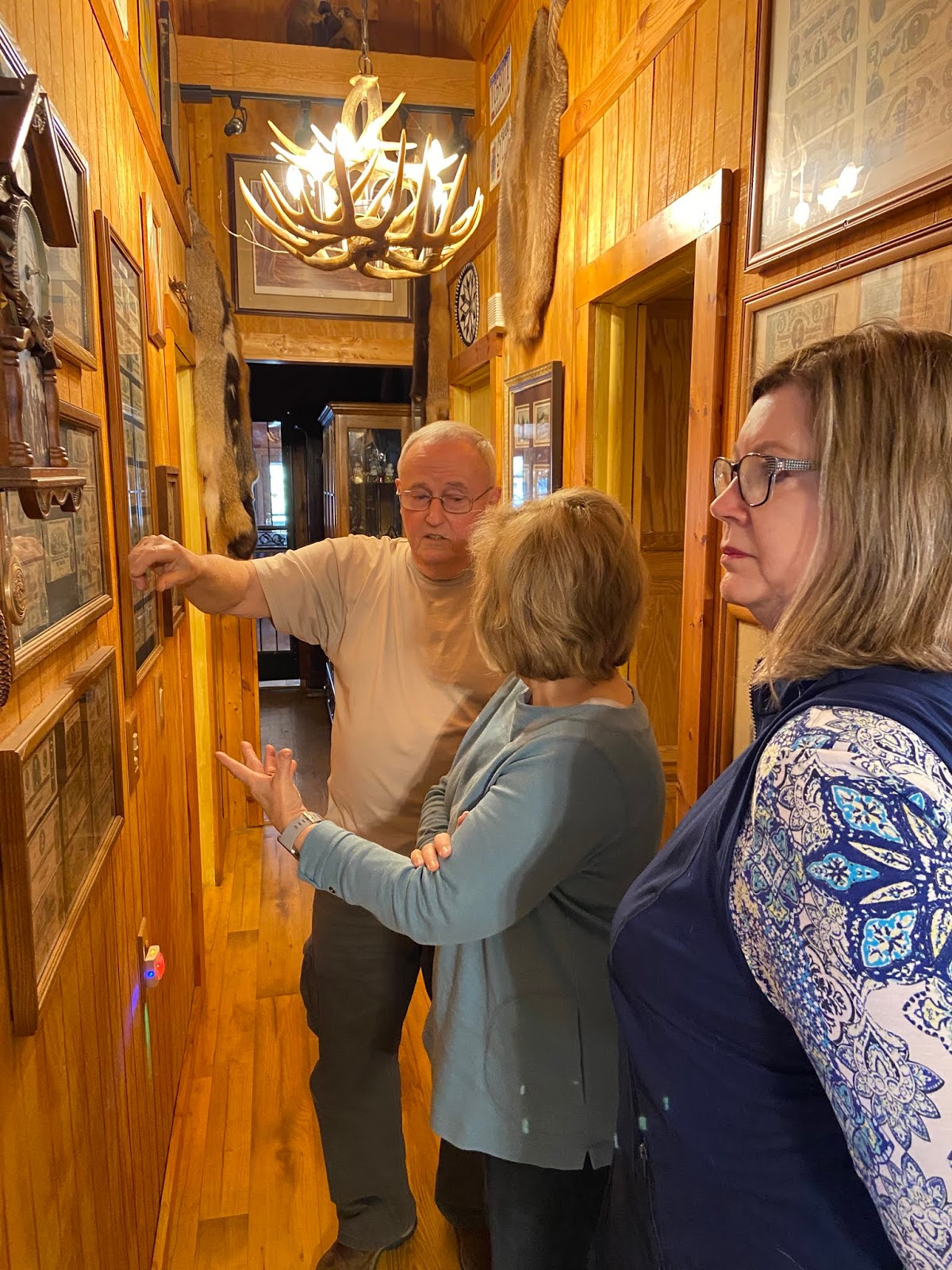
Pictured are Alice, Becky and Bob.


A  Ph.D. in biology and botany from Auburn, Bob taught for decades at the University of North Alabama and also conducted hundreds of environmental studies for governmental and corporate agencies.  It is not an exaggeration to say that Bob is one of the most knowledgeable persons living concerning the flora, fauna and animal life of the Tennessee River Valley.

His home, which he shares with his wife, Joy, his high school sweetheart from Irondale, Alabama, reflects Bob's taste in outdoor life.  The home feels like a comfortable forest lodge with wooden paneling, chandeliers of antlers and walls festooned with scenes of wildlife and southern history.

Below the Daly 'lodge' in the woods of North Alabama.

Bob bands hummingbirds, captured in a special trap filled with sugar water on a back porch.  Generally he attracts up to 400 of these tiny birds each migration season!  The ladies are watching a video on his computer of dozens of these beautiful creatures feeding.


Outside on the grounds, two cousins, now seniors in life, reminisce on how we used to hunt arrow heads along Alabama river bottoms and scorpions under the scrub oak trees on the Daly farm in Irondale, oh say 60 years ago or so!


Below are photographs I have saved (and hundreds and hundreds more of family) from the various  albums.  Here is a quick trip down memory lane of Bob and family in the 1940s and 50s.  The initial picture is of Bob in the sailor's hat, one year old me and my mother, Geraldine Stansbery Holliman (1923-2015), on the front lawn at 2300 N. 3rd Avenue in Irondale, our grandparents house.


The one below is damaged, but shows Bob on the left,  Pam Holliman in the center, Ralph and Motie Holliman's first born.  Three year old me on the right. The year is 1949.   Again photographed at Ulyss and Pearl Caine Holliman's Irondale home.  Judging from the way Pam and I are dressed, this must have been a Sunday in the summer.


Below, Bob, Becky and Glenn at Daytona Beach, Florida in 1955. Grandmother Holliman had died in May 1955, and the Dalys and  Bishop Hollimans took Ulyss Holliman on vacation.  I remember a day of fishing with my grandfather, father and Bob. Below we are digging for sand fleas.


Finally, Bob with his father, Robert W. Daly, Sr. (1901-1959) and his mother, Vena (1909-1990).  The family loved to visit Florida and fish.  These experiences no doubt helped develop Bob's life long interest in biology.


After the better part of the day with Bob, and significantly increasing our knowledge of nature's mysteries,  my sisters and I bid goodbye to our very knowledgeable first cousin, and drove on to Gadsden, Alabama where we lived from 1960 to 1964.  More on our trip in the next blog. - GNH 


Saturday, November 3, 2018

An Alabama Family in World War II, Part 40


Three Holliman Sons in Route to the Invasion of Europe
by Glenn N. Holliman

The sons and daughters of Ulyss and Pearl Caine Holliman of Irondale, Alabama wrote hundreds of letters to each other during World War II.  The contents of this correspondence are now a precious history of one family and the travail of that global conflict.  Thanks to the sharing of my cousins and late father, I have scanned and saved them in one folder, available to all descendants. GNH

In early February 1944, Melton P. Holliman (1908-1958) oldest of the seven children of Ulyss and Pearl Caine Holliman of Irondale, Alabama, finished his medical corp training at Camp Barkeley, Texas and traveled three days and four nights by train to Camp Reynolds near Greenville, Pennsylvania.  The huge train had 18 Pullman cars and carried 492 men. 

Below, Bishop and Melton Holliman in 1942, the year before Melton entered the Army at age 35 leaving behind wife Ida and daughter Patti.  Bishop, single, had joined the Navy the month before Pearl Harbor December 1941.


Melton arrived to 18 inches of snow and temperatures as low as 5f, quite a change from the Texas plains where he had spent five months learning to be a soldier in Uncle Sam’s rapidly expanding Army. According to Melton’s very home sick letters, the food was terrible and the weather, for an Alabama native, even more so. 

Camp Reynolds was a way station, a temporary posting for those troops about to be sent to England, an island said to be groaning of the weight of weapons, tanks, an Army Air Corp and a million or so G.I.s.  They were there for the forthcoming invasion of Nazi Europe, to topple Hitler and to liberate a broken Europe. 


Camp Reynolds, Greenville, Pennsylvania was potato field  in 1942.  By 1943, up to 75,000 troops at a time were passing through this replacement center awaiting transfer from training to assignments in either the Pacific or European Theaters.  Today the location is an industrial park, after briefly serving as a P.O.W. camp in 1945/46.

It was ‘hurry up and wait’ until early March 1944 when his group moved near to the transport docks in New York and Brooklyn.  There for yet another three weeks, Melton and many others waited for a ship to take them overseas.  There was leisure to see New York City for the first time and to write home about ‘the most wonderful view I have ever seen’ from atop the Empire State Building and the delicious steaks at Jack Dempsey’s Restaurant.  

He toured the then new Rockefeller Center, home of NBC Radio and Music Hall, and took long walks with his buddies along the side walks of New York, marveling at the diversity and size of the largest city in America. 

Once headed back to the deployment barracks, he marveled that the black soldiers did not sit in the rear of the bus and later that a Negro chaplain had preached to an audience of mainly white troops. 

His younger brother, Ralph (1925-2017) had arrived in England  in the autumn of 1943 after a rough ride on a troop ship over the North At antic.  While he could not tell the folks where he was in England, we now know he was an clerk with a headquarters company of the 9th Army Air Force.  First he was based in Bournemouth near the English Channel and later near Oxford, England.  As duty stations and work went in that WWII Army, Ralph, an enlisted man, all 19 years old, was fortunate to log flights and keep company records of transports, airplanes that on D-Day would haul parachutists to Normandy and later fly supplies to the continent. 


Ralph wrote the folks back in Irondale of his trips to London and seeing Big Ben, Parliament, Buckingham Palace and other sights. He promised to take his young wife Motie to see the same some day (and he did so decades later).

Right, Ralph in 1941, age 16.  

For my father, Bishop (1919-2018), he spent most of the winter of 1944 at sea on the USS Barker, Destroyer 213, a radioman who listened for German U-Boats signals.  Christmas 1943 was spent at sea, and again in January convoy duty took him from Norfolk to Africa and Bay of Biscay and then back to Boston. 

He wrote “Our mission was to sink subs but as far as I know we didn’t sink any.  However, there aren’t that many left out there.  We had several exciting experiences and one or two narrow escapes.  All in all, it was a rough trip, and I am certainly glad it is over.”

Above, Bishop in Boston on liberty at the Bunker Hill Monument.

After ten days off the New England coast for sea trials and firing practice, it was back to Norfolk and another convoy in mid-February, this time to the Mediterranean to escort supply ships for General Mark Clark’s Army which was slowly pushing up the mountainous terrain of Central Italy. 


For Melton, classified a pharmacist now making $80 a month, almost all sent home to Ida and Patti, he wrote that he had a job to do and the sooner he got to it, the sooner the war would be over. 

“I hear the Allies bombed Rome and the monastery (Monte Cassino).  They shouldn’t have waited so long to do it.”


March 29, 1944 Melton sent a V-Mail that he had arrived in England.  Now three sons of Ulyss and Pearl were in the European Theater and the invasion of France was only months away.


Monday, July 30, 2018

Well Nigh Fifty Years On

by Glenn N. Holliman

A half century has passed, fifty turns around the sun and now all seven children of Ulyss and Pearl Caine Holliman are gone.  This family, founded by a 1907 union of a 23 year old young man and a 19 year old girl, both of a rural Alabama county, both the children of farmers, led to 18 grandchildren who scattered across Alabama and America.  And so many great grandchildren that this writer cannot catalog them all.

The picture below was taken at a July 1968 family reunion on the front steps of the Irondale, Alabama 'White House' constructed in 1946 by Robert W. and Vena Holliman Daly.  Vena had long been anxious for a larger home than the one her family occupied for many years in the 2300 3rd Avenue North block, on the hill overlooking the railroad yards of  Irondale, Alabama.


Left to right, first row: Virginia Holliman Cornelius, Robert W. Daly, Jr. holding his niece, Suzanne Herrin Wilder, on his lap, Carol Cornelius Morton and her husband, Carl Blomstran.

Second row: Walter Cornelius, E.C. Herrin holding the youngest person attending, his son David, Mary Daly Herrin, Carol Daly (Bob's wife) and Gerry Holliman (wife of Bishop Holliman).


Third row: Euhal Holliman and Motie Holliman (wife of Ralph Holliman).


Fourth row: Glenn Holliman, his wife, Lynn, Ralph Holliman, Vena Holliman Daly, Clayton Herrin, 
Loudelle Holliman Ferrell and her husband, Charles, and Bishop Holliman.

Fifth row: Jean Holliman, Tommie Holliman Allen, Alice Holliman Murphy, Linda Herrin Bradley, Becky Holliman Payne, Kathy Holliman, Susan Cornelius Williams.


Back Row: George Hairston holding daughter Holly; Patti Holliman Hairston.


The location chosen for the new house was inside the Irondale city limits adjacent to U.S. Highway 78, the 4-lane road from Birmingham to Atlanta.  Within a generation land beside this busy highway became so valuable that developers acquired the house and lot in the late 1960s, removed the house and stately oak trees and put up a business office complex.  Today the United Methodist Church borders part of the old property line.

After the untimely death of Robert W. Daly, Sr. in 1959, Vena eventually accepted a position as matron of an University of Alabama sorority (later also at the University of Mississippi). Vena's daughter Mary and son-in-law and E.C. Herrin, and their growing family of four children moved into the home.

The year 1968 was a benchmark in American history and my personal story.  The Vietnam War was dividing the nation as over 500,000 US troops were trying to subdue a communist nationalist movement, a civil war, in Southeast Asia.  An average of 500 American men were dying a week as a result of an aggressive North Vietnamese Tet Offensive attack. The presidency of Lyndon B. Johnson floundered and collapsed as a result of the stalemate and cost in blood and treasure.

At home the Civil Rights movement climaxed with African-Americans gaining long deferred rights to vote and utilize public accommodations such as restaurants and hotels.  The cultural upheaval stressed the social fabric of the nation, especially the Deep South.  Dr. Martin Luther King, the non-violent, but confrontational leader, was assassinated by a white man that April and as a  result many inner cities in the country were torched by black angry mobs.

A Democratic candidate to replace Johnson in the presidency, Senator Robert F. Kennedy, a brother of the assassinated president John F. Kennedy, was himself murdered by a Palestinian immigrant in Los Angeles in June.  It seemed the nation was tearing itself apart with violence, both home and abroad.

A 21-year old Glenn N. Holliman, son of Bishop and Geraldine Stansbery Holliman, graduated from Tennessee Tech that June, along with his young wife, Lynn.  Within a week, a draft notice arrived from my Gadsden, Alabama board calling me to take a physical in Montgomery to ascertain if I was fit to join Uncle Sam's Army.

So, off to Alabama I went in July.  As my Uncle Ralph and Aunt Motie and their daughter Kathy, residents of Atlanta, were visiting Birmingham, my parents and sisters, Becky and Alice, headed south from Tennessee to join a family gathering that Mary Daly Herrin arranged in Irondale.

I have found only one other photograph of the July 1968 event and that is a table groaning with fried chicken, potato salad and ice tea.  Vena is identifiable in picture in a black dress and white ribbon.  Holly Hairston (Melton Holliman's grand daughter) in the foreground is facing toward the table and Loudelle is partially visible on the left.


I don't remember much about this reunion because of my personal emotional trauma.  By August, I was at Ft. Benning, Georgia and, after short stops at Ft. Dix, New Jersey and Ft. Hamilton, New York, by January 31, 1969, arrived in Vietnam.  My new home for a year was the 1st Infantry Division, forty some odd miles north of Saigon.

1968, a year in which it can be said America had a nervous breakdown, families such as this one still gathered and celebrated their loving relationships and common heritage.  At Christmas that year, three American astronauts in Apollo 8 circled the moon providing a smoothing balm to a horrendous twelve months.  And that was the year McDonalds introduced the iconic Big Mac hamburger (hmm, a plus or minus for the American waistline?).

Eventually the Vietnam War ended, African-Americans began playing football for Auburn and Alabama, air-conditioning proved ubiquitous in the South and families still gathered for festivals and funerals.  Six of the seven children of Ulyss and Pearl rendezvoused in Irondale that July 1968 and forthcoming decades.  (Melton, the first born, had died in 1958.)

Now I am age 71 (gasp).  This summer of 2018, Bishop, my father died at age 98, and the children of that 1907 marriage are no more with us.  But of course the seven still are....with us.

Sunday, July 15, 2018

The Passing of a Generation, Part 2


Further Reflections on the Passing of My Father, 
H. Bishop Holliman, 1919-2018
by Glenn N. Holliman

In 1919, when my father first saw daylight, the victorious allies of World War I forced a revengeful Treaty of Versailles on a defeated Germany.  That same year an angry and disgruntled 28 year-old German army veteran of that War to End All Wars joined the fledgling National Socialist party in Munich.  Adolph Hitler’s acquisition of power in 1933 would eventually turn my Father’s life upside down, as it did hundreds of millions of others around the world. 

The 1920 Federal Census reported that for the first time a majority of Americans no longer lived on a farm but made their lives and daily bread in a town or city.  As with millions of others, the trajectory of the Holliman family in the early 1900s was in the direction of urban life. 

Part of farm life continued into Alabama urban areas.  Here ca 1921, Bishop plays in the family chicken yard.  He is still in ‘baby clothes’.  The family raised chickens for decades and for a time in the late 1930s had a milk cow. 


As normal for many Americans of the time, Bishop’s parents, Ulyss and Pearl Caine Holliman, had only sixth and eighth grade educations from a rural county school.  However, thanks to the move to Irondale, Alabama during World War I, the educations attained by their children would make an incredible difference in their lives and those of the grandchildren, i.e. yours truly.

May 1921 Ulyss Holliman contracted for $2,000 a six room, 28ft by 42ft unpainted house to be constructed at 2300 3rd Avenue North on a large hill lot in the E.N. Montgomery sub-division.  The plot overlooked the busy railroad yard and tracks that dominated the central corridor of Irondale. 


Above, left to right, six of the seven children of Ulyss and Pearl Caine Holliman - Vena, Euhal, Loudelle, Melton holding Virginia and Bishop in front, ca 1923 before Ralph was born in 1925.  Both Melton and Euhal in knickers and caps.  Vena in her Sunday best. My father is wearing a hat held down by Euhal, and carries a stick and wears white short pants.


It was the existence of the railroad that had led the Hollimans to Irondale Pearl’s father, William Lee Caine, from Fayette County took a job as a watchman for the railroad and moved his wife Lula Hocutt Caine and daughter Vista to this new community, only a few decades old.  A short time later, perhaps 1917, Pearl’s family followed as did her other sister, Maude Caine Cook and her family.

The all-wooden house was wired for that new marvel of that generation – electricity – but alas not running water or an indoor bathroom.  Such would be added in 1936.  Until then the family heated water in a huge cast iron pot every Saturday night and took a bath as my father said  ‘whether we needed it or not’.  As Irondale had suffered a devastating tornado in the early 1900s, my grandfather built a simple earth shelter into the side of the hill.  Fortunately, it was never needed, and it eventually collapsed.

Below the house at 2300 3rd Avenue North, Irondale, Alabama in 2013.


My grandfather caught the bus, later the street car, for the short ride to Birmingham to work six days a week, from the family home in Irondale, Alabama.  Later thanks to the Franklin Roosevelt’s New Deal, Ulyss’s work week was reduced to forty hours.  My branch of the Holliman families were Republicans, unusual for the times in the Deep South.  

Ironically, although opposed to most of the domestic programs of the 1930s Democratic administration, few persons benefited more from Federal programs than did my grandfather and father – for example, Social Security, labor unions, paid vacations, public works and college work programs.

As the fifth child of seven, my father grew up surrounded by siblings in a religious home.  His parents raised the children in a conservative Methodist tradition, prohibited dancing, card playing, alcoholic beverages and insisted on weekly attendance at church, often twice on Sunday. 

Below the family ca 1924 in a highly productive garden.  Cousin James Cook has joined the photograph, probably taken by Ulyss Holliman.  

The family did purchase a radio in 1929.  Bishop remembered his Mother allowed him to stay home from school to listen to the inaugural speech of President Herbert Hoover that year.  

The Hoover years were cursed with the Great Depression, the central reality of my father’s adolescence in the 1930s.  In 1933 Hitler became chancellor of Germany and by 1941, Dad was in the U.S. Navy and once again the United States was in a World War.

For several years I have been writing the history of this Alabama family before and during World War II.  The stories of Bishop, his parents, siblings, in-laws and the children to come are articulated at this blog site.  If I live long enough and my mind stays clear, I hope to carry on these stories into the post war years. The formal obituary of my father is contained in the next article on the Passing of this Generation. - GNH


Friday, June 15, 2018

The Passing of a Generation, Part 1


The last child of Ulyss and Pearl Caine Holliman has Passed, and the Greatest Generation comes to an End
By Glenn N. Holliman


My father, Homer Bishop Holliman, left picture 2002, born December 17, 1919, breathed his last at 3:10 p.m. on Saturday, June 9, 2018.  He was surrounded at his Cookeville, Tennessee hospital bed by his three children – Becky, Alice and yours truly.  And my two children, Grace and Chris and Becky’s son, Bryan.  His last illness was only a few days and mercifully largely free of pain and discomfort.

My Dad lived through 40% of the history of the United States, his days largely spent in the 2oth Century America.  A prolific writer, he recorded stories of his family, his growing up in Alabama and his observations on the time and culture in which he moved and had his being.

His parents, Ulyss and Pearl, born respectively in 1884 and 1888 in rural Fayette County, Alabama, were descendants of 17th century immigrants from the British Isles.  In 1836, my branch of the Hollimans migrated to west Alabama from the Carolina's.

Dad’s grandfather, John Thomas Holliman, 1844-1930, photo right 1900, fought in seven major battles for the Confederacy in the 1860s serving under Braxton Bragg, James Longstreet and Robert E. Lee.  He returned home in 1865, became a ‘dirt farmer’, had six sons, the last being Ulyss.  My father knew his grandfather and remembered him as a tall ancient man, thin with a long white beard.  John Thomas Holliman was almost illiterate and died a year before his wife, Martha Jane Walker.  My great grandmother’s father, Samuel Walker, experienced the three days at Gettysburg and the siege of Petersburg, including the tragedy at the Crater.

Ulyss married Pearl Elmer Caine, a neighboring girl, when she was 18 around 1906.  (Pictured below in 1945.) He is listed in the 1910 census as a farmer.  Soon the children began to appear – Melton in 1908, Vena in 1909, Euhal in 1912 and Loudelle in 1914.  Some time in those years, the family left the farm and moved to the village of Fayette.  There Ulyss found employment in the local lumber mill.

Their world was rapidly changing – oil lamps were giving way to electric lights and horses to motorized carriages.  And 50 or so miles away by railroad, a ‘magic’ city, powered by coal, limestone, iron ore and northern capital, was growing rapidly offering economic opportunity and a way for a father to better support his four children.  So in 1917, this Holliman family moved to a suburb of Birmingham – Irondale -  a railroad switching yard for a growing number of freight and passenger trains that tied an emerging southern economy to a more financially robust America.

Before long, three additional children came along – Bishop in 1919, Virginia in 1922 and Ralph in 1925.  Pearl was 37 and Ulyss 41, when their family was complete.  Ulyss, good with his hands, took employment as a carpenter with the Birmingham Electric Company, a corporation which ran the municipal street car line.  When my grandfather was born, there were no street cars in Birmingham and when he died in 1965, there were no street cars.  But in between these technological eras, he worked 32 years repairing the wooden cars and supporting a family of nine persons.

That move from the land, where countless ancestors had toiled, to a newly industrialized urban area changed everything for my father’s generation.  As President Franklin Roosevelt remarked in the 1930s, this generation had a rendezvous with destiny, and so it was to be.

Continued soon to Part 2….


Saturday, April 28, 2018

An Alabama Family in World War II, Part 38

by Glenn N, Holliman


Letters of my Grandmother, Fall 1943

In August 1943, Ulyss and Pearl Caine Holliman, ages 59 and 55, of Irondale, Alabama saw their oldest son, Melton P. Holliman, b 1908, inducted in the U.S. Army. Two young sons, Bishop, b. 1919, U. S. Navy, and Ralph, b. 1925, U.S. Army, had been called to the colors earlier.  Now the fourth and last son, Euhal, b. 1914, and father of three pre-school children, had received notice.  

Son-in-law, Walter Cornelius was in training, but there are fewer letters to trace his war as he was state-side until 1945. His wife, Virginia, b 1922, was able to travel with him to several of his postings.


Left, Walter and Virginia, in California, a young couple a long way from Alabama.

Pearl wrote from September to November 1943 numerous letters.  Exerts are below.

“Well, I guess Euhal will have to go in a few months.  It looks like all the men will go up to (age) #38.  We are doing our part as best we can and looking forward to you boys all coming home soon.  May the Lord bless and keep you. Love, Mother H.

We had a bond rally in Irondale last nite and us women are to go from house to house to sell bonds.”


Above, forty years after the war, 1985, beginning with Vena on the far left, Loudelle, Bishop, Ralph, Virginia, Ida and Euhal, closest to the camera.

My father, Bishop, had just returned from the Mediterranean where his destroyer provided vital shell fire at the invasion beach in Gela, Sicily and experienced a Luftwaffe attack at Palermo.  The USS Butler returned to Brooklyn Navy Yard, and Bishop was sent for refresher code training at Cisco Bay, Maine before transfer to the USS Barker later that month.  June 1943 until June 1945, he would spend approximately 75% of his time at sea escorting convoys.

A great deal of my grandmother’s letters had to do with sharing changing address of her sons in training and assignments.  That month of September 1943, she wrote Bishop:

Ida (Melton’s wife) just called; she had just got a wire.  Melton is in Abilene, Texas at Camp Barkley.  He came through Irondale and Birmingham last Friday.  Too bad all of you have to come so close to home and can’t stop.  Be sure and write to him.  He will be lonely.”


Right, Melton in autumn, 1943, training as a medic in the Army.

Bishop, Ralph and Melton, all three, at one time during the war traveled by train through Irondale within sight of their grandmother Lula Caine’s house.

"Bishop called Saturday night, and Motie (Ralph’s wife) got a telegram from Ralph, both in New York (Bishop and Ralph).  Wouldn’t it be grand if they could have run into each other…Jr. Caine (a nephew of Pearl’s) came home last week.  He really is a good-looking man now, weight 174 pd.  He had not been home in over two years.


Ira and Patsy (Melton’s 1-year old daughter) came out last week.  Patsy is some smart girl.  Virginia, Mary and Vena say the new boy (Bob Daly, b. 10/1943) looks like me.  

I tell them it does not.  You know you can’t tell who they look like when so young.”


Right, 1952, Ulyss, Pearl and Bishop

Pearl wrote in October about Ralph who had been stationed in Reno, Nevada:

“We finally heard from Ralph.  He is somewhere in England. Motie got a cable from him.  I sure was glad to hear from him….They have just announced London was bombed last night and a dance hall bombed with lots of soldiers and girls killed. Ralph wrote he had not been to London yet so he must be close by. So he needs our prayers.

I hope he will never go near a dance hall.  If bombs don’t fall. They are loaded with sin bombs.”


My grandmother’s language is disjointed, but she believed dancing was sinful.  Her education ended in the 8th grade in a rural Fayette County, Alabama school.  Raised Methodist. she and Ulyss joined the evangelical Christian Alliance Gospel Tabernacle in Birmingham in the mid-1930s.  Their adult children remained Methodist or Baptist, and a mild rift occurred between the generations.

Left, Ulyss Holliman, second from the right, in a Birmingham News photograph, ca 1950, an elder in the Gospel Tabernacle Church.

Next posting, letters from Bishop at sea, Ralph in England and Melton in Texas.