Showing posts with label USS Butler. Show all posts

Tuesday, January 3, 2017

An Alabama Family in World War II, Part 34

by Glenn N. Holliman

Invasion Day at Gela Beach, Sicily - 10 July 1943

It was the greatest invasion fleet in world history - greater even than D-Day 1944.  More than 3,000 allied ships and boat of all sizes carried or escorted seven divisions of British and American troops.  These men stormed the beaches of Sicily and seized the first bit of European territory from Italian and German fascism.  

One of those ships, the USS Butler, a 1942 destroyer carrying submarine depth charges, torpedoes, 5 inch guns, and over 200 young sailors, one being my father, Bishop Holliman, provided anti-submarine and anti-aircraft protection for this massive fleet. The deck guns would be called upon to shell Herman Goring's crack German Division at Gela Beach. 

The Butler to the right.


For my father, and hundreds of thousands of others, it was a baptism of fire and fear. Here are more of his words written in August 1943 and mailed surreptitiously to avoid censorship to his niece, Mary Daly (Herrin) in Irondale, Alabama.  Caught up in describing those days in July 1943, he moves back and forth from past to present tense.  I have done some minor editing for clarification.


For historical background, I am using Rick Atkinson's excellent work, The Day of Battle, the War in Sicily and Italy, 1943-1944.  When appropriate, I add notes from this work in red amplifying my father's narrative.

H. Bishop Holliman, b 1919, writes:

"Arriving there (Bizerte), there seemed to be hundreds of ships - all kinds-transports, landing barges, British, American, etc. There were several sunken ships at the harbor entrance. There was hardly a building in the city that had not been damaged or totally destroyed. The city looked like a cyclone had swept through. Moreover there were many farm houses which seemed to escaped the bombs.  It was terribly hot (t)here."


Bizerte had been evacuated by the Germans in May 1943, but not before scuttling a dozen ships at the narrow neck of the Bizerti bay.  Navy divers had worked feverishly to clear the channel. What my father saw was 'a solid forest of masts, and many species of amphibious vessels ready to transport the 1st and 3rd Infantry Divisions to Sicily.

"On Monday night (5 July 1943) we fueled up from a tanker in the harbor and tied up there for the rest of the night.  All of us remarked how dangerous it would be to have an air raid while we were tied up there.  I went on watch at 2 a.m. the next morning (6 July 1943) and as fate would have it at 3:30 a.m. the Germans came over.  The shore batteries and guns of other ships started firing before we did. Simply because the officer on watch thought 'It was target practice', my job, during battle is the same as the other work I do, copying code. So I have to sit there at the  typewriter typing away as if nothing were happening.  There are about six others so we are able to relived each other from time to time.  The raid lasted about an hour.  But no bombs fell close to me.  There were hits on other ships.  Two fellows were killed on one, and a destroyer was hit. We not able to tell how many of the planes were shot down."

Atkinson writes "Luftwaffe raiders sometimes sneaked across the Sicilian Strait before dawn...alarms wailed, smoke generators churned out a thick gray blanket to hide the ships, and searchlight batteries impaled the planes on their beams as hundreds of antiaircraft guns threw up fountains of fire...."

"On Thursday morning (8 July 1943) we left for Sicily where the captain had told us the afternoon before we were to take. On Friday he gave out all the information - how many ships, time and place of the attack, who the leaders were, etc.

He also said he expected to fight the ship to the very last.  There would be no giving up or thoughts of abandoning ship!

Friday noon and night (9 July 1943) we were fed as much as we could eat, such as it was. There was very little concern or unnecessary excitement.  There were many ships in view, arranged in convoy units.

Early Friday afternoon the sea began to get rough, and I was off watch so I lay down part of the time. But the sea got rougher.  There were no clouds for rain, but the wind blew strong. Believe it or not this was the only rough weather we had encountered up to that time.  By supper time the ship was rolling and almost impossible to eat.  I went on watch at 5 pm and I got sick, and I mean sick.  There were many others in the same fix.  It was not a comforting thought to be going into battle so sick you could not raise a finger to protect yourself and furthermore you don't care."

Atkinson writes that a polar cold front briefly collided with a secondary cold wave over the Mediterranean hemmed in by a low mass of air over Yugoslavia.  The results were 37 knot winds and very heavy seas for over 12 hours.  The troops and sailors suffered mightily from the storm.  US Naval Vice Admiral Henry K. Hewitt on the flagship Monrovia even considered calling off the invasion during the height of the storm, but trusting his meteorologist continued on.  The storm abated around 2 a.m. on 10 July 1943, Invasion Day.

"My watch was over at 9:30 pm and we were scheduled to take our battle stations at 11 p.m. zero hour being 2:45 a.m. (Saturday, (10 July 1943) so I lay down on the deck in the radio shack where my station is and tried to sleep until then.  I blew up my life jacket and used it for a pillow.

I woke up a little before 11 and the captain was talking over the loud speaker.  We were approaching our place of rendezvous (that's the place where all the ships were to assemble, Vena). The captain was telling us of what he expected and the usual line of talk, also he read a few verses from the Bible, some religious poems and prayed the Lord's Prayer.  He had wanted to have a religious service that night, he said, but was impossible due to the rough sea."

Vena was Bishop's oldest sister, married to Robert W. Daly, Sr. and mother of Mary Daly Herrin and Robert W. Daly, Jr.  The rendezvous of hundreds of ships, sixty miles long and a mile wide,  took place just east of Malta before turning toward Sicily during the night.

The captain was Lt. Commander Michell Dudley Matthews (1903-1985) who retired in 1957 as a Rear Admiral.  It was a young man's war with many ships and too few trained officers.

"The rest of the night some of us would lie down on the deck and snooze while others would copy and then exchange.  The sea had become much smoother around 2 a.m. but I think the invasion was held up about an hour. There was very little action until 3 or 4 a.m. An officer from the deck describes what is going (on) through the loud speaker.  Otherwise the men below deck would not have any idea what is going on.

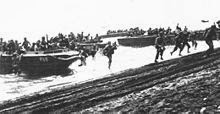
After the troop ships unloaded and landed, there was considerable firing on the beach. Many fires but no opposition to speak of. This is at Gela, Sicily where the American troops landed." 

Below, the US 7th Army landings under General George Patton at Gela Beaches.  The 1st Infantry landed on the middle beach on 10 July 1943 and overcame some Italian resistance. The next day and the arrival of German tanks would be another story.


Unloading the ships began at 3:30 a.m. at Gela with confusion and courage.  There was more opposition at Gela than my father, with his limited view at the time, knew. Mines were the major danger and some shore guns. The 1st Infantry secured the beach but with casualties. The Italian defenders soon were overcome.  The real test was on 11 July 1943 when German tanks moved on the beach head.

"No one was frightened and it seemed just like a drill. Our ship's job was to act as part of anti-submarine patrol. However, we got word we could expect an attack at dawn. Over thirty planes were supposed to be coming. At dawn everyone was tired and worn out.  Until the tension slacks off you do not realize the strain you have been under.  All we had for breakfast was orange juice and two boiled eggs.

All day Saturday I was at watch or at General Quarters (Battle Stations). There was firing from the beach and firing from some of the ships.  There was so much going on I was never able to remember just what all was taking place.  The only thing I remember doing that day was eating breakfast.

Early Saturday morning the captain announced the (censored)  had been sunk with only 69 survivors.  He seemed pretty shaken up about it and it made us all realize there had been more danger than we had suspected.  At that time no one knew what had sunk her."


The unfortunate ship was the USS Maddox, serving as a destroyer screen as was the USS Butler for German U-boats.  One German airplane dropped two bombs and within a few minutes the ship sank dragging down 212 men. A tug rescued only 74 survivors.

There were personal reasons for the young captain Matthews of the Butler to be upset.  Above left, the photograph taken from the USS Thorn (647) shows in the background the Butler  (636) right moored in Brooklyn harbor next to the USS Maddox (622), left in the fall of 1942.  The two captains would have known each other.  The Maddox captain went down with the ship. Above right, the USS Maddox on sea trials.


The Battle for Sicily against 300,000 Italians and a very determined two German divisions would continue until late August, and the USS Butler would face more enemy fire....to be continued.

Monday, October 31, 2016

An Alabama Family during WW II, Part 33


by Glenn N. Holliman

My Father, Bishop Holliman, a young sailor from Irondale, Alabama, wrote a long document in August 1943 detailing his experiences in the Allied invasion of Sicily the previous month.  So fresh were his memories that he moves his writing back and forth from present to past tense.

Moving to the Front

June 1943, the USS Butler, a one year old destroyer crewed by freshmen sailors, joined a convoy of transports and warships in Hampton Roads, Virginia and crossed the Atlantic on a course to the Mediterranean.  The objective was to invade Italy's island of Sicily, a stepping stone to Adolph Hitler's Fortress Europe.  Under dictator Bineto Mussolini, Italy had allied itself with Nazi Germany, part of the famed Pact of Steel, the Axis of Germany, Italy and Japan.

Upper right, the port of Oran in 1943.  U.S. and British troops on November 8, 1942 invaded North Africa to engage Vichy French, Italian and German forces.  In May 1943 in Tunisia the last Axis forces surrendered to the British, USA and Free French.  North Africa, cleared of German power, became the staging point for the attack on Italy and additional German divisions.  Just like the USS Butler, the US Army and Navy were 'new', filled largely with troops and sailors who were serving in combat for the first time and commanders who were learning how to command massive numbers of men, war assets and supplies.  

Fresh from radio code school in Maine, Bishop Holliman's first war cruise was also his first trip across the Atlantic.  And it was a voyage into combat.  Below are his words from a letter he wrote in August 1943 after arriving back in the States.

"On June 22, we entered the Med. and saw land for the first time in two weeks. My greatest desire was to get a view of the Rock of Gibraltar, but unfortunately I was asleep or on watch when we went by.  However, we could get a view of the Spanish and African coasts.  We arrived in Oran (Algeria)...our stopover...for the purpose of refueling.  There was plenty of evidence of the USA there - army jeeps, guns, ships, etc." 

Below, a map of the western Mediterranean Sea during Operation Torch.  On November 8, 1942, USA and British forces invaded Morocco and Algeria, at that time French colonies.  Oran was taken by the American First Infantry Division which took casualties before subduing French forces who believed they were defending against hostile invaders. Oran became an important port for the clearing of North Africa in the winter and spring 1943 and the invasion of Sicily in July 1943.


"We proceeded on to Algiers, 24  hours away.  Upon arrival...we did not go into port immediately but spent another 24 hours on maneuvers with landing barges and other craft.  We knew then the time and place were drawing near.


The harbor was filled with Allied ships of all kinds.  It seems impossible that the Italians or Germans did not expect an invasion of some kind.  There was no reason whey they could not find out about the equipment and ships at these Med. ports.   

The first to do at Algiers was to get the mail off-and that we did-my first card had been mailed back at Oran.  We also had church services in the mess hall-on the way over too-conducted by one of the officers.


A couple of days after arriving, liberty was granted.  I went ashore on Sunday afternoon- the Sunday before the Fourth. There were many modern buildings in the city but most of the places were filthy and unattractive.  There was no place to buy any refreshments or food. The place was filled with army trucks, jeeps, cars and there were thousands of soldiers and sailors from every allied country including native Africans and Free French.
The only place Americans could go was to the Red Cross building where they were able to get ice cream at certain hours, and which wasn't any good. and something they called sandwiches.  They also have movies there, but the place is so crowded we can hardly move about.  It is the only place for the boys to go.  It is pitiful to see the boys walking around with nothing to do. 

I talked to one soldier from Iowa, who had been over there since November.  He said the mail was about the only thing they had to look forward to.  However, he seemed to be pretty well satisfied and not going hungry.  Probably getting better food than we were on the ship.  I told one fellow I had not tasted a Coca Cola in over a month.  He said he had not had one in a year.  So it isn't the service men who are getting all the drinks.

Up until about the 7th of July we did patrol work around the Algiers' area.  Each day we hoped that would be the day to get started to wherever we were to go.  During our stay here there were rumors to the effect that there had been air raids, but were not concerned. All this time weather was very hot in the day and cool at night.  In the crew quarters though it was always too hot to sleep."

Right, Algiers during a 1943 air raid.


"On Sunday afternoon, we left Algiers to move 'closer' to the front so the captain said...to Bizerte"...to be continued.


Monday, October 3, 2016

The Invasion of Sicily - An Alabama Family at War - Part 32

A Son under Fire!
by Glenn N. Holliman

By the summer of 1943, three sons and a son-in-law of Ulyss and Pearl Caine Holliman of Irondale, Alabama were in uniform serving in World War II.  One son went into battle that July, H. Bishop Holliman, a radioman on the USS Butler, a destroyer escorting transports and warships during the Allied invasion of the island of Sicily.  The ship's guns supported the American infantry facing the German crack Herman Goring Division.  Later in the battle the Butler fired on German bombers that attacked the ship.

By May 1943, Generals Eisenhower and Montgomery had pinned Nazi and Italian forces in a vice in Tunisia forcing the surrender of almost 250,000 troops.  The Americans and British now turned their energies on the island of Sicily, a part of Italy as their entry into Occupied Europe.  


Sicily is in red below, a triangle shaped island 
seemingly about to be kicked by the Italian boot.


Bishop Holliman, fresh from radio school, crossed the Atlantic for the first time and found himself part of the greatest invasion yet in world history, the taking of Sicily by Eisenhower's forces.  Upon returning to the States, unharmed in August 1943, he typed an 11 page synopsis of the engagement and mailed it to his niece, Mary Daly Herrin. I am quoting liberally from that document which can be found at www.bholliman.com. Click on the Records page and insert and click Sicily in the Search box.


Right 1943, Mary Daly Herrin and her Uncle Walter Cornelius in Army uniform at her home in Irondale, 2300 block of 3rd Avenue North.  Walter had married Virginia Holliman in 1942.

Below is page one of his transcript, typed on Navy time and paper. While faint of ink now, he writes of returning to the ship in Norfolk, and being advised to send home his 'blues' and other non-essential items.  The ship dispersed to the Chesapeake Bay and waited for several days for escort duty.  All liberty was cancelled and rumors flew fast.


"We pulled out on Tuesday June 8th, and the group were about 25 freighters, troops, etc, 15 destroyers and 3 cruisers. While in the Atlantic the captain announced this was a 'high speed' convoy.

All the way over there were lectures on what to do if captured by the enemy, etc. what to say.  And also information on injuries, how to protect yourself from certain woulds, First Aid Stations on the ship, etc. The expectation of seeing action kept the time from being dull."


Above Bishop home at 2300 3rd Avenue North, Irondale, Alabama after the war. With a new bride and the G.I. Bill, he returned to his interruped education at Birmingham-Southern College.

Below is a three day watch schedule as lived by Bishop in 1943 in which he writes this was one of the easier schedules on the ship!  He was earning his $77 a month!


Below the USS Butler at sea.  The ship was commissioned at Philadelphia in 1942 and quickly decommissioned after hostilities in 1946.  The ship was broken up for scrap by 1948 after dodging bombs in both the Mediterranean and Pacific. War is expensive and wasteful.


Next posting arriving in the Mediterranean, shore leave and then the invasion.

Saturday, December 6, 2014

How a World War Changed an Alabama Family, Part 26

by Glenn N. Holliman

 H. Bishop Holliman turns 95!

 Above at home in Avilla, Indiana, comforted by his wife of fourteen years, Ellen Cox Holliman, Bishop enjoys his sun room and his cappuccino.  He turns 95 on December 17, 2014, eyesight and hearing diminished, but mind clear and understated sense of humor ever present.  He continues to write of his youth in his beloved Irondale, Alabama, trains and his World War years.  In fact, an article about a girl he met on the train at Chistmas 1942 will be appearing this February 2015 in the magazine The Good Ole Days.  With tongue-in-cheek, he has bequeathed his 'little black book' to his nephew Charles H. Ferrell!

Below from his 1991 handwritten memoirs, the Christmas of 1942, the family story he told us every holiday season for decades as we gathered around the family table....as his son, a mere 68 years of age, I am happy to post it this holiday season.- GNH

I'll be Home for Christmas 1942 by H. Bishop Holliman

For H. Bishop Holliman, November 1942 would see his one year anniversary in the U.S. Navy.  Now he was a radioman on the USS Butler, a brand new Navy destroyer.  The 'terrible ordeal' of the shake down cruise off the coast of New England over, the 1,000 or so ton ship was ready for war duty, to protect convoys and ward off German U-boats during World War II.

"Eventually the Butler was ready for sea duty, and our first voyage was to Bermuda escorting a convoy of merchant ships.  It was an uneventful trip, and I have forgotten how long we were gone.  I'm sure we returned to Philly for a short stay, and I continued to see Gerry when I had liberty." 

"Gerry" or Geraldine Stansbery would become Bishop's wife June 26, 1945, one of three war time marriages in his immediate family.  This one lasted forty-two years, produced three children, eight grandchildren and as of this writing, fourteen great grandchildren. She became a widow this year, losing her husband of twenty-five years, The Rev. Don Feick, an Episcopal priest.  Age 91, she now resides in a retirement home in Cookeville, Tennessee.

"In mid-December, we escorted a convoy to Galveston, Texas, and this voyage took several days coming and going.  I suppose when I left Philly it was a 'tearful good-by', as I had no idea when ever I would return there.  I had no assurance I would ever see Gerry again.  I promised to write and thereby hangs a tale!

Upon our return from Galveston on Christmas Eve 1942, I was granted unexpected leave, so I boarded the train in Norfolk, Virginia and rode all day and night transferring, I guess at Lynchburg, Virginia to the Southern, thinking it would take me all the way to Birmingham.  The train was 'standing room' only, and I remember enjoying the company of a girl part of the way.  She probably had been to see a sailor friend, but I detected no lasting inclination toward him!"

Left, the railroad routes in the southern U.S. in the first half of the 20th Century.  Passenger service soared during World War II and crashed after the conflict.  Air passenger traffic and the Interstate Highway System doomed most passenger trains by the 1960s.

"While in route, I learned the train terminated in Atlanta, and I would have to get to Alabama the best way I could.  Since I wanted to surprise the family (and walk in on Christmas Day), I had not called, so no one knew I was homeward bound.  Well, the train reached Atlanta in the dead of night, and the next one to Birmingham would be up in the day, so I devised another way to get home as soon as I could.  I went down to the Greyhound Station and rode a bus on home, arriving in Irondale just about day break the day after Christmas."

Raised on small farms in Fayette County, Alabama, and farmers in their early married life, Pearl and Ulyss Holliman continued to grow a large garden and raised chickens (as did millions of Americans) at their home at 2300 3rd Avenue North in Irondale, Alabama.  Pearl sent this photograph to her son Bishop in 1942, promising to save some of the chickens for his next time home.  This writer can remember as a child her fried chicken, collard greens and butter from her kitchen churn.

"I can still remember the excitement my appearance at the front door generated for Mama, Daddy and all the others.  But I was finally home and glad to be there on my second Christmas in the navy.  My leave was for only a few days, because I was to be assigned to radio school in Cosco Bay, Maine, January 1, 1943."

For contact information to send Bishop birthday or Christmas greetings, please write glennhistory@gmail.com.

 Next posting, more World War letters of an Alabama Holliman family.... 

Have questions about Holliman family history? You are invited to join the Hollyman Email List at Hollyman-Subscribe@yahoogroups.com and the Hollyman Family Facebook Page located on Facebook at "Hollyman Family". Post your questions and perhaps one of the dozens Holyman cousins on the list will have an answer. For more information contact Tina Peddie at desabla1@yahoo.com, the list and Facebook manager for Hollyman (and all our various spellings!).

There is also a massive Ancestry.com Holyman and Associated Families Tree available for review.  For an invitation to this collection of over 20,000 individuals, please write glennhistory@gmail.com.  

I also have a collection of associated family manuscripts and research collected by the late Walt Holliman, Cecil Holliman and Rhodes Holliman.  Happy to send these materials by email and to insure their research is available.  The surnames: Alexander, Baldwin, Barham, Bass, Beall, Blakeney,  Baker, Bond, Bostick, Brewer, Bryan, Bryant, Bullock, Calvert, Carter, Champion, Chew,Cofer, Cole, Crafford, Crockett, Curtis, Dale, Daniel, Davidson, Davies, De Mallpas, Douglas, Duckett, Edwards, Edgerton, Emerson, Fitzhugh, Fowlehurst, Fox, Gains, Garrison, Gonson, Graves, Gray, Guyton, Guins, Hall, Hamby, Hawkins,Hendrix, Hill, Hogg, Holliman, Holt, Howard, Jackson, Jones, Judkins, Love, Lucas, Maget, Mansfield, Manwaring, McBee, McComas, McCurdy, McNewsome, Nicholson, Norsworthy, Noyall, O'dell, Oliver, Pearce, Peerce, Pettigrew, Petway, Pitman, Plow, Plyler, Porten, Prather, Petite, Ridgely, Riggan, Roberts, Smith, Spencer, Sprigg, Standley, Stanyard, Swan, Strother, Thompson, Thornton, Thrope, Trelawney, Turpin, Underhill, Underwood, Wallace, Walters, Weedon, Whitherspoon, Whitten,Williams,Wilmot,Wilson, Whitaker and Yerby.  These are mainly Alabama families and their ancestors from the Carolinas and Virginia. Materials vary from one page to 200. - GNH at glennhistory@gmail.com.


Sunday, August 3, 2014

How a World War Changed an Alabama Family, Part 23

by Glenn N. Holliman

 The Allies Respond....

 Between May and September 1942, 14 German U-Boats prowled Gulf of Mexico waters sinking 58 ships of over 300,000 tons. - Alabama, The History of a Deep South State, University of Alabama Press, Tuscaloosa, 2004.  In the South Pacific the battles of the Solomon Islands continued with a fearful toil of the U.S. Navy.

Below, the USS Enterprise, the last U.S. carrier afloat in the eastern Solomons, takes punishment, but does not sink in the fall of 1942.
 
But the tide of war was changing....

"Between the 4th and 22nd November, 1942, the face of the war changed its entire expression.  On the 4th, (General Bernard) Montgomery won the battle of El Alamein.  On the 8th, American and British forces landed in French North Africa.  On the 22nd, the Russians closed the pincers behind the German 6th Army in Stalingrad." - Volume II of the Dairies & Letters of Harold Nicolson, Atheum, New York, 1967.

For Bishop Holliman, radio seaman from Irondale, Alabama, the war was heating up.  After 40 mm machine gun practice in Rhode Island, his destroyer, the USS Butler, began sea trials, sailing out of Philadelphia and into the North Atlantic of the New England coast.  It was October and November, and the sea was rough.  And so was the shakedown cruise.  

Below, the Butler, all of 1,000 tons in size, sailing from her commissioning port of Philadelphia in 1942.


Below, a letter to Bishop's sister, Loudelle Holliman Ferrell, and his brother-in-law, Charles.  Recently, the Rev. Charles Ferrell had taken an appointment at the United Methodist Church in Jacksonville, Alabama as the senior pastor.   Bishop describes the fatigue and intensive training necessary to prepare the crew and ship for war duty, but does not forget niece and nephews.  

Notice his reference to the second front, the Allied invasion under the command of General Dwight D. Eisenhower of North Africa. Also, the sinking of a U-boat by another destroyer on post with the Butler.


"If you see a sub, don't report it.  Maybe it will sink us."

Below, the Charles Ferrell's and 'a new nephew', John Melton Ferrell, named after his uncle, Melton Pearson Ferrell (1908-1958).  Left to right, Charles Halford, Charles, Carolyn, John and Loudelle.  Loudelle and Charles wrote often to her brothers, Bishop, Ralph and Melton Holliman, during the war.

 Next post, more stories and photographs of an Alabama family at war....

Have questions about Holliman family history? You are invited to join the Hollyman Email List at Hollyman-Subscribe@yahoogroups.com and the Hollyman Family Facebook Page located on Facebook at "Hollyman Family". Post your questions and perhaps one of the dozens Holyman cousins on the list will have an answer. For more information contact Tina Peddie at desabla1@yahoo.com, the list and Facebook manager for Hollyman (and all our various spellings!).
For additional information on Hollimans, check out http://hollimanfamilyhistory.blogspot.com/ . 

Saturday, May 3, 2014

How a World War Changed an Alabama Family, Part 20

by Glenn N. Holliman

The Destroyer...the Weapon to Defeat the U-Boat and a Chance Meeting of a future Wife!

Until the spring of 1943, the German submarine was the greatest threat of Nazi tyranny to deny United States supplies and troops bound for African and European battlefields.  Hundreds of allied ships were torpedoed in the Atlantic.  Uncle Sam's chief weapon to defeat this undersea armada was the destroyer, a  speedy, heavily armed, pint-sized vessel especially built to escort convoys and drop depth charges on the enemy.

In August 1942, H. Bishop Holliman of Irondale, Alabama, was assigned to the USS Butler, 643, built and launched at the Philadelphia, Pennsylvania Navy Yard.   This sleek, brand-new, state of the art ship was commissioned on 15 August 1942.  Radio seaman Holliman and 206 other sailors went aboard to make this ship their home and to prepare it for the North Atlantic.


Left, in February 1942, ship yard builders worked over time to construct the Butler.


Below, a painting of this Gleaves class ship, over 2,000 tons loaded.  She had four 5 inch guns, depth charges, machine guns and two torpedo tubes.  She was in the invasion of Sicily, numerous conveys and finally took battle wounds in the Pacific.  Ironically at age 3, in 1945, with the War won, she was stricken from the Navy inventory and in 1948 was broken up for scrap. 

It took several months to prepare the Butler for its first shakedown cruise. In the meantime, sailors had time for weekend passes. For a young man from Alabama, the northeast with its big cities of Philadelphia and New York were exciting and historic places to visit and enjoy. 

 In one weekend trip to Manhattan, Bishop took in a NBC radio show, the Army-Navy Hour at Rockefeller Center studios. He was selected from from the audience to participate in a singing performance and managed to warble a tune. For this he won a Ronson cigarette lighter. He mailed it to his brother, Melton Holliman, a smoker. 


Left, this 1942 photograph of two sailors jumping for joy on their skates at the ice rink at Rockefeller Center captured the mood of many service men who were able to experience the sights and sounds of New York City. Millions of young Americans were seeing parts of their country for the first time. 

This movement of people had vast consequences for many, including my father who decided one weekend, September 12th, to visit Irondale buddy, Charles Pugh, then a serviceman,  stationed at Atlantic City, New Jersey. 

Bishop Holliman never met up with Charles that weekend but he did chance to meet a 19 year old from Philadelphia, a girl recently relocated north with her family from Bristol, Tennessee.  That teenager's name was Geraldine Stansbery, a young lady who later became this writer's mother in 1946.  Ah, the fortunes of war!

Right, Gerry in 1942 at her Philadelphia home.  Born and raised in East Tennessee, when her brother-in-law Vance Sherwood, who was married to Louise Stansbery, took a transportation job in Pennsylvania, Gerry and her mother, Mayme Osborne Stansbery moved with them.  Mayme's marriage to Charles S. Stansbery had ended in 1933.

Bishop and Gerry's marriage took place June 26, 1945 in Philadelphia, a war time romance with lasting consequences, especially for this writer and my two sisters.


Next More Stories from an Alabama Family....

 Have questions about Holliman family history? You are invited to join the Hollyman Email List at Hollyman-Subscribe@yahoogroups.com and the Hollyman Family Facebook Page located on Facebook at "Hollyman Family". Post your questions and perhaps one of the dozens Holyman cousins on the list will have an answer. For more information contact Tina Peddie at desabla1@yahoo.com, the list and Facebook manager for Hollyman (and all our various spellings!).

Or join your many cousins at MyFamily.com and view an expanded Holliman family tree and many files on the history of the family. Just write to glennhistory@gmail.com for an invitation


Sunday, April 13, 2014

How a World War Changed an Alabama Family, Part 19

by Glenn N. Holliman

More of the Summer of '42....

In the War, the Germans closed in on the Russian city of Stalingrad, named after the Russian Communist leader, Joseph Stalin.  In the South Pacific, the U.S. Navy and Marines began a counter-attack on the Japanese Empire.  The island was called Guadalcanal, and it became the focal point of the Pacific War for almost half a year.   

During late June of 1942, inner ear trouble forced my father, Bishop Holliman of Irondale, Alabama, out of the Navy Air Corp in New Orleans.  He went on duty logging airplane training flights and keeping watch over an office.  For a while he was able to move off base and lived in a rooming house enjoying 'civilian' life to a modest extent.  The Air Corp had raised his sights, and he began to dream of becoming an officer in the Merchant Marine.


 However, before a transfer could be arranged between services, the Navy posted him to the U.S.S. Butler, a new destroyer about to undergo its initial shake down cruise out of Philadelphia.  So it was good bye to the South and new adventures and a new military service occupation - an apprentice seaman, a radioman, bound for action in the North Atlantic. 

Bishop took the Alabama Great Southern train from New Orleans to his duty station.  He knew when he would pass through his home town Irondale, Alabama, and so alerted the family.  The train would not stop but at the appointed time, Lula Hocutt Caine, Bishop's 81 year old grandmother, stood on her side back porch on 2nd Avenue in Irondale where she could see the train roar through.  She  vigorously waved a white towel. 

My father saw the flapping towel, even though his grandmother could not see him.   

In his memory, he sees her to this day.  Right, Bishop Holliman in 2010, 68 years later, standing in front of the former home of Lula Hocutt Caine (1861-1957).

His sister, Vena Holliman Daly (1909-1990), and her family managed a vacation in Daytona Beach, Florida that summer.  Right, Vena and her daughter, Mary Daly Herrin, right with unidentified girl on the left.  Vena wore a kamona to protect her self from the Florida sun in this 1938 photograph. 
 
Brother-in-law Robert W. Daly, Sr. wrote that the beach was nearly deserted, only 1/4th the tourists compared to earlier summers.  It would be their last Florida vacation for the duration of the war.  

Due to the lack of tires and fuel, the Daly family had taken the train.   In the book "Forth to the Mighty Conflict, Alabama and World War II" author Allen Cronenberg states that between March and May of 1942, the whole state had only new 1,366 tires!  Because of  this rationing, Robert Daly, Sr. parked his car and started taking the bus to his bank manager's job in Woodlawn.

Loudelle and Charles Ferrell welcomed a new son to their family that summer, a boy named John Melton.  The new baby's uncle, Melton Holliman, sent his namesake a silver cup and spoon as a birth present.  Charles was pastor of the Methodist Church in Jacksonville, Alabama. Right, John Melton Ferrell, age 1 in 1943.  

Below in the 1930s, Melton Holliman giving his niece, Mary Daly Herrin a ride on a bike.  Mary's expression seems to indicate some unease with her precarious position in the basket!  Melton was told by his Mobile, Alabama draft board that summer of 1942 that he, a 34 year old that year, could expect to be called up for service in 1943. 


Author Allen Cronenberg states that over 320,000 men enlisted or were drafted from Alabama during the war.  Three would be Holliman brothers of Irondale - Melton, Bishop and Ralph.  A fourth brother, Euhal, was called up but excused due to parenthood (four children by 1944) and a possible health issue.

Next an Alabama sailor in the Northeast....

Have questions about Holliman family history? You are invited to join the Hollyman Email List at Hollyman-Subscribe@yahoogroups.com and the Hollyman Family Facebook Page located on Facebook at "Hollyman Family". Post your questions and perhaps one of the dozens Holyman cousins on the list will have an answer. For more information contact Tina Peddie at desabla1@yahoo.com, the list and Facebook manager for Hollyman (and all our various spellings!).

Or join your many cousins at MyFamily.com and view an expanded Holliman family tree and many files on the history of the family. Just write to glennhistory@gmail.com for an invitation


.