Showing posts with label Loudelle Holliman Ferrell. Show all posts

Tuesday, January 19, 2021

From My Sister's Attic, Part 2

 by Glenn N. Holliman

Letters from the Past

Recently my sister Becky Holliman Payne forwarded a box of letters, pictures and memorabilia saved by our late mother, Geraldine Stansbery Holliman Feick (1923-2015).  While I have a computer folder of letters from our Holliman grandmother, Pearl Elmer Caine Holliman (1887-1955), I found four not seen before.  Written between December 1944 and May 1945, they capture the feelings of a mother (Pearl) whose family has been in rapid transition since her third born son, Bishop (1919-2018), shipped off to the Navy in November 1941, a few weeks before Pearl Harbor.

There would be three war time marriages from her seven children - Virginia and Walter Cornelius (1942), Ralph and Motie Chism (1943) and Bishop and Gerry (1945).  

Between 1942 and 1945 additional grandchildren for Ulyss and Pearl joined the family, They were John Ferrell (1942), Patti Holliman (1942), Anne (1942) and Jean Holliman (1944), Robert W. Daly, Jr. (1943) and Carol Cornelius (1945). These offspring joined five earlier grandchildren, Mary Daly (1931), Charles H. Ferrell (1936), Carolyn Ferrell (1938) and Jerry and Terry Holliman (1940).  

Pearl did her best with letters to keep up with this expanding flock.  The one examined below and others in next posts welcomed my mother into the growing family.  The warmth, care and worries of a mother and grandmother come through to us again, more than 75 years after they were penned.


Ulyss S. (1884-1965) and Pearl Caine Holliman (1887-1955), Christmas 1946 at their home at 2300 3rd Avenue North, Irondale, Alabama.


Bishop and Melton Holliman, 1942.  Bishop Holliman,  a young seaman,  and Melton age 34, the year before he was drafted into the Army.
Page 1, December 3, 1944, Pearl Holliman to Geraldine Stanberry, fiancĂ©e of Bishop Holliman.

This letter contains additional information on my Uncle Melton Holliman's (1908-1958) sudden evacuation in November 1944 from a medical unit near Metz, France to England.  After finishing 17 weeks of training at Camp Barkeley, Texas in February 1944, it took until September 1944 before he reached his assignment with General George Patton's 3rd Army.  After only two months of duty as a medic, his health broke down. He left England and arrived at an Army hospital on Long Island, NY shortly after Christmas.  His wife Ida and daughter Patti joined him.  Later he transferred to light hospital duty in Jackson, Mississippi and returned to civilian life, a pharmaceutical salesman in the summer of 1945. 

Ralph Holliman (1924-2017) served as a clerk in the US Army Air Corp stationed first in England in late 1943 and later in France by the late summer of 1944 at a transport base near Paris.

Above Ralph and Motie (1925 - 2003)
Page 2 above contains information on Virginia (1922-2011), Loudelle Holliman Ferrell (1914-1998) and Robert W. Daly, Sr. (1903-1959).

 "Come one of these days all the boys will be home and we will be one big happy family again." 
- Pearl Caine Holliman, 1944


Sunday, March 17, 2019

Lost Pictures Found of the 1968 Reunion, Part 2

by Glenn N. Holliman


1968 - A Summer of Discontent 

For those of us old enough to remember 1968, it was a wretched year.  Two political assassinations, inter-cities burning due to unresolved racial strive, an angry presidential election season, a war bitterly dividing a nation and the resulting tragedy of hundreds of young Americans and Vietnamese dying weekly.

I was thin as a rail, newly married, just graduated from college and headed for graduate school in history.  Current events intervened and Uncle Sam called me (read drafted) for military duty.  That July 1968, my young wife, Lynn, and I traveled to Gadsden, Alabama  from our home in Tennessee where I boarded a bus, traveled to Montgomery's military receiving station and passed my physical.  In August, I stepped across a line swearing to defend the Constitution from all enemies, foreign and domestic.  Six months later I was in Vietnam.

Below, left to right, Motie, Ralph's wife, myself,
 Lynn and my sister, Becky, all of 18 in the background.


That July, 1968  E.C. and Mary Daly Herrin opened their home and spacious grounds for a Holliman family reunion.  Grandpa Uylss Holliman had died in 1965, and three years later a number of his children and their offspring gathered in Irondale, Alabama.  This was a happy respite for me, facing a difficult immediate future.  I remember the picnic as it was yesterday and not a half century ago.

Patti Holliman Hairston, Melton and Ida's daughter, was present with her first child, Holly.


Virginia Holliman Cornelius in the foreground.  In 1968, Virginia was an up and coming banker en route career-wise to become in her time the highest ranking female banking executive in Alabama history. My mother, Gerry, stands behind her and E.C. Herrin in background.


For some reason Charles and Loudelle Holliman Ferrell and Ralph Holliman posed with arms folded.  Ralph's daughter Kathy, holds his arm.  Something about Holliman formality.  It was a time with men dressed in white shirts and ties for a picnic.  That would change in a generation.


Vena Holliman Daly, the matriarch of the family at that time, below with her niece, Carol Cornelius.  Carol now lives with her husband Chuck Morton in retirement village for North Americans in Mexico.  


For some reason fate decried that of all the male cousins, I drew the straw to go to blighted war in South East Asia.  As a result of passing my physical (half in my group failed), I was soon at Fort Benning, Georgia.  The brief Alabama reunion in the rear view mirror, it was a time of testing and maturing. 

Funny, I still feel naive and still trying to develop a bit of wisdom, this being 50 plus years later.  I wonder if the many grandchildren of Ulyss and Pearl Caine Holliman have similar thoughts as we climb remorselessly into our very senior years?


By late October 1968, basic training was over (above), and even thinner,  I was soon en route to advanced training at Ft. Dix, New Jersey and Ft. Hamilton, New York.  By February 1, 1969, I was with the 1st Infantry Division north of Saigon, along with another 500,000 young Americans in an ill-fated attempt to intervene in an Asian civil war.

Next posting, back to World War II, and how our Alabama family held up during the crushing year of 1944.


Tuesday, November 13, 2018

An Alabama Family in World War II, Part 41

The Run Up to the Invasion of Europe
By Glenn N. Holliman

April 15, 1944, my father, Bishop Holliman (1919-2018) received a ten-day leave in Boston after another tiring convoy trip to and from the European Theater. He took the occasion to train to his home in Irondale, Alabama. 

Crowded, the trip took the better part of two days to make the journey.  It took another two days back before his leave expired on April 25th, hence only six days home.

Left in 1940, 20 year old Bishop Holliman, right and his friend, a Methodist minister, Paul Nelson Propst.  Bishop would name his son, Glenn Nelson Holliman, after Paul with whom he maintained contact for the rest of Paul's life, one of the few pre-war friendships Bishop was able to maintain after the service.

The length of Bishop's military obligation, 3 years and 10 months, had weakened most of Bishop's many Methodist Church relationships.  Charles Ferrell helped Bishop gain employment as a youth assistant for the North Alabama Methodist Conference, a job that enabled my father to pay much of his way through three years of Birmingham-Southern College from 1937-1941.  

'Big Mama' was the family name given lovingly to The Rev. Charles Ferrell's mother. My Uncle Charles was assigned to the Ensley Highlands Methodist Church in the fall of 1944 after a pastorate in Huntsville, AlabamaLeft to right are Charles H. Ferrell, his mother Loudelle, her daughter Carolyn and Mrs. Ferrell in black.


He had hoped to see his sister, Loudelle Holliman Ferrell (1914-1998), who lived in Huntsville, Alabama with her husband, Charles, a Methodist minister and their children – Hal, Carolyn and the latest addition, two-year-old John Melton.  Time and distance did not permit a visit.  His brother-in-law Robert Daly, Sr. observed in his letters that gasoline rationing now limited most civilians to three gallons a week.

Bishop, who had been at sea for much of the past eight months, was fatigued.  Generally, on his destroyer, the USS Barker, he was on radio duty for four hours on and four hours off around the clock.  He wrote Loudelle that he probably would not try to return home again between sea duty unless he had longer leave time, that the emotional experience of saying good bye to his parents and loved ones, and the coming and going was wearing on him. 

The truth is Bishop’s world had enlarged beyond his childhood home and experiences.  Forty years later he wrote by late 1943, he finally felt at home in the Navy, had learned his job and had some buddies on the USS Barker.  After 2 ½ years in the military, his world had grown larger – numerous trips to the Mediterranean and others up and down the Eastern Seaboard.  He had met persons from all over the United States, persons of different cultures and faiths (or no religious traditions).  For my father and millions of other, the war expanded personal horizons.
 
Right, Bishop Holliman and his brother Euhal at the Vena Daly home in Irondale, Alabama in 1967. Note the hats worn by men in that era!

His return north-bound train did stop in Attala (Gadsden, Alabama) and his brother Euhal (1912-1989) and his family, wife Edna, and children Jerry, Terry and Anne, turned out in their Sunday best to greet Bishop for the few minutes as passengers got off and on.  My father wrote how touched he was by their short visit.  Euhal, the father of three children and with a fourth on the way (Jean born 1944), was called up for his physical but not conscripted that spring of 1944, probably due to his family responsibilities and his health.  He had suffered debilitating rheumatic fever as a baby.

 
Below at the home of Bishop Holliman in 1954, Johnson City, Tennessee.  Far left and far right, twins born 1940, Jerry and Terry Holliman, Euhal's sons and middle, left and right, Glenn N. Holliman, b 1946 and Rebecca Holliman Payne, b 1950, all preparing for a game of baseball in the front yard.  Jerry and Terry had traveled with their grandparents from Alabama to visit.  Bishop was a field representative for the Social Security Administration, and made numerous relocations in the 1950s and early 1960s.  We lived in Johnson City from 1952 to 1957.

His brothers Melton and Ralph (stationed in England), both worried Euhal might be drafted and hoped he would not be due to the above noted reasons.  Although 17 years of age separated Melton (b 1908), the oldest son of Ulyss and Pearl Caine Holliman, and Ralph (b 1925), the youngest son, the four brothers were close emotionally.

Their sister Virginia’s husband during that spring, Walter Cornelius in the Army Air Corp was training in Mississippi and Tennessee.  The Holliman family as with millions of others were now dealing with a long war, one that did not yet suggest an end in sight. 

Unknown to the American public, hundreds of thousands of these soldiers, sailors and airmen were about to enter major battles in Southeast Asia (Burma), the Pacific (the invasion of Saipan and the Philippines and for the Holliman sons, France (D-Day and the sweep across France).  Before the summer and fall of 1944 would pass, tens of thousands of American homes would be receiving dreaded telegrams from the War Department announcing the deaths of their sons.

Melton (1908-1958) who wrote daily from England to his wife, Ida (1905-1995), remarked in early April 1944:

“Of course Honey, you know how much I miss you and Patsy, b 1942.  I am glad you have her with you; she is so sweet.  We are fighting for the loved ones at home.  That is the reason we are here. So that she and you can live peacefully, and she can grow up unafraid.”


Above in 1942, Melton and Ida Hughes Holliman.  Melton wrote daily while in the Army to Ida and their young daughter, Patti (whom Melton called Patsy). 

By late May, Melton was complaining that he had moved ten times since arriving in England, that the mail had slowed and that he was stationed at a port (evidently on the English Channel, a jumping off post for the Invasion). Finally, on June 2, 1944 he had received a temporary assignment in his military occupation, a pharmacist.

From finishing his training in January 1944, Melton had been traveling and waiting, moving and waiting, perhaps not realizing that hundreds of thousands of other men also were moving into position for the June 6th Invasion of Europe.  Historians have noted that the U.S. military in England was like a ‘coiled spring’, tightly wound and ready to be unleashed on a Nazi occupied continent.  Melton, Ralph and Bishop were all part of the great enterprise that was about to free western Europe from tyranny. 

Left, Bishop's son, Glenn, b. 1946 passing through the Straits of Gibraltar, October 2018, 75 years after his father made the same journey to the Battle of Sicily, and 74 years after Bishop sailed through on June 5/6, 1944.

The night of June 5, 1944 my father’s destroyer approached the Straits of Gibraltar moving from east to west, once again on convoy duty.  

That day, the U.S. Army liberated Rome.  

The next morning, Bishop Holliman would hear over the ether waves the alert for all U.S. ships that the great invasion of France was on.  He and millions of others hoped against hope that the end of the war was drawing neigh. We know the brutal conflict would continue for another 11 months in Europe and Japan would not surrender until August 1945.

And Melton would be a casualty before the year of 1944 was out.

Sunday, July 15, 2018

The Passing of a Generation, Part 3


The Formal Obituary of Homer Bishop Holliman, 1919-2018

Homer Bishop Holliman, 98, passed away June 9, 2018, after a short illness in Cookeville, Tennessee.  Bishop Holliman was born in Irondale, Alabama, December 17, 1919, to Ulyss and Pearl Caine Holliman. 


He was preceded in death by his three wives, Geraldine Stansbery Holliman Feick, mother of his three children; Anne McLaughlin Holliman and Ellen Parks Cox Holliman.  Also, he was preceded in death by his brothers and sisters, Melton, Vena, Euhal, Loudelle, Virginia and Ralph.

Right in 1965, Euhal, Vena, Bishop, Loudelle and Ralph.  Below with his father, Ulyss (1884-1965).


He was a graduate of Shades Cahaba High School, Birmingham-Southern College, B.A., and the University of Alabama, M.Ed. 

He served from 1941-1945 in the U.S. Navy on destroyers in the North Atlantic and Mediterranean as a radioman listening for Nazi U-Boats. He was at the 1943 Invasion of Sicily in 1943 and escorted transports in the English Channel after the D-Day Invasion. In 2015 he was a member of a World War II Honor Flight to Washington, D.C.

After the war, he taught school for six years in Homewood, Alabama.

His career with the Social Security Administration began in 1952 in Birmingham, Alabama.  He worked in Johnson City, Tennessee; Columbia, South Carolina; Florence, South Carolina; Gadsden, Alabama and Cookeville, Tennessee where he served as manager of the SSA District office from 1964 to 1983.  He received two commissioners’ awards for Outstanding Service from Elliott Richardson, Secretary of Health, Education and Welfare and from Robert Ball, Commissioner of the Social Security Administration. 


Mr. Holliman was a lifelong member of the United Methodist Church and was active in church and civic affairs in Cookeville including president of Rotary Club, the United Way, the Red Cross, and the Regional Library Board and was a longtime member of the Friendship Sunday School Class of FUMC. He was a Paul Harris Fellow of the Cookeville Rotary Club.  He helped in preservation of the railroad depot and its conversion into a railroad museum.  For many years he wrote a column entitled “Aunt Polly” for the Cookeville Dispatch. Upon his retirement from the SSA, he was a columnist for the Cookeville Herald-Citizen and was a regular contributor to the HighBaller, a publication of the Depot Museum.

Survivors: Mr. Holliman is survived by three children, Glenn N. Holliman (Barbara) of Newport, PA; Rebecca Holliman Payne (Paul) of Cookeville, Tennessee and Alice Holliman Murphy (Bill) of Trophy Club, Texas.  He is also survived by eight grandchildren: Grace Holliman, Bryan Payne, Erin Murphy Hensley, Chris Holliman, Jonathan Murphy, Allison Payne Mahan, Patrick Murphy and Sean Murphy and eighteen great-grandchildren; Will, Holly, Drew, Camille, Juliana, Heidi, Macy, Josalyn, Zachary, Katie Grace, Abel, Raimey, Derek, John, Jake, Killian, Ashton and Mia.
Christmas, 2017 in Cookeville, Tennessee, Bishop seated is surrounded by his children, many grandchildren and great grandchildren, the last group photograph made.  He is wearing his World War II cap.  This picture was made at the Cookeville Train Depot which he helped finance.
In addition, Lori Griggs and Logan McClain, caregivers for Mr. Holliman in his last months are recognized for their dedication and many kindnesses, as well as the staff at Heritage Point.

Many of the writings of H. Bishop Holliman, his memories of Irondale, Alabama in the 1930s, his war memoirs and reflections on life can be found at www.bholliman.com, a virtual archives of Holliman and associated family manuscripts and papers.  - Glenn N. Holliman

Sunday, August 3, 2014

How a World War Changed an Alabama Family, Part 23

by Glenn N. Holliman

 The Allies Respond....

 Between May and September 1942, 14 German U-Boats prowled Gulf of Mexico waters sinking 58 ships of over 300,000 tons. - Alabama, The History of a Deep South State, University of Alabama Press, Tuscaloosa, 2004.  In the South Pacific the battles of the Solomon Islands continued with a fearful toil of the U.S. Navy.

Below, the USS Enterprise, the last U.S. carrier afloat in the eastern Solomons, takes punishment, but does not sink in the fall of 1942.
 
But the tide of war was changing....

"Between the 4th and 22nd November, 1942, the face of the war changed its entire expression.  On the 4th, (General Bernard) Montgomery won the battle of El Alamein.  On the 8th, American and British forces landed in French North Africa.  On the 22nd, the Russians closed the pincers behind the German 6th Army in Stalingrad." - Volume II of the Dairies & Letters of Harold Nicolson, Atheum, New York, 1967.

For Bishop Holliman, radio seaman from Irondale, Alabama, the war was heating up.  After 40 mm machine gun practice in Rhode Island, his destroyer, the USS Butler, began sea trials, sailing out of Philadelphia and into the North Atlantic of the New England coast.  It was October and November, and the sea was rough.  And so was the shakedown cruise.  

Below, the Butler, all of 1,000 tons in size, sailing from her commissioning port of Philadelphia in 1942.


Below, a letter to Bishop's sister, Loudelle Holliman Ferrell, and his brother-in-law, Charles.  Recently, the Rev. Charles Ferrell had taken an appointment at the United Methodist Church in Jacksonville, Alabama as the senior pastor.   Bishop describes the fatigue and intensive training necessary to prepare the crew and ship for war duty, but does not forget niece and nephews.  

Notice his reference to the second front, the Allied invasion under the command of General Dwight D. Eisenhower of North Africa. Also, the sinking of a U-boat by another destroyer on post with the Butler.


"If you see a sub, don't report it.  Maybe it will sink us."

Below, the Charles Ferrell's and 'a new nephew', John Melton Ferrell, named after his uncle, Melton Pearson Ferrell (1908-1958).  Left to right, Charles Halford, Charles, Carolyn, John and Loudelle.  Loudelle and Charles wrote often to her brothers, Bishop, Ralph and Melton Holliman, during the war.

 Next post, more stories and photographs of an Alabama family at war....

Have questions about Holliman family history? You are invited to join the Hollyman Email List at Hollyman-Subscribe@yahoogroups.com and the Hollyman Family Facebook Page located on Facebook at "Hollyman Family". Post your questions and perhaps one of the dozens Holyman cousins on the list will have an answer. For more information contact Tina Peddie at desabla1@yahoo.com, the list and Facebook manager for Hollyman (and all our various spellings!).
For additional information on Hollimans, check out http://hollimanfamilyhistory.blogspot.com/ . 

Sunday, May 18, 2014

How a World War Changed an Alabama Family, Part 21

by Glenn N. Holliman

Brothers Visit and Babe Ruth Swings...

From the Memoirs of Bishop Holliman - "I remember seeing Euhal (1912-1989) and Edna (1916-1992) (Holliman) and their twin sons, Terry and Jerry (1940-2003), at the train station in Attalla, Alabama one time, or maybe more, as the train stopped there.  The Birmingham Special or the Pelican on the Alabama Great Southern line.  They lived in Gadsden, and Euhal worked at the Jitney-Jungle food store."  Below right, Terry and Jerry in 1941 in Irondale, Alabama at their grandparents.


"Euhal and Edna were not inclined to write and I seldom heard from them.  I have two letters written in 1942.  Euhal had gotten a 10% raise and hoped he would get more, as nearly all the men in the store had been drafted.

 Terry and Jerry (twins born in 1940) were the only children they had then, and Euhal commented on how they growing.  Indicative of how people thought then was a remark from Euhal in a letter: 'Terry and Jerry say for you to them a Jap!'"

In 1965, Euhal and four of his siblings gathered at Vena Daly's home in Irondale, Alabama.  Left to right, twenty years after World War II and now almost fifty years ago, are Euhal Holliman, Vena Holliman Daily, Bishop Holliman, Loudelle Holliman Ferrell and Ralph Holliman. Notice the narrow ties of the men, and Loudelle's stylish sun glasses!


"While stationed in Philadelphia in 1942, I took a liberty to New York City and chanced upon a special event that would standout in my memory forever more.  A special Old Timers baseball game was played at Yankee Stadium (August 23, 1942) on Sunday afternoon and I received a free ticket...I guess from the USO, to the game."


"The stadium was full, I remember and the two big name 'old-timers' were Babe Ruth and Walter Johnson.  So I could always say I saw two of the greatest even though it was not in a regulation game.  The Babe was the last to be introduced, and when he came out of the dugout, believe me, the stadium rocked and roared!  Walter Johnson pitched to him and he hit several into the right field stands and then circled the bases.  The crowd cheered.  It was indeed a thrill to see all of them.  I have forgotten who the others were, but Johnson and Ruth I did not forget." - Bishop Holliman Memoirs


That game played on August 23, 1942 was filmed by Movietone News and can be found today on You Tube.  Over 69,000 were present that day, and $80,000 was raised for the Army-Navy Service Fund. Above, middle right the Babe circles the bases and acknowledges the crowd.  Ruth was 48 years old then and had six years to live before dying from cancer.


Next More Stories from an Alabama Family during World War II....

 Have questions about Holliman family history? You are invited to join the Hollyman Email List at Hollyman-Subscribe@yahoogroups.com and the Hollyman Family Facebook Page located on Facebook at "Hollyman Family". Post your questions and perhaps one of the dozens Holyman cousins on the list will have an answer. For more information contact Tina Peddie at desabla1@yahoo.com, the list and Facebook manager for Hollyman (and all our various spellings!).

Or join your many cousins at MyFamily.com and view an expanded Holliman family tree and many files on the history of the family. Just write to glennhistory@gmail.com for an invitation


Friday, March 28, 2014

How a World War Changed an Alabama Family, Part 18

by Glenn N. Holliman

Letters from Home....the Summer of 1942

By June 1942, the German army had resumed its invasion of the Soviet Union, driving deep into the Caucasus and advancing on Stalingrad.  In the Pacific, the American Navy inflicted a decisive and war turning defeat on the Japanese Navy at Midway.  Four Japanese carriers were sunk to the loss of the USS Yorktown.  There would be no more Japanese advances, and gradually as resources permitted, the United States began to counter attack.  Below the Yorktown carrier after taking a dive bombing attack, June 5, 1942.

Below, a sample from the letters my father H. Bishop Holliman received from family in Alabama while based in New Orleans in the U.S. Navy.  In late June 1942, ear trouble forced him out of the Navy Air Corps.  He hoped to stay in New Orleans on shore duty, but Uncle Sam soon had other ideas.

"Bishop, still hope you will be able to stay in the Air Corp.  Is your ear any better?  I hope you will be able to do what you want to do.  I'd think twice about the Merchant Marine...if I were on the ocean, I'd rather be on a battleship." -  Melton Holliman, June 21, 1942

  Below, Melton and Ida Hughes Holliman, parents of Pattie Holliman Hairston.


 Melton wrote his younger brother again: "Sorry you couldn't stay in the Air Corp, but I don't want you up there where you have trouble hearing...stay where you are in base as long as you can.  The subs are sinking too many our ships."- June 28, 1942

Bishop's sister, Loudelle Holliman Ferrell wrote:  

"We just received a card from Mama telling us the good news that you will be in New Orleans for the duration and will not be flying.  It certainly was good news.  I feel like God has answered our prayers.  Charles said that you were too fine a boy for anything bad to happen to you. We don't know what you will be doing but it is a happy thought you will no longer be in danger." - June 28, 1942.   Mama was Pearl Caine Holliman (1888-1955), my grandmother.

Below, The Rev. Charles T. Ferrell, Loudelle Holliman Ferrell and their two children, Charles Halford and Carolyn Ferrell Tatum at their Jacksonville, Alabama parsonage during part of World War II.  Charles T. Ferrell, a Methodist minister, had degrees from Birmingham-Southern College and Yale Divinity School.  The moderate Methodism, most of the Holliman family embraced in the 1930s and 40s, occasionally created some tension with their religiously fundamentalist parents, Pearl and Ulyss Holliman.


Remarkably Loudell wrote in 1942 what I was able to confirm seventy years later in my family research. 

 "I read where Ezekiel Holliman baptized Roger Williams in Rhode Island in 1639.  William in turn baptized Holliman and 11 others.  This the establishment of the Baptist Church in America.  Of course we will have to claim Ezekiel as one of our ancestors!" 

Ezekiel and our branch of the family share a distant great grandfather from Cuddington, Buckinghamshire, England, probably from the early 1500s.

Bishop's Aunt Vista Caine Humber Robbins Gumpp (1898-1986) of Irondale wrote a revealing letter also that summer.  "How are doing in the air corps?  I bet every minute is interesting.  I've always wanted to fly. O' to be a man now.  Women never get a break.  I'd much rather be in the thick of it than sitting home worrying, honest!  Mother is well, bless her heart.  She will soon be 81.  I hope the good Lord spares her many more years.  No one will ever know how much I would miss those phone calls from her.  I saw my grand daughter and believe me that is the best looking kid I ever laid my eyes on.  Shut yo, mouth Grandma!" - June 21, 1942  Mother was Lula Hocutt Caine, b. 1891, this writer's great grandmother.

 The grand daughter referred to in Vista's letter is Pattie, the girl on the left in the photograph below.  Dorothy Humber Prince, Vista's daughter, in the center, holds her new child, David, on her lap and Bobby Prince on the left in this post World War II Christmas card.
 

A decade younger than her sister, Pearl, Vista's approach to life was more of the 1920s.  Bishop remembers her as a 'flapper', one who drank, smoked, enjoyed the company of young men and not a church goer.  The paragraph from the above letter captures a bit of her effervescent, dynamic approach to life.   

Mary Daly Herrin has spoken of an estrangement between the two sisters, one that required Mary, at the request of her grandmother, Pearl, to write to Vista on at least one occasion when Vista and her third husband, Fred Grumpp, lived in Indianapolis, Indiana.  Mary's husband, E.C. Herrin, believes elements of Vista's personality were captured in several of the characters Fanny Flagg created in the book, Fried Green Tomatoes, based on a the Fortenbery's 1930s Irondale cafe.


Whatever the differences between the sisters, the surviving siblings of Lula Hocutt Caine (1861-1957, Grandma Caine to her many great grandchildren), gathered for a photograph in the early 1950s.  Front row is Floyd Caine (1883-1966) and his mother, Lula.  Back row staring grimly are Pearl and Vista.  There was only a decade's difference between Pearl and Vista, but the younger sister on the right could have passed for her daughter.


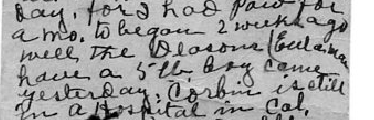
The letters from home almost always contained news of Irondale neighbors.  The renters of the house next door to the Robert W. Dalys (owned by the Dalys) were Isaac and Emma Mae Partain DeasonBelow in her own handwriting, Pearl, wrote of the Deasons gaining a new addition to their family.  'Ike' ran an Irondale automobile service station at the time.  The person Corbin may have been a son of Minnie Mae Partain, who also lived at 2006 3rd Avenue North in Irondale.  Later that autumn, the family moved out of their Daly rental, evidently with hard feelings on both sides.

Next More Letters, War News and Bishop transfers to a Destroyer....

Have questions about Holliman family history? You are invited to join the Hollyman Email List at Hollyman-Subscribe@yahoogroups.com and the Hollyman Family Facebook Page located on Facebook at "Hollyman Family". Post your questions and perhaps one of the dozens Holyman cousins on the list will have an answer. For more information contact Tina Peddie at desabla1@yahoo.com, the list and Facebook manager for Hollyman (and all our various spellings!).

Or join your many cousins at MyFamily.com and view an expanded Holliman family tree and many files on the history of the family. Just write to glennhistory@gmail.com for an invitation.

Sunday, December 1, 2013

How a World War Changed an Alabama Family, Part 12

by Glenn N. Holliman

A War Time Visit and a Wedding!

In the first winter of World War Two for the United States, the conflict went very badly for the U.S. and Allies.  In January 1942, the Japanese Navy rampaged in Southeast Asia with European colonies, one after another, falling before the onslaught of ships and soldiers.  The U.S. colony of the Philippines remained under siege, MacArthur and his troops being pushed into a corner of Bataan.  The Germans remained deep in Soviet territory, and the Nazi general, Rommel, continued to occupy a huge portion of North Africa thereby threatening British forces in Egypt and the all important Suez Canal. 

With German U-boats devastating the merchant tanker fleet off the U.S. East and Gulf coasts, it was critical for the U.S. Navy to build ships, man them and send them into battle against this menace.  One of the hundreds of thousands of young Americans being trained that dreary winter was Bishop Holliman of Irondale, Alabama.  By mid-January, he was learning the hows and wherefores of sonar operations, those sound waves emanating from surface ships that bounced off submarines and revealed their presence, allowing for the dropping of boat killing depth charges.  His duty station was Key West, Florida. 

In those anxious days, not knowing when they would see Bishop again, members of his family drove the hundreds of miles from Alabama to the tip of Florida to visit for a long weekend of January 30 - February 1, 1942.

Below, The Rev. Charles T. Ferrell, his mother-in-law Pearl Caine Holliman, Ralph Holliman, his sister Loudelle Holliman Ferrell, and Ulyss S. Holliman in an unusual pose.  Bishop Holliman must have taken this photograph along a beach at Key West, on an unusual blustery, chilly day in the sub-tropics.

In order to visit Bishop, his mother, father, one sister, a brother-in-law and a brother, missed the wedding of another family member, Virginia Holliman who on Janaury 30, 1942 married her high school boy friend, Walter Cornelius of Birmingham, Alabama. The wedding took place in the Irondale home of her sister, Vena Holliman Daly and brother-in-law, Robert W. Daly, Sr

The young couple below....Pearl Caine Holliman, Virginia's mother, had objections to the marriage, generally based on cultural differences between the two families.  Pearl and Ulyss had become conservative evangelical Christians in the 1930s, leaving the Irondale Methodist Church, which they believed to be too liberal. 

They joined the Gospel Tabernacle in Birmingham, a Christian and Missionary Alliance church pastored by a flamboyant radio evangelist, Glenn Tingley, who in 1934 pioneered in the deep South the proclamation of a fundamentalist gospel over the air waves.  Biblical literalists, Pearl and Ulyss did not believe in intoxicating beverages, card playing, movies on Sunday or dancing.  Walter's father ran a cross roads store in Shelby County, Alabama and his family was much more tolerant of such activities.

Born 1922 in Irondale, a working class suburb of Birmingham, Virginia had a successful high school experience at Shades Cahaba in Homewood, Alabama, probably one of the best secondary schools available in the state at the time.  She excelled in scholarship, led the debate team, was president of several clubs and editor of the yearbook.  After graduation in 1940, she started Howard College. 

Virginia caught a gleam of what a woman could achieve in a new age, and Walter, ambitious himself, represented a route to a larger life.

Her parents had been born in the 1880s, and poorly educated in rural schools in Fayette County, Alabama.  There was a generation and education gap between parents and child, and further gap growing between urban and rural cultures and religion.  And there was a war on, and young people married quickly before the Armed Forces separated them.


Below, Pearl Caine and Ulyss Holliman with their son, Bishop Holliman, in his U.S. Navy uniform at Key West.  Photographs indicate Pearl, b 1887, 55 years old when this picture was made, aged rapidly during the war.  Three of their sons and Walter Cornelius would be posted overseas. Ulyss was 58 when this picture was taken. In addition to her handbag, Pearl is holding coconuts.
 
 
From the 1942 Diary of Bishop Holliman, Sunday, February 1 - "Met the folks at 9 a.m. Went to church and ate dinner with the Reviers (a church family). Rode around in the afternoon.  I drove for the first time since I left home. Made pictures (see below).Went to church that night.  Charles preached good sermon.  (Charles Ferrell, a Methodist minister, must have been invited into the pulpit that evening.) I left the folks about 11 p.m.  Bid them good bye - sad parting."

 
Above, on the beach in their Sunday best, Ralph Holliman, b 1924, who was in his senior year of high school at Shades Cahaba.  A year later his Army draft number would come up, and he would marry his high school sweet heart, the second member of the family, but not the last, to marry during the war.  Left to right - Ralph, Charles Ferrell, Bishop Holliman and his father, Ulyss S. Holliman.
 

From the Diary of Bishop Holliman, 23 February, 1942 - "Received orders to leave - me to New Orleans.  Assigned to P.C. (patrol craft) boats."
 
Next off to New Orleans and a change of plans....
 
Have questions about Holliman family history? You are invited to join the Hollyman Email List at Hollyman-Subscribe@yahoogroups.com and the Hollyman Family Facebook Page located on Facebook at "Hollyman Family". Post your questions and perhaps one of the dozens Holyman cousins on the list will have an answer. For more information contact Tina Peddie at desabla1@yahoo.com, the list and Facebook manager for Hollyman (and all our various spellings!).
 
Or join your many cousins at MyFamily.com and view an expanded Holliman family tree and many files on the history of the family.  Just write to glennhistory@gmail.com for an invitation.

 Since early 2010, I have been publishing research and stories on the broad spectrum of Holliman (Holyman) family history at http://hollimanfamilyhistory.blogspot.com/ . For stories on my more immediate family since the early 20th Century, I have been posting articles since early 2011 at http://ulyssholliman.blogspot.com/ .  GNH