Showing posts with label Rebecca Holliman Payne. Show all posts

Wednesday, April 1, 2020

A Visit Between Two Storms

by Glenn N. Holliman

On March 3, 2020 a vicious late-winter tornado touched down in Nashville, Tennessee, hop-scotched along I-40 east and destroyed homes in the suburbs of Cookeville, Tennessee.  There 18 persons died in just a few minutes of horror.

Fortunately my sister Becky Holliman Payne and her family who live in that Cumberland Plateau community escaped the violence and quickly joined hundreds of others in providing relief to those afflicted.  A long scheduled trip to visit cousins and our old home places in Alabama had been planned with my sister, Alice Holliman Murphy and me.  We  were to fly from our domiciles in Texas and Pennsylvania respectively to Nashville on March 5th and then drive south.

As the Nashville airport was open and professional first responders were busy at work, we decided to go ahead with our plans.  We met that afternoon of the 5th, and the three of us drove  to Florence, Alabama.

Little did we know that one storm was behind us and another, more dangerous, approaching!

The next morning, we spent much of the day with our first cousin, Bob Daly, son of Robert W. Sr. and Vena Holliman Daly at his home north of Florence.  His home is really a nature conservancy where for decades Bob has nurtured his 40 acres as a wildlife park.

Pictured are Alice, Becky and Bob.


A  Ph.D. in biology and botany from Auburn, Bob taught for decades at the University of North Alabama and also conducted hundreds of environmental studies for governmental and corporate agencies.  It is not an exaggeration to say that Bob is one of the most knowledgeable persons living concerning the flora, fauna and animal life of the Tennessee River Valley.

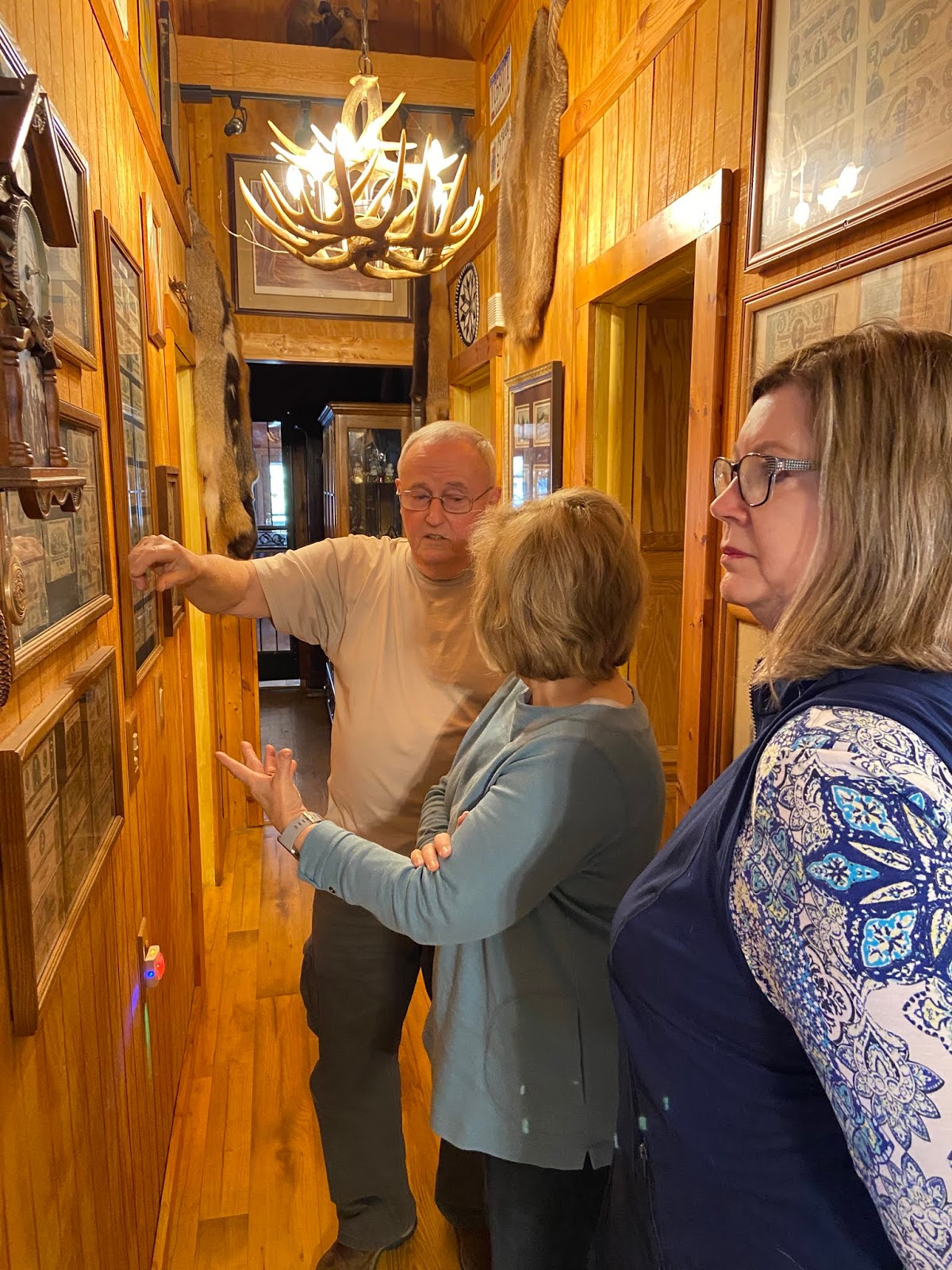
His home, which he shares with his wife, Joy, his high school sweetheart from Irondale, Alabama, reflects Bob's taste in outdoor life.  The home feels like a comfortable forest lodge with wooden paneling, chandeliers of antlers and walls festooned with scenes of wildlife and southern history.

Below the Daly 'lodge' in the woods of North Alabama.

Bob bands hummingbirds, captured in a special trap filled with sugar water on a back porch.  Generally he attracts up to 400 of these tiny birds each migration season!  The ladies are watching a video on his computer of dozens of these beautiful creatures feeding.


Outside on the grounds, two cousins, now seniors in life, reminisce on how we used to hunt arrow heads along Alabama river bottoms and scorpions under the scrub oak trees on the Daly farm in Irondale, oh say 60 years ago or so!


Below are photographs I have saved (and hundreds and hundreds more of family) from the various  albums.  Here is a quick trip down memory lane of Bob and family in the 1940s and 50s.  The initial picture is of Bob in the sailor's hat, one year old me and my mother, Geraldine Stansbery Holliman (1923-2015), on the front lawn at 2300 N. 3rd Avenue in Irondale, our grandparents house.


The one below is damaged, but shows Bob on the left,  Pam Holliman in the center, Ralph and Motie Holliman's first born.  Three year old me on the right. The year is 1949.   Again photographed at Ulyss and Pearl Caine Holliman's Irondale home.  Judging from the way Pam and I are dressed, this must have been a Sunday in the summer.


Below, Bob, Becky and Glenn at Daytona Beach, Florida in 1955. Grandmother Holliman had died in May 1955, and the Dalys and  Bishop Hollimans took Ulyss Holliman on vacation.  I remember a day of fishing with my grandfather, father and Bob. Below we are digging for sand fleas.


Finally, Bob with his father, Robert W. Daly, Sr. (1901-1959) and his mother, Vena (1909-1990).  The family loved to visit Florida and fish.  These experiences no doubt helped develop Bob's life long interest in biology.


After the better part of the day with Bob, and significantly increasing our knowledge of nature's mysteries,  my sisters and I bid goodbye to our very knowledgeable first cousin, and drove on to Gadsden, Alabama where we lived from 1960 to 1964.  More on our trip in the next blog. - GNH 


Tuesday, November 13, 2018

An Alabama Family in World War II, Part 41

The Run Up to the Invasion of Europe
By Glenn N. Holliman

April 15, 1944, my father, Bishop Holliman (1919-2018) received a ten-day leave in Boston after another tiring convoy trip to and from the European Theater. He took the occasion to train to his home in Irondale, Alabama. 

Crowded, the trip took the better part of two days to make the journey.  It took another two days back before his leave expired on April 25th, hence only six days home.

Left in 1940, 20 year old Bishop Holliman, right and his friend, a Methodist minister, Paul Nelson Propst.  Bishop would name his son, Glenn Nelson Holliman, after Paul with whom he maintained contact for the rest of Paul's life, one of the few pre-war friendships Bishop was able to maintain after the service.

The length of Bishop's military obligation, 3 years and 10 months, had weakened most of Bishop's many Methodist Church relationships.  Charles Ferrell helped Bishop gain employment as a youth assistant for the North Alabama Methodist Conference, a job that enabled my father to pay much of his way through three years of Birmingham-Southern College from 1937-1941.  

'Big Mama' was the family name given lovingly to The Rev. Charles Ferrell's mother. My Uncle Charles was assigned to the Ensley Highlands Methodist Church in the fall of 1944 after a pastorate in Huntsville, AlabamaLeft to right are Charles H. Ferrell, his mother Loudelle, her daughter Carolyn and Mrs. Ferrell in black.


He had hoped to see his sister, Loudelle Holliman Ferrell (1914-1998), who lived in Huntsville, Alabama with her husband, Charles, a Methodist minister and their children – Hal, Carolyn and the latest addition, two-year-old John Melton.  Time and distance did not permit a visit.  His brother-in-law Robert Daly, Sr. observed in his letters that gasoline rationing now limited most civilians to three gallons a week.

Bishop, who had been at sea for much of the past eight months, was fatigued.  Generally, on his destroyer, the USS Barker, he was on radio duty for four hours on and four hours off around the clock.  He wrote Loudelle that he probably would not try to return home again between sea duty unless he had longer leave time, that the emotional experience of saying good bye to his parents and loved ones, and the coming and going was wearing on him. 

The truth is Bishop’s world had enlarged beyond his childhood home and experiences.  Forty years later he wrote by late 1943, he finally felt at home in the Navy, had learned his job and had some buddies on the USS Barker.  After 2 ½ years in the military, his world had grown larger – numerous trips to the Mediterranean and others up and down the Eastern Seaboard.  He had met persons from all over the United States, persons of different cultures and faiths (or no religious traditions).  For my father and millions of other, the war expanded personal horizons.
 
Right, Bishop Holliman and his brother Euhal at the Vena Daly home in Irondale, Alabama in 1967. Note the hats worn by men in that era!

His return north-bound train did stop in Attala (Gadsden, Alabama) and his brother Euhal (1912-1989) and his family, wife Edna, and children Jerry, Terry and Anne, turned out in their Sunday best to greet Bishop for the few minutes as passengers got off and on.  My father wrote how touched he was by their short visit.  Euhal, the father of three children and with a fourth on the way (Jean born 1944), was called up for his physical but not conscripted that spring of 1944, probably due to his family responsibilities and his health.  He had suffered debilitating rheumatic fever as a baby.

 
Below at the home of Bishop Holliman in 1954, Johnson City, Tennessee.  Far left and far right, twins born 1940, Jerry and Terry Holliman, Euhal's sons and middle, left and right, Glenn N. Holliman, b 1946 and Rebecca Holliman Payne, b 1950, all preparing for a game of baseball in the front yard.  Jerry and Terry had traveled with their grandparents from Alabama to visit.  Bishop was a field representative for the Social Security Administration, and made numerous relocations in the 1950s and early 1960s.  We lived in Johnson City from 1952 to 1957.

His brothers Melton and Ralph (stationed in England), both worried Euhal might be drafted and hoped he would not be due to the above noted reasons.  Although 17 years of age separated Melton (b 1908), the oldest son of Ulyss and Pearl Caine Holliman, and Ralph (b 1925), the youngest son, the four brothers were close emotionally.

Their sister Virginia’s husband during that spring, Walter Cornelius in the Army Air Corp was training in Mississippi and Tennessee.  The Holliman family as with millions of others were now dealing with a long war, one that did not yet suggest an end in sight. 

Unknown to the American public, hundreds of thousands of these soldiers, sailors and airmen were about to enter major battles in Southeast Asia (Burma), the Pacific (the invasion of Saipan and the Philippines and for the Holliman sons, France (D-Day and the sweep across France).  Before the summer and fall of 1944 would pass, tens of thousands of American homes would be receiving dreaded telegrams from the War Department announcing the deaths of their sons.

Melton (1908-1958) who wrote daily from England to his wife, Ida (1905-1995), remarked in early April 1944:

“Of course Honey, you know how much I miss you and Patsy, b 1942.  I am glad you have her with you; she is so sweet.  We are fighting for the loved ones at home.  That is the reason we are here. So that she and you can live peacefully, and she can grow up unafraid.”


Above in 1942, Melton and Ida Hughes Holliman.  Melton wrote daily while in the Army to Ida and their young daughter, Patti (whom Melton called Patsy). 

By late May, Melton was complaining that he had moved ten times since arriving in England, that the mail had slowed and that he was stationed at a port (evidently on the English Channel, a jumping off post for the Invasion). Finally, on June 2, 1944 he had received a temporary assignment in his military occupation, a pharmacist.

From finishing his training in January 1944, Melton had been traveling and waiting, moving and waiting, perhaps not realizing that hundreds of thousands of other men also were moving into position for the June 6th Invasion of Europe.  Historians have noted that the U.S. military in England was like a ‘coiled spring’, tightly wound and ready to be unleashed on a Nazi occupied continent.  Melton, Ralph and Bishop were all part of the great enterprise that was about to free western Europe from tyranny. 

Left, Bishop's son, Glenn, b. 1946 passing through the Straits of Gibraltar, October 2018, 75 years after his father made the same journey to the Battle of Sicily, and 74 years after Bishop sailed through on June 5/6, 1944.

The night of June 5, 1944 my father’s destroyer approached the Straits of Gibraltar moving from east to west, once again on convoy duty.  

That day, the U.S. Army liberated Rome.  

The next morning, Bishop Holliman would hear over the ether waves the alert for all U.S. ships that the great invasion of France was on.  He and millions of others hoped against hope that the end of the war was drawing neigh. We know the brutal conflict would continue for another 11 months in Europe and Japan would not surrender until August 1945.

And Melton would be a casualty before the year of 1944 was out.