Sunday, May 18, 2014

How a World War Changed an Alabama Family, Part 21

by Glenn N. Holliman

Brothers Visit and Babe Ruth Swings...

From the Memoirs of Bishop Holliman - "I remember seeing Euhal (1912-1989) and Edna (1916-1992) (Holliman) and their twin sons, Terry and Jerry (1940-2003), at the train station in Attalla, Alabama one time, or maybe more, as the train stopped there.  The Birmingham Special or the Pelican on the Alabama Great Southern line.  They lived in Gadsden, and Euhal worked at the Jitney-Jungle food store."  Below right, Terry and Jerry in 1941 in Irondale, Alabama at their grandparents.


"Euhal and Edna were not inclined to write and I seldom heard from them.  I have two letters written in 1942.  Euhal had gotten a 10% raise and hoped he would get more, as nearly all the men in the store had been drafted.

 Terry and Jerry (twins born in 1940) were the only children they had then, and Euhal commented on how they growing.  Indicative of how people thought then was a remark from Euhal in a letter: 'Terry and Jerry say for you to them a Jap!'"

In 1965, Euhal and four of his siblings gathered at Vena Daly's home in Irondale, Alabama.  Left to right, twenty years after World War II and now almost fifty years ago, are Euhal Holliman, Vena Holliman Daily, Bishop Holliman, Loudelle Holliman Ferrell and Ralph Holliman. Notice the narrow ties of the men, and Loudelle's stylish sun glasses!


"While stationed in Philadelphia in 1942, I took a liberty to New York City and chanced upon a special event that would standout in my memory forever more.  A special Old Timers baseball game was played at Yankee Stadium (August 23, 1942) on Sunday afternoon and I received a free ticket...I guess from the USO, to the game."


"The stadium was full, I remember and the two big name 'old-timers' were Babe Ruth and Walter Johnson.  So I could always say I saw two of the greatest even though it was not in a regulation game.  The Babe was the last to be introduced, and when he came out of the dugout, believe me, the stadium rocked and roared!  Walter Johnson pitched to him and he hit several into the right field stands and then circled the bases.  The crowd cheered.  It was indeed a thrill to see all of them.  I have forgotten who the others were, but Johnson and Ruth I did not forget." - Bishop Holliman Memoirs


That game played on August 23, 1942 was filmed by Movietone News and can be found today on You Tube.  Over 69,000 were present that day, and $80,000 was raised for the Army-Navy Service Fund. Above, middle right the Babe circles the bases and acknowledges the crowd.  Ruth was 48 years old then and had six years to live before dying from cancer.


Next More Stories from an Alabama Family during World War II....

 Have questions about Holliman family history? You are invited to join the Hollyman Email List at Hollyman-Subscribe@yahoogroups.com and the Hollyman Family Facebook Page located on Facebook at "Hollyman Family". Post your questions and perhaps one of the dozens Holyman cousins on the list will have an answer. For more information contact Tina Peddie at desabla1@yahoo.com, the list and Facebook manager for Hollyman (and all our various spellings!).

Or join your many cousins at MyFamily.com and view an expanded Holliman family tree and many files on the history of the family. Just write to glennhistory@gmail.com for an invitation


Saturday, May 3, 2014

How a World War Changed an Alabama Family, Part 20

by Glenn N. Holliman

The Destroyer...the Weapon to Defeat the U-Boat and a Chance Meeting of a future Wife!

Until the spring of 1943, the German submarine was the greatest threat of Nazi tyranny to deny United States supplies and troops bound for African and European battlefields.  Hundreds of allied ships were torpedoed in the Atlantic.  Uncle Sam's chief weapon to defeat this undersea armada was the destroyer, a  speedy, heavily armed, pint-sized vessel especially built to escort convoys and drop depth charges on the enemy.

In August 1942, H. Bishop Holliman of Irondale, Alabama, was assigned to the USS Butler, 643, built and launched at the Philadelphia, Pennsylvania Navy Yard.   This sleek, brand-new, state of the art ship was commissioned on 15 August 1942.  Radio seaman Holliman and 206 other sailors went aboard to make this ship their home and to prepare it for the North Atlantic.


Left, in February 1942, ship yard builders worked over time to construct the Butler.


Below, a painting of this Gleaves class ship, over 2,000 tons loaded.  She had four 5 inch guns, depth charges, machine guns and two torpedo tubes.  She was in the invasion of Sicily, numerous conveys and finally took battle wounds in the Pacific.  Ironically at age 3, in 1945, with the War won, she was stricken from the Navy inventory and in 1948 was broken up for scrap. 

It took several months to prepare the Butler for its first shakedown cruise. In the meantime, sailors had time for weekend passes. For a young man from Alabama, the northeast with its big cities of Philadelphia and New York were exciting and historic places to visit and enjoy. 

 In one weekend trip to Manhattan, Bishop took in a NBC radio show, the Army-Navy Hour at Rockefeller Center studios. He was selected from from the audience to participate in a singing performance and managed to warble a tune. For this he won a Ronson cigarette lighter. He mailed it to his brother, Melton Holliman, a smoker. 


Left, this 1942 photograph of two sailors jumping for joy on their skates at the ice rink at Rockefeller Center captured the mood of many service men who were able to experience the sights and sounds of New York City. Millions of young Americans were seeing parts of their country for the first time. 

This movement of people had vast consequences for many, including my father who decided one weekend, September 12th, to visit Irondale buddy, Charles Pugh, then a serviceman,  stationed at Atlantic City, New Jersey. 

Bishop Holliman never met up with Charles that weekend but he did chance to meet a 19 year old from Philadelphia, a girl recently relocated north with her family from Bristol, Tennessee.  That teenager's name was Geraldine Stansbery, a young lady who later became this writer's mother in 1946.  Ah, the fortunes of war!

Right, Gerry in 1942 at her Philadelphia home.  Born and raised in East Tennessee, when her brother-in-law Vance Sherwood, who was married to Louise Stansbery, took a transportation job in Pennsylvania, Gerry and her mother, Mayme Osborne Stansbery moved with them.  Mayme's marriage to Charles S. Stansbery had ended in 1933.

Bishop and Gerry's marriage took place June 26, 1945 in Philadelphia, a war time romance with lasting consequences, especially for this writer and my two sisters.


Next More Stories from an Alabama Family....

 Have questions about Holliman family history? You are invited to join the Hollyman Email List at Hollyman-Subscribe@yahoogroups.com and the Hollyman Family Facebook Page located on Facebook at "Hollyman Family". Post your questions and perhaps one of the dozens Holyman cousins on the list will have an answer. For more information contact Tina Peddie at desabla1@yahoo.com, the list and Facebook manager for Hollyman (and all our various spellings!).

Or join your many cousins at MyFamily.com and view an expanded Holliman family tree and many files on the history of the family. Just write to glennhistory@gmail.com for an invitation


Sunday, April 13, 2014

How a World War Changed an Alabama Family, Part 19

by Glenn N. Holliman

More of the Summer of '42....

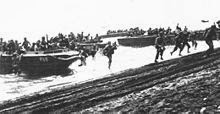
In the War, the Germans closed in on the Russian city of Stalingrad, named after the Russian Communist leader, Joseph Stalin.  In the South Pacific, the U.S. Navy and Marines began a counter-attack on the Japanese Empire.  The island was called Guadalcanal, and it became the focal point of the Pacific War for almost half a year.   

During late June of 1942, inner ear trouble forced my father, Bishop Holliman of Irondale, Alabama, out of the Navy Air Corp in New Orleans.  He went on duty logging airplane training flights and keeping watch over an office.  For a while he was able to move off base and lived in a rooming house enjoying 'civilian' life to a modest extent.  The Air Corp had raised his sights, and he began to dream of becoming an officer in the Merchant Marine.


 However, before a transfer could be arranged between services, the Navy posted him to the U.S.S. Butler, a new destroyer about to undergo its initial shake down cruise out of Philadelphia.  So it was good bye to the South and new adventures and a new military service occupation - an apprentice seaman, a radioman, bound for action in the North Atlantic. 

Bishop took the Alabama Great Southern train from New Orleans to his duty station.  He knew when he would pass through his home town Irondale, Alabama, and so alerted the family.  The train would not stop but at the appointed time, Lula Hocutt Caine, Bishop's 81 year old grandmother, stood on her side back porch on 2nd Avenue in Irondale where she could see the train roar through.  She  vigorously waved a white towel. 

My father saw the flapping towel, even though his grandmother could not see him.   

In his memory, he sees her to this day.  Right, Bishop Holliman in 2010, 68 years later, standing in front of the former home of Lula Hocutt Caine (1861-1957).

His sister, Vena Holliman Daly (1909-1990), and her family managed a vacation in Daytona Beach, Florida that summer.  Right, Vena and her daughter, Mary Daly Herrin, right with unidentified girl on the left.  Vena wore a kamona to protect her self from the Florida sun in this 1938 photograph. 
 
Brother-in-law Robert W. Daly, Sr. wrote that the beach was nearly deserted, only 1/4th the tourists compared to earlier summers.  It would be their last Florida vacation for the duration of the war.  

Due to the lack of tires and fuel, the Daly family had taken the train.   In the book "Forth to the Mighty Conflict, Alabama and World War II" author Allen Cronenberg states that between March and May of 1942, the whole state had only new 1,366 tires!  Because of  this rationing, Robert Daly, Sr. parked his car and started taking the bus to his bank manager's job in Woodlawn.

Loudelle and Charles Ferrell welcomed a new son to their family that summer, a boy named John Melton.  The new baby's uncle, Melton Holliman, sent his namesake a silver cup and spoon as a birth present.  Charles was pastor of the Methodist Church in Jacksonville, Alabama. Right, John Melton Ferrell, age 1 in 1943.  

Below in the 1930s, Melton Holliman giving his niece, Mary Daly Herrin a ride on a bike.  Mary's expression seems to indicate some unease with her precarious position in the basket!  Melton was told by his Mobile, Alabama draft board that summer of 1942 that he, a 34 year old that year, could expect to be called up for service in 1943. 


Author Allen Cronenberg states that over 320,000 men enlisted or were drafted from Alabama during the war.  Three would be Holliman brothers of Irondale - Melton, Bishop and Ralph.  A fourth brother, Euhal, was called up but excused due to parenthood (four children by 1944) and a possible health issue.

Next an Alabama sailor in the Northeast....

Have questions about Holliman family history? You are invited to join the Hollyman Email List at Hollyman-Subscribe@yahoogroups.com and the Hollyman Family Facebook Page located on Facebook at "Hollyman Family". Post your questions and perhaps one of the dozens Holyman cousins on the list will have an answer. For more information contact Tina Peddie at desabla1@yahoo.com, the list and Facebook manager for Hollyman (and all our various spellings!).

Or join your many cousins at MyFamily.com and view an expanded Holliman family tree and many files on the history of the family. Just write to glennhistory@gmail.com for an invitation


.

Friday, March 28, 2014

How a World War Changed an Alabama Family, Part 18

by Glenn N. Holliman

Letters from Home....the Summer of 1942

By June 1942, the German army had resumed its invasion of the Soviet Union, driving deep into the Caucasus and advancing on Stalingrad.  In the Pacific, the American Navy inflicted a decisive and war turning defeat on the Japanese Navy at Midway.  Four Japanese carriers were sunk to the loss of the USS Yorktown.  There would be no more Japanese advances, and gradually as resources permitted, the United States began to counter attack.  Below the Yorktown carrier after taking a dive bombing attack, June 5, 1942.

Below, a sample from the letters my father H. Bishop Holliman received from family in Alabama while based in New Orleans in the U.S. Navy.  In late June 1942, ear trouble forced him out of the Navy Air Corps.  He hoped to stay in New Orleans on shore duty, but Uncle Sam soon had other ideas.

"Bishop, still hope you will be able to stay in the Air Corp.  Is your ear any better?  I hope you will be able to do what you want to do.  I'd think twice about the Merchant Marine...if I were on the ocean, I'd rather be on a battleship." -  Melton Holliman, June 21, 1942

  Below, Melton and Ida Hughes Holliman, parents of Pattie Holliman Hairston.


 Melton wrote his younger brother again: "Sorry you couldn't stay in the Air Corp, but I don't want you up there where you have trouble hearing...stay where you are in base as long as you can.  The subs are sinking too many our ships."- June 28, 1942

Bishop's sister, Loudelle Holliman Ferrell wrote:  

"We just received a card from Mama telling us the good news that you will be in New Orleans for the duration and will not be flying.  It certainly was good news.  I feel like God has answered our prayers.  Charles said that you were too fine a boy for anything bad to happen to you. We don't know what you will be doing but it is a happy thought you will no longer be in danger." - June 28, 1942.   Mama was Pearl Caine Holliman (1888-1955), my grandmother.

Below, The Rev. Charles T. Ferrell, Loudelle Holliman Ferrell and their two children, Charles Halford and Carolyn Ferrell Tatum at their Jacksonville, Alabama parsonage during part of World War II.  Charles T. Ferrell, a Methodist minister, had degrees from Birmingham-Southern College and Yale Divinity School.  The moderate Methodism, most of the Holliman family embraced in the 1930s and 40s, occasionally created some tension with their religiously fundamentalist parents, Pearl and Ulyss Holliman.


Remarkably Loudell wrote in 1942 what I was able to confirm seventy years later in my family research. 

 "I read where Ezekiel Holliman baptized Roger Williams in Rhode Island in 1639.  William in turn baptized Holliman and 11 others.  This the establishment of the Baptist Church in America.  Of course we will have to claim Ezekiel as one of our ancestors!" 

Ezekiel and our branch of the family share a distant great grandfather from Cuddington, Buckinghamshire, England, probably from the early 1500s.

Bishop's Aunt Vista Caine Humber Robbins Gumpp (1898-1986) of Irondale wrote a revealing letter also that summer.  "How are doing in the air corps?  I bet every minute is interesting.  I've always wanted to fly. O' to be a man now.  Women never get a break.  I'd much rather be in the thick of it than sitting home worrying, honest!  Mother is well, bless her heart.  She will soon be 81.  I hope the good Lord spares her many more years.  No one will ever know how much I would miss those phone calls from her.  I saw my grand daughter and believe me that is the best looking kid I ever laid my eyes on.  Shut yo, mouth Grandma!" - June 21, 1942  Mother was Lula Hocutt Caine, b. 1891, this writer's great grandmother.

 The grand daughter referred to in Vista's letter is Pattie, the girl on the left in the photograph below.  Dorothy Humber Prince, Vista's daughter, in the center, holds her new child, David, on her lap and Bobby Prince on the left in this post World War II Christmas card.
 

A decade younger than her sister, Pearl, Vista's approach to life was more of the 1920s.  Bishop remembers her as a 'flapper', one who drank, smoked, enjoyed the company of young men and not a church goer.  The paragraph from the above letter captures a bit of her effervescent, dynamic approach to life.   

Mary Daly Herrin has spoken of an estrangement between the two sisters, one that required Mary, at the request of her grandmother, Pearl, to write to Vista on at least one occasion when Vista and her third husband, Fred Grumpp, lived in Indianapolis, Indiana.  Mary's husband, E.C. Herrin, believes elements of Vista's personality were captured in several of the characters Fanny Flagg created in the book, Fried Green Tomatoes, based on a the Fortenbery's 1930s Irondale cafe.


Whatever the differences between the sisters, the surviving siblings of Lula Hocutt Caine (1861-1957, Grandma Caine to her many great grandchildren), gathered for a photograph in the early 1950s.  Front row is Floyd Caine (1883-1966) and his mother, Lula.  Back row staring grimly are Pearl and Vista.  There was only a decade's difference between Pearl and Vista, but the younger sister on the right could have passed for her daughter.


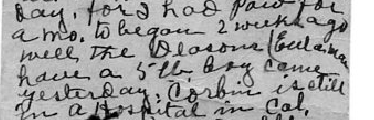
The letters from home almost always contained news of Irondale neighbors.  The renters of the house next door to the Robert W. Dalys (owned by the Dalys) were Isaac and Emma Mae Partain DeasonBelow in her own handwriting, Pearl, wrote of the Deasons gaining a new addition to their family.  'Ike' ran an Irondale automobile service station at the time.  The person Corbin may have been a son of Minnie Mae Partain, who also lived at 2006 3rd Avenue North in Irondale.  Later that autumn, the family moved out of their Daly rental, evidently with hard feelings on both sides.

Next More Letters, War News and Bishop transfers to a Destroyer....

Have questions about Holliman family history? You are invited to join the Hollyman Email List at Hollyman-Subscribe@yahoogroups.com and the Hollyman Family Facebook Page located on Facebook at "Hollyman Family". Post your questions and perhaps one of the dozens Holyman cousins on the list will have an answer. For more information contact Tina Peddie at desabla1@yahoo.com, the list and Facebook manager for Hollyman (and all our various spellings!).

Or join your many cousins at MyFamily.com and view an expanded Holliman family tree and many files on the history of the family. Just write to glennhistory@gmail.com for an invitation.

Sunday, March 16, 2014

How a World War Changed an Alabama Family, Part 17

by Glenn N. Holliman


Battles in the Pacific and an Irondale Blackout....

During the first months of 1942, Japanese military advanced virtually unhampered through Southeast Asia.  With much of the American fleet resting on the sea floor of Hawaii, the Japanese Navy dominated the South Pacific.  That began to change in May 1942 with the Battle of the Coral Sea off the coast of Australia.


In May 1942 the Japanese Navy was advancing on Port Moseby, the front door to Australia.  The U.S. Aircraft carriers, Yorktown and Lexington, engaged in the first ever exclusive air dual between opposing ships. Both nations lost a carrier, but the advance of Nipponese fleet was effectively thwarted and Australia was safe from invasion. Below the crew of the valiant Lexington abandon ship.

Nerves on the home front were jittery.  May 20, 1942, Irondale, Alabama experienced a practice blackout.  In a letter to my father, H. Bishop Holliman, my grandmother, Pearl Caine Holliman (1887-1955), expressed her excited feelings to her only son then in the service during World War II.   At this time, Bishop was training to be a pilot in the U.S. Navy Air Corps.  His family at home was worried.

 "Dear Bishop - 10 o'clock we have just had a blackout.  We did not know we were going to have it, so we did not where the bombs were coming or not til after it.  Was all over and then they said it was a trial blackout.  One or two in Irondale did not turn all lights out til the last minute.  All these air raid wardens had a time.  I don't what we would have done if the planes had begun to fly over."


 Right, Robert W. Daly, Sr. (1901-1959) in his air raid warden hat standing beside his father-in-law, Ulyss S. Holliman (1884-1965) at 2300 3rd Avenue North, Irondale, Alabama.


By the middle 1930s, Pearl and her husband, Ulyss, had left the Methodist Church in Irondale due to theological differences to attend worship services at the Tabernacle, an emotional, evangelical, Bible-based congregation in Birmingham.  The pastor was one Glenn Tingley, one of the first radio preachers in the South. 


My grandmother's letters often reflected her earnest religious feelings.  During the spring and summer of 1942, her son, Bishop, was stationed in a city not known for conventional Protestant values - New Orleans, Louisiana!  Pearl was not only worried about her son's physical safety; she was worried about the temptations of the French Quarter!

"I will always wonder what you did Saturday night and Sunday.  May you always remember you are a Christian and not go any place you would not take Christ with you.  Now that is all I have to say."

On one occasion that summer of 1942, Bishop was able to visit home on a quick leave and fly back to New Orleans from Birmingham.  Commercial flying was still in its infancy in 1942 and considered a dangerous adventure.  His Mother wrote him of her worries and faith.
 
"We were so anxious to hear how you enjoyed our ride (flight).  I do believe Dad got a bigger thrill than you did.  I tell you (he) was really going.  I do believe I would take a ride in one now if I had the price.  I was not worried about you at all...we went to the Tabernacle.  Dad went to the men's prayer meeting and I went in the women's so they all prayed for you, and I knew you would be okay.  We went to hear Dr. Ham, and I want to tell you. He says we have one thing to do and only one and 'that be ready to meet Jesus.'  Wish ever one of you children could have heard him.  I mean 'heard' him!"

Left, Bishop Holliman  with a sailor friend and several girls in New Orleans on a Sunday afternoon spring 1941.  My father, far right in the photograph, is in his spiffy uniform and looks straight into the camera.  The girl looks a bit coy and is holding hands with the other sailor.  

As with millions of others during the War, Bishop met persons of many different faiths or no faith traditions, some with high ethical values, others with few.  Higher education and travel were changing the views of an Alabama family.

 Right, his brother, Melton and sister-in-law Ida Holliman visited Bishop while he was stationed in New Orleans that spring and summer.  A pharmacutical salesman living in Mobile, Alabama, Melton would be drafted into the Army in August 1943 at the age of 35.

Another son of Pearl and Ulyss's, Ralph Holliman, would join the Army in March of 1943.  Pearl wrote of his last days of high school in a letter to Bishop, reflecting how proud she was of both sons.   "Ralph has been busy with his test paper.  He is to be toastmaster at the Irondale banquet, the same one you was last year."  

 
Above, Ralph's 1942 graduation announcement from Shades Cahaba High School in Homewood, Alabama.  He received the Spanish American Legion Award and the a Jerusalem pen for work done on the school newspaper. In a few months, he would see his name posted in the Irondale Selective Service office.

Next posting, more letters from home....


Have questions about Holliman family history? You are invited to join the Hollyman Email List at Hollyman-Subscribe@yahoogroups.com and the Hollyman Family Facebook Page located on Facebook at "Hollyman Family". Post your questions and perhaps one of the dozens Holyman cousins on the list will have an answer. For more information contact Tina Peddie at desabla1@yahoo.com, the list and Facebook manager for Hollyman (and all our various spellings!).

Or join your many cousins at MyFamily.com and view an expanded Holliman family tree and many files on the history of the family. Just write to glennhistory@gmail.com for an invitation.

Saturday, February 22, 2014

How a World War Changed an Alabama Family, Part 16

by Glenn N. Holliman


In early April 1942, the U.S. began to fight back, more symbolically than effectively, with an air strike on Tokyo and other Japanese cities.  General James H. Doolittle led 16 B-25s off the deck of the USS Hornet on a pin-prick raid on Japan that had enormous consequences. 
Morale in the U.S. soared as the first pay back for Pearl Harbor although Corregidor, the last American holdout in the Philippines, soon fell.  The Japanese, infuriated by an attack on their homeland, first launched their armies deeper into a China killing tens of thousands in a land that harbored the downed U.S. pilots.  Tojo's government then ordered the Japanese Navy to turn eastward to capture the Midway Islands, the suspected launching site of Doolittle's raid.  The Battle of Midway would become a major turning point in the Pacific War.


State-side the Armed Forces continued to train and prepare a generation of young Americans to carry the war to the Axis powers - Japan, Germany and Italy.  One young Alabamian was my father, H. Bishop Holliman of Irondale, Alabama.  His story continues.

Above, in his flying gear, Bishop entered into U.S. Navy flight training in New Orleans in late April 1942.  From his journal - "Started classes - very tough - math, physics, aerodynamics, meteorology, drill, really working us.  Same schedule through out the week.  Sunday, May 5th, on duty all day. Same all week.  Letters and newspapers make the time pass quicker and more endurable - Air Corps much better than Navy - boys are nice.

20 May - Started flying - went up one hour - very nice, classes in morning and night.  Flying and studying remainder of week.  Flying and studying (week after week).  Being treated for ear trouble."  
The ear trouble would doom his flying career, but we will come back to that later.  Above, the BT-13 Valiant was built by the thousands for the Navy and Army Air Corps during the war.  This is airplane Bishop trained in during the spring of 1942.
 
Civilian folks had to cope with the War also Robert W. Daly, Sr., Bishop's brother-in-law, wrote that spring - "Remember all our funds go to the USO, Red Cross, Community Chest, defense bonds, Stamps for Soldiers, the Salvation Army, home defense & etc.  The average person at home does not have any savings after meeting living expenses.  So don't be discouraged; we are all in the same boat. You don't need to worry about your Birmingham gals because there are no boys left to go with them."

Robert's letter, as with millions of letters during the War, carried news of home town folks.  For example, Archibald Jones, son of the Irondale Methodist Church minister married that April to Sadie Christine, a marriage that lasted to Archie's death in August 1997.  Sadie died in 2010.  Dick Petty, born 1917 and a former manager of the local grocery, was en route to Australia when his 66 year old mother, Mary Petty of 2nd Avenue in Irondale, died of heart failure.  Robert Daly served as one of the pall bearers.


Right in 1940 at Cheaha State Park, the highest point in Alabama, back row, Bishop and Ralph Holliman, brothers.  Front row, Vena and her daughter, Mary Daly Herrin, and far right, Irene Petty whose brother served in Australia during World War II and whose mother died in 1942. Irene served for a while as postmistress in Irondale.  She died in 1978 in Birmingham, Alabama.


Next more Training and News from the Home Front....

 Have questions about Holliman family history? You are invited to join the Hollyman Email List at Hollyman-Subscribe@yahoogroups.com and the Hollyman Family Facebook Page located on Facebook at "Hollyman Family". Post your questions and perhaps one of the dozens Holyman cousins on the list will have an answer. For more information contact Tina Peddie at desabla1@yahoo.com, the list and Facebook manager for Hollyman (and all our various spellings!).

Or join your many cousins at MyFamily.com and view an expanded Holliman family tree and many files on the history of the family. Just write to glennhistory@gmail.com for an invitation.


Monday, February 3, 2014

How a World War Changed an Alabama Family, Part 15

by Glenn N. Holliman

From Subchaser to Flight School...and the Home Front....


In the spring of 1942, the wave of Japanese conquest in the Pacific rolled on.  General Douglas MacArthur was ordered out of the Philippines, but he vowed to return.  The embattled American army and Filipino troops were pushed from Bataan to Corregidor for a last stand. Australia, deeply worried about the Nipponese juggernaut bearing down on the nation, welcomed the arrival of 30,000 U.S. troops in March of that year.  The Japanese navy even penetrated the Indian Ocean to Ceylon (Sri Lanka) and sank the British carrier Hermes.  

In those dark days, the United States rushed to build weapons and train young men for war on many fronts.  One of the millions mobilized was my father, H. Bishop Holliman, of Irondale, Alabama, a suburb of the steel city of Birmingham.


After his  first leave ended, he reported back 5 April 1942 to his duty station in Algiers, Louisiana, home of a U.S. Navy training base.  Bishop took a physical and joined as a trainee in the Navy Air Corps. 


Letters from home remained important to the boys in the service.  Bishop's Mother, Pearl Caine Holliman wrote often and filled her letters with news of relatives and friends in the close-knit community of Irondale.  What follows are exerts from letters written in March and April of 1942.  These comments about persons at home are undoubtedly typical of millions of other epistles in that era.  She writes of other young men whose lives were disrupted by the war.

"Mother is better for the last few days and she may make it after all.  Dr. Odom thinks she will get better when the weather gets warm."  Mother was Lula Hocutt Caine, 1861-1957, Grandma Caine to the generations that remember her.  Her father, Manassas Hocutt, died at the Battle of Stones River in Murfreesboro, Tennessee, January 1863. Lula married William Lee Caine of Fayette County, Alabama and had four children to grow to maturity - Floyd, Pearl, Maude  and Vista


Below, this photograph is from the early 1920s, probably taken in Irondale.  The writing of the identifications of Vista, Maude and Pearl is that of H. Bishop Holliman.


Below, an earlier photograph, perhaps 1904 and taken in Fayette County, Alabama - back row, left to right are Maude (1893-1940), Floyd (1883-1966) and Pearl (1887-1955).  Front row, Lula's mother-in-law, Melissa C. Anthony Caine, 1829-1913.  Vista (1898-1986), Lula and William Lee Caine (1862-1938).  In the 1910s, William took a job as a railroad guard in Irondale.  His children, two of them married, soon followed with their families.  With this move, the Caines and Hollimans left their farms and took jobs in transportation.   This may be the only known photograph of my great, great grandmother, Melissa Anthony Caine.


"Vista is worse; I don't know what Ralph will do with her."  Her younger sister, Vista Caine Humber, lived in Irondale and may have been having marital issues with her first husband, Ralph.  Cousin E.C. Herrin believes the never-seen character, Vista, in the movie Fried Green Tomatoes may have been inspired by the real Aunt Vista.  The book, "Fried Green Tomatoes" by Alabamian Fannie Flagg, was based on the life and work of Flagg's great aunt, Bess Fortenberry who owned the hot dog stand, later Irondale Cafe of the 1930s. Bess's brother, Ed Fortenberry, owned a local grocery store. Below Vista, her daughter Dorthy and her niece, Vena Holliman Daly, in the early 1930s at Lookout Mountain, Chattanooga, Tennessee.  Note they are touring wearing formal clothes and heels!

"Your Uncle Lee Cooke has not married yet."  
Lee Cooke was the husband of Pearl's sister, Maude Caine.  Maude had the misfortune to contract polio as a child.  Her family moved to Irondale from Fayette, Alabama and lived in the house on the hill just above the Ulyss and Peal Hollimans.  In the 1930s, Lee and Maude moved to St. Claire County, Alabama.  After Maude's death in 1940, Lee remarried. 

"Charles Ferrell has a call to Fairfax, $200 a year more and a larger church."  
A Methodist minister with a Yale Divinity degree, Charles was an up and comer in the North Alabama Conference.  His wife, Loudelle, was Pearl's second daughter.  Below, Charles Halford, Charles T. Ferrell, Carolyn Ferrell Tatum, John Melton and Loudelle in 1942.  Actually in 1942, Charles was assigned to Huntsville, Alabama


"The Jones have moved into the house with Runyans while the parsonage is built."  The Rev. L.L.  Jones was the Irondale Methodist minister, age 52.  The Runyans were members of his congregation.  Renfro Runyan, age 53, ran the local water plant.

"The Hamiltons went to see Drayton, who is assigned to a subchaser."  John W. Hamilton of Irondale was a county tax collector, an elected position and one that paid a salary of $5,000 a year, a princely sum in 1942.  Their son Drayton (1916-1990) became an attorney in Montgomery, Alabama after serving in the Navy from 1940 to 1948.  His wife was Hilda Sims (1914-2001).  Drayton's sister, Mary Virginia Hamilton, was a good friend of Virginia Holliman Cornelius (1922-2011).

"Ralph Byram left Sunday for Atlanta." Ralph, headed to Ft. McPherson for Army induction, was the son of Joseph and Lena Byram who lived at 2223 3rd Avenue North in Irondale. Joe in 1940 worked for the Works Progress Administration (W.P.A.), a New Deal agency created to provide employment and public works.

"Ralph has a new suit; trying to get him ready for his speeches."  Ralph Holliman, b. 1924, was the last of seven children of Pearl and Ulyss Holliman's children to leave home.  After graduation from Shades Cahaba in May of 1942, he would be drafted into the U.S. Army in 1943 and serve in England and France.


Ralph, b 1924, visiting his brother, H. Bishop Holliman, b 1919, in Key West, Florida, February 1942.

Next the Philippines Fall and a Sailor begins flight training....


 Have questions about Holliman family history? You are invited to join the Hollyman Email List at Hollyman-Subscribe@yahoogroups.com and the Hollyman Family Facebook Page located on Facebook at "Hollyman Family". Post your questions and perhaps one of the dozens Holyman cousins on the list will have an answer. For more information contact Tina Peddie at desabla1@yahoo.com, the list and Facebook manager for Hollyman (and all our various spellings!).

Or join your many cousins at MyFamily.com and view an expanded Holliman family tree and many files on the history of the family. Just write to glennhistory@gmail.com for an invitation.