Sunday, April 24, 2016

The Loss of a Vietnam Veteran

by Glenn N. Holliman

The Loss of a Veteran....

As many of you know, I have been writing in the space about my return to Vietnam, that war of my youth.  There were millions of us, mostly young men in the 1960s, who were in an out of that conflict over a multi-year period.  One of those U.S. Army Vietnam veterans, a career soldier, was Joel W. Phillips, married to my first cousin, Anne Holliman Phillips.  Anne is the first born daughter of my late uncle and aunt, Euhal and Edna Westbrook Holliman.

Joel (pictured left), born 1942, died this past Saturday, April 23, 2016 after a long illness.  As his wife Anne says, he is no longer suffering.  At this writing Anne is in their Dothan, Alabama home, surrounded by her three children and numerous grandchildren.  The military honor service will be held Tuesday, April 26 in Houston County, Alabama, Joel's childhood and adult home.


Anne remembers that Joel at a Mobile, Alabama Mardi Gras one year told her he had rather be in a bunker in Vietnam than at the festival!  I suspect there are many career soldiers like Joel, a 22 year plus veteran, who found much purpose in military service.  (Right, Joel's mother, Bertha Lee Sanders Phillips)

I got to know Joel better at the last reunion in Orange Beach, Alabama at Al and Linda Herrin Bradley's home (which they kindly opened to dozens of Hollimans for a weekend).  

Joel shared pictures of his children and grandchildren which I scanned into my computer, and filed in my Euhal and Edna Holliman, Irondale, Alabama folder.  He was exceedingly proud of his family, and took great pride in their success and well being.  (Joel and Anne in 2007)

We lost Joel's  father-in-law and mother-in-law in 1989 and 1992, but I know Euhal and Edna would have been proud also of these descendants, just as they were very proud of the lives of their own six children - Terry, Jerry, Anne, Jean, Tommie and Bill.

So as Joel goes to his next roll-call, this Vietnam veteran, who served all of two years, 1/10th of Joel's time, delivers him a well-earned salute and thanks him for his service to his country and family.  

Survivors include Ann Phillips; sons, Michael (Jenifer) Phillips and Jeffrey (Karri) Phillips; daughter, Nancy (Bobby) Justice; grandchildren, Serra Justice, John Justice, Alex Phillips, Lexie Phillips, and Hannah Phillips; great-grandson, Rylan Brennecke.  Anne kindly gave me permission to write this article.

Tuesday, April 12, 2016

After 46 Years...a Trip Back in Time, Part 13

by Glenn N. Holliman

Memories continued of a war in 1969....

By 1969, the U.S. Army felt the strains of a war that was dividing America, a protracted struggle in Vietnam.  The year for my service, January 31, 1969 to January 30, 1970, was shared with over 540,000 other Americans.  My Army division, the famed 1st Infantry of World War I and II combat, was composed mainly of draftees and career officers serving a second tour of duty in country.


Right, 22 years old, skinny, a college graduate in Lai Khe, Vietnam.  I had most of my life yet to be lived....

I remember composing a letter while on day time guard duty in a tower over looking a portion of the perimeter of Lai Kai, headquarters for the Division and 3rd Brigade.  In that epistle I noted that for four years the Division had occupied territory 40 miles of so northwest of Saigon, pushing against the Cambodia border.  And for four years the same ground had been contested between the U.S. forces and Viet Cong and North Vietnam troops.

True, the U.S. never lost a full-blown battle, but the night belonged to the V.C. The mighty pay loads of our B-52 bombers could blow apart tunnel complexes of the enemy, when such could be found. Our technology was overwhelming when an adversary would stand and fight, but this was a different, confounding war.

A 1st Infantry bunker with action in the background outside the perimeter. 1969

The V.C. fought the war against American conventional might, not in stand up battles, but rather by controlling the villages in the dark, ambushing high value targets such as convoys and forever harassing the Army and then disappearing into the bush or jungle. 

The North Vietnamese took horrific casualties, but just as had George Washington with the British, they had only to remain a force in being, and to wait until the Americans tired of the loss in blood and treasure and went home.

And that is exactly what happened.

In 1969, moral among U.S. troops was slipping.  I remember one night in barracks hearing a loud explosion, not incoming mortars or rockets, but that of a grenade.  A young officer, overbearing with his enlisted men, had been 'fragged' by one of his troops, i.e. a live grenade rolled into his quarters.  Wounded, he lived.  

Drugs were becoming a problem.  I remember waking up in the middle of the night at a Fire Support Base by a young lieutenant rummaging through the medic's bag looking for pain killers.  Another night walking through the barracks, waking soldier's for guard duty, I stumbled across troops smoking dope.  

Another time I discussed with the enlisted men in the field what it was like to patrol in the bush. 

 "Our 2nd lieutenant said he had only one mission here and that was to keep us alive until we could all go home."  

The desire to engage and defeat an enemy was rare among the troops in 1969.   Being a senior enlisted man or conscientiousness officer was not easy with an army of draftees.  Not easy when the USA was torn apart by anti-war marches and race riots.  The 1960s were destructive for America.  Our nation had a lot of self-inflicted wounds.   

Above and below, a patrol on Thunder Road, aka Highway 13.  In 1969 a muddy track and conflicted.  By 2015, a paved highway was lined with apartment and business office complexes!


 The government in Saigon, propped up by U.S. monies and supplies, was wobbly and the Army of the Republic of Vietnam (ARVN) loath to expend itself.  The will to win lay with North Vietnam, fighting a classic war of independence and a perceived puppet government still control by westerners.  The South Vietnamese soldier above had his military intelligence office next to our chaplain's office in the 3rd Brigade Headquarters, Lai Khe.


 That Christmas of 1969 the famed quintessential comedian of the 20th century, Bob Hope, came to Lai Khe came to entertain us.  He brought some pretty girls and Neil Armstrong who had been the first man to step on the Moon five months before.  In was incongruous - one of human kind's greatest feats justipositioned with one of human kind's great tragedies - warfare.


Bob Hope, a conservative patriot, announced to us that President Richard Nixon had a plan to end the war.  Amazingly the troops - thousands of us - booed.  Hope was taken aback, confused and stuttered, 'Yes, he really has a plan.'  The writing was on the wall; the army of draftees had had it.  We just wanted to go home.  

Below, the Bob Hope field after the 1969 show before being 'policed'.  A mail transport lands on the Lai Khe airfield.  The company mess hall in the picture on the left.

In 2015, I walked the same ground, exactly where the above picture was taken in 1969.  Below are rubber trees that now cover the same field.  The mess hall long since gone.  Left to right Dr. Jim Holliman and his wife Karen and my daughter, Grace who accompanied me on this emotional journey.


Next posting, more as an aged veteran returns and reflects....

Monday, March 14, 2016

After 46 Years...a Trip Back in Time, Part 12

by Glenn N. Holliman

I continue with photographs of 1969 and 2015, a nostalgic, emotional return to my 1st Infantry base camp in Lai Khe, Vietnam.  My daughter, Grace, and two cousins - Dr. Jim and Karen Holliman, kindly accompanied me.


From Fire Support Base Oran, elements of the First Infantry await their helicopter lift into the boonies, February 1969.

Left, Lai Khe -  damage to our barracks from a V.C. rocket attack.  Below, a Viet Cong wounded POW being carried by medics to surgery.

.
Below, approximately 8 miles from the Chu Chi Tunnels, elements of the 1st Infantry move toward Fire Support Base Lorraine near Ben Cat.   This desolate landscape had been doused with Agent Orange and worked over by massive plows to clear the tree lines.  Nineteen million gallons of herbicides had been sprayed on the Vietnam countryside, defoliating 12 million acres of forests and damaging the soil of millions of acres of farms. (The Tragedy of Vietnam by Patrick J. Hearden)  

 Ironically, I took this picture the same day in July 1969 that Apollo 11 landed on the moon.
The juxtaposition of humankind's progress and degradation disturbs me to this day.

Below, June 1969, I was on guard duty around the perimeter at Lai Khe.  A Vietnamese village bordered the camp on the north.  In the middle of the night, the Viet Cong attacked with rockets.  As they traveled at less than the speed of sound, one could here them coming.  The noise was that of a locomotive drawing nearer and louder.  I slammed myself down next to the concrete culvert pictured below.  The houses, a hundred or so feet away, behind the wire were hit; five Vietnamese nationals died.  


I heard their screams.  I still hear them a half century later.     
Right, March 2015, my daughter stands with me where I point out where I was guarding that night so long ago.   Grace was born five years after that event.  
I am a most fortunate man.


Next post, more memories of an old man returning to the Vietnam-American War....

Thursday, March 10, 2016

After 46 Years...a Trip Back in Time, Part 11

By Glenn N. Holliman

In 2015, I returned to Viet Nam with my daughter, Grace Holliman, and two cousins, Dr. Jim and Karen Holliman.  My reflections continue....

Two generations have been born since my year in the Vietnam-American War, January 1969 to January 1970.  My service was with the 1st Infantry Division, a storied outfit that fought during World War II in North Africa, Sicily and stormed the beaches at Normandy.  In 1943 at the beach head in Gela, Sicily, my father's destroyer lay off shore and plummeted the German armor that came close to pushing the Big Red One into the sea.

Above in Lai Khe, Vietnam, 2015, left to right - Jim and Glenn Holliman and Grace and Karen Holliman. Below, a Fire Support Base, Aachan II in May 1969 near Lai Khe. The 'fire' from the 105 artillery pieces supported companies on patrol.


Now his son, born three years after his Sicily battle, would spend time at Fire Support Base Gela, named after the earlier battle. When I arrived in 1969, the division had been in country four years, basically sticking to base camps and night defensive positions, patrolling the bush and setting ambushes at night. The Americans and the South Vietnamese owned the day; the North Vietnamese and South Vietnamese communists (Viet Cong in the vernacular of the time) controlled the night.


During the darkness, the enemy would leave their tunnels at Chu Chi, tote rocket propelled explosives outside our Lai Khe base and fire them at random. Most of the time they missed but too often they destroyed people and property. The picture shows clean up after a direct hit on a Lai Khe bunker.

Most Americans living today have little idea how traumatic the 1960s were to our country. An undigested long overdue Civil Rights movement roiled the nation. Peaceful protests demanding greater freedom for African-Americans shook the halls of Congress and led to the destruction of racial segregation.  Unfortunately rage in the inner cities resulted in riot after riot during the warmer months of those years.  


Right below summer 1966, the Rev. Ralph Abernathy, assistant to Martin Luther King, prays during a march through Mississippi at signs demanding the impeachment of Earl Warren, chief justice of the U.S. Supreme Court and another criticizing King.


Ironically, black and white soldiers fought together in Southeast Asia, as the USA tried to live into a great meaning of freedom for its minority citizens.  It was a turbulent, polarizing time. Divisions in the early 21st Century in this country are tame by comparison.


Below, 1st Infantry military police in Lai Khe passing a bunker, 1969.


We are born in to a time and place in history, and my time has been that of the post World War II era, the Cold War and now a protracted conflict with Islamic extremism.  My brother- in-laws and I served in the Cold War era (of which Vietnam was a part), and my nephews in Iraq and Afghanistan. 

U.S. interventions such as Vietnam and Iraq have not been wise, both conflicts self-selected by the American government in response to perceived threats.  Certainly in the case of Vietnam in the 1960s there was an over reaction to communist ideology and not enough confidence that the capitalistic system would prevail over centrally directed economic autocracies. And not enough knowledge of the long history of an ancient culture and peoples.

Below right a 1969 ambush on Highway 13 north of Lai Khe.  We called it Thunder Road, an unpaved dirt strip in 1969.  Compare if you will the same road in 2015, lined with business parks, sidewalks and lush fields.  The highway toward Cambodia is now paved with traffic lights and development.  The killing fields I knew have blessedly turned into homes and industry.


Over 55,000 Americans died in Vietnam and an estimated 1 million North and South Vietnamese.  For those of us, the 3 million plus Americans who rotated in and out of the long running conflict - 1963 to 1975, the time in country has been seared into our consciousness.  


The veterans of that war are thinning out as Mother Nature takes her toll.  Here is more of my story, one of millions. May future governments think very hard before they send young men and women into harm's way.  Many support wars when they begin; many fewer do so when the conflicts go on and on and on.


Above, fire, destruction and American G.I.s on Thunder Road, 1969

###############################################################

To know more on this conflict, one might read Patrick J. Hearden's well-named 2005 publication, The Tragedy of Vietnam.


Next post, more 1969 and 2015 photographs of one old soldier's memories....


Monday, February 29, 2016

After 46 Years...a Trip Back in Time, Part 10

by Glenn N. Holliman

In this post, I record the sites and my feelings of returning to my 1969 base camp in Lai Khe, Vietnam.  As a young man, I served for a year as a chaplain's assistant with the 3rd Brigade, 1st Infantry Division, U.S. Army.  My duties involved pulling guard, time in the field at the Division's fire support artillery bases (FSBs) and night defensive positions (NDPs) and clerk of the office. I feared returning in 2015 would be emotional.  It was.


Below left in 1969, simple dirt roads en route to Lai Khe from Saigon.  Below right in 2015, a four lane highway with attractive middle division of flowers flanked by modern construction. 


 Left, 1969, the body of a North Vietnamese soldier killed in night action, left along the highway a few miles south of Ben Cat, which by 2015 was a four lane highway with flanking shops and residences.   As if a war had never passed that way.

Below right, the former Michelin rubber plantation of Lai Khe from the air in 1969.  Top of the photo shows the defoliated open country side.  Highway 13, then a dirt two lane road runs through the camp.  The open space top right is the air field.

Below left, the HQ of the 3rd Brigade, 
former French rubber plantation offices, in
1969 our office and barracks. In 2015 all had
been razed and replaced by a business park.


Above left, the perimeter of Lai Khe in 1969.  From time to time enemy rocket fire would descend on the base, several times while I was on guard in the night.  Above right in red, an old man of 68 years stand in the rubber of Lai Khe and remembers being 22.      

More in the next post on the return to youth and conflict.

Saturday, February 13, 2016

After 46 Years...a Trip Back in Time, Part 9

by Glenn N. Holliman


This memoir of a return to Vietnam after forty-six years had passed since a young soldier served with the 1st Infantry Division, US Army, continues with photos and thoughts of southern Viet Nam then and today....

  March 13, 2015, Friday, Saigon

Up early for a 6 am shuttle, three and half hours to Ha Noi airport.  Stop half way at a gift shop/café and have coffee strong enough to walk.  To modern airport and a snack.  Then emails and at 1:15 pm board Vietnamese Air to Saigon or Ho Chi Minh City.  Again a modern Viet Nam Airlines Airbus 320.  Two hours later we arrive, met by our Northfolk Hotel driver.  The Norfolk, a la 1991, an Australian owned hotel, only three blocks from the ornate Belle Epoch period, the Cathedral, 1880, dedicated to Mary, Mother of Jesus by the French colonialists.

I saw Saigon from the air before landing at Than San Nhah.  Incredible…it was Manhattan, Singapore, whatever –high rises, skyscrapers and apartment complexes.  Even a golf course.  This city is a combination of Paris and Miami.  Capitalism is every where – garish flashing neon signs, bank building, communication hubs, etc. and a nod or two to the liberation of 1975.  I am feeling very old.

Only when we checked in and looked at a map, and I asked the location of the former American embassy did the desk clerk ask me if I had been there in the war.  Yes, I said, a long time ago. 

Check in and cousins Karen, Jim and I walk around the Cathedral Square, taking our aim at an Asian open air restaurant.  I have again rice and prawns and half a bottle of French wine.  Back to my large, air conditioned room.  Caution in the bathroom – do not drink the tap water.  Ho Chi Minh City, not yet there.


Saigon Cathedral in 1969 and in 2015 with my daughter Grace and high rise buildings.


It was called Saigon in 1969, the mid point in America's ill-fated over reach to stem 'the tide of international communism'.  During my 365 day tour of what was then the Republic of South Viet Nam, over 500,000 troops from a USA population of perhaps 225,000,000 poured resources into what was a civil war among an ancient culture and nation.

Although stationed 40 miles or so north of Saigon in a rubber plantation called Lai Khe (just north of Ben Cat), as part of my duties, I visited the capitol city three or four times.  Below are some views of Saigon then and today.

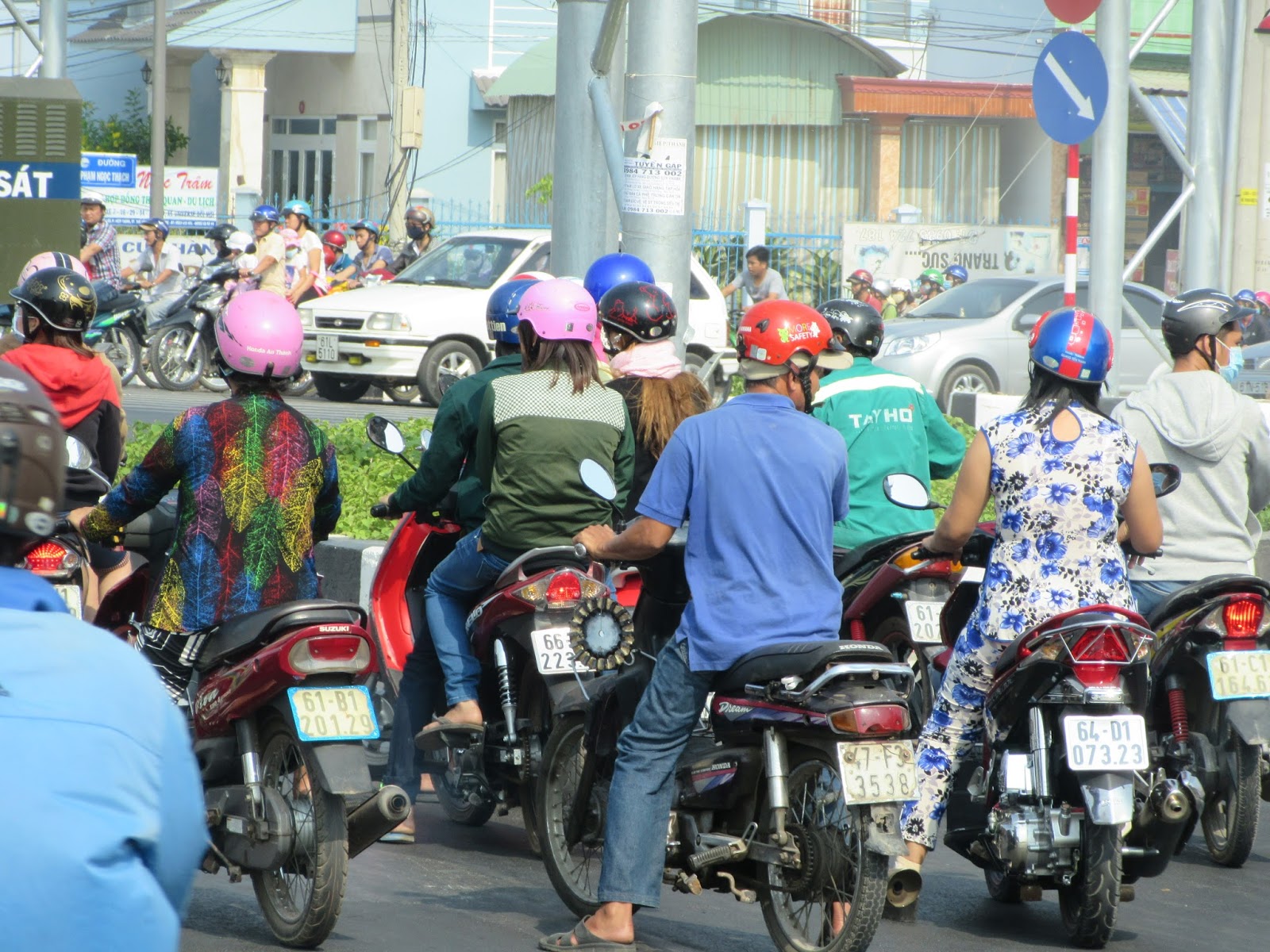
Right, Saigon street scene in 1969; left crowded  streets and motor bikes in 2015.


The National Assembly building in 2015 and 1969.  Below, South Vietnam soldier guarding Saigon bridge in 1969, a city one year removed from the devastating Tet Offensive that soured America on the conflict. 


With cousin Karen and daughter Grace, 2015 and a warm March evening in Ho Chi Minh City.  Below right, passing a movie theatre in 1969.


Below, street scenes from 1969 including a young lady in blue in her ao dai, the Vietnamese formal and office wear for women.


En Route from Saigon to Long Binh, through Ben Cat and back to Lai Khe, one passed this haunting South Vietnamese military cemetery and statue in 1969.  The tragic war ended in 1975 with the collapse of the government once supported by the United States.  Over 55,000 Americans and an estimated one million Vietnamese died between 1962-1975.


Next post on this Viet Nam memory tour is the return to my Army base, 3rd Brigade, 1st Infantry, US Army, Lai Khe, SVN.