Sunday, July 14, 2013

How a World War changed an Alabama Family, Part 5

by Glenn N. Holliman

Summer 1941

22 June 1941, full of hubris and more than mildly insane, Adolph Hitler launched his war machine east against the Soviet Union.  Earlier that spring, his Wehrmacht had swallowed the Balkans, Greece and Crete and joined the Italians in North Africa.  German foreign minister Von Ribbentrop wrapped Nazi arms around Hungary, Bulgaria, Romania and Finland.  Britain, supported by her dominions Canada, Australia, New Zealand and South Africa, stood on the continental fringes of Europe facing foes Italy and Germany. 
German Panzer IIIs invaded Russian in what most of the world thought would be an easy conquest.  It was not to be.
n Panzer III tanks close to a border battle near Brest-Litovsk on June 22
Mad with ambition, a loathing of communism, racial and religious hatred and swollen with excessive confidence in his armies, Hitler hurled over 3 million men against another sadist dictator, Joseph Stalin, the communist autocrat of the largest geographical nation on the planet.  The battle of two titans commenced, and the world held its breath.
In the United States the World War would soon reach out and engulf an Alabama family....
 
The year before, 1940, Walter Cornelius, second row, far left in coat and tie, graduated from Shades Cahaba High School in Homewood, Alabama.  His future brother-in-law, Ralph Holliman, Class of 1942, sat near him in the middle of this group picture in the white and black shirt with the collar.  In early February 1942, Walter married Virginia Holliman, also Class of 1940.  Both Walter and Ralph would serve in the U.S. Army during the war - Walter in Saipan and Ralph in France.


From the memoirs of Bishop Holliman of Irondale, Alabama - "In the summer of 1941, I went back to Lake Junaluska, attended the Methodist Youth Conference at Montevallo College (and was elected president and interesting to note, my opponent was Howell Heflin, later U.S. Senator from Alabama) and worked intermittently at Hill's Grocery in Irondale, Alabama.  I am afraid I did not dwell a great deal on the prospects of the U. S. entering the war even that terrible summer in Europe."

Below Bishop Holliman 'concentrating' on his religious duties at  the Methodist Conference Center of Lake Junaluska, North Carolina in 1941.
In August 1941, a letter from his draft board sent Bishop scurrying back from a vacation in Florida with the Daly and Ferrell families. Checking in, Bishop was told he would be called in the fall.  Not anxious to join the U.S. Army, Bishop enlisted in the U.S. Navy, ready to go at a later date.

In the meantime, a girl friend, Gloria Zackey, who was a secretary  for Sloss-Sheffield Steel and Iron Company on 1st Avenue in Birmingham, recommended him for a temporary job, filing in chronological order cancelled checks.  "I was paid 75 cents an hour and thought a $26 a week pay check was pretty good."

Above, ten year old Mary Daly (Herrin) in a bathing cap suits typical of the period holds hands at Daytona Beach, Florida, August 1941 with her cousins Carolyn (Tatum) and Charles Halford Ferrell. The war would soon bring such vacations to a screening halt for most Americans.  Vena Holliman Daly and Loudelle Holliman Ferrell were Bishop, Virginia, Euhal and Ralph Holliman's sisters.

That same August, President Franklin D. Roosevelt rendezvoused in Newfoundland by ship with Prime Minister Winston S. Churchill of the United Kingdom.  Their military leaders met, and from the meetings at sea, was issued the Atlantic Charter, a just vision of a post-war world, declared boldly before the U.S. was formally in the war. Below, Roosevelt, Churchill and their staffs on the deck of the HMS Prince of Wales.

And again that summer of 1941, generally not noticed by many Americans, the State Department, utterly disgusted with Japan's continued war and invasion of China, initiated an embargo of the selling of U. S. petroleum to Japan.  For the militaristic government of Japan without oil, the clock began to tick rapidly toward a decision either to seize supplies in the Dutch East Indies or acquiesce to U.S. demands to cease their four year invasion of China. 

The government of new Prime Minister Hideki Tojo, a Japanese army general, refused to consider a withdrawal from China, and began plans to confront the U.S. militarily. Japan would decide to secure by violence the resources needed to maintain their military and civilian economy.  Time was running out in the Pacific, while most U.S. eyes were focused on the North Atlantic and Europe.  Below the Prime Minister of Japan who authorized the attack on Pearl Harbor.

"For ten years, Japan had been front page news, but I was not cognizant of how big a threat she was and I know that in the summer of 1941, I did not view that country as an enemy we would soon fight.  I guess all our attention was on Europe and I simply did not foresee future conflict with the 'Rising Sun'.  In later years I wondered how I could have been so uninformed - or ignorant - about what was happening in the Pacific." - Bishop Holliman
Next Posting, a Holliman joins the Navy....

Have questions about Holliman family history and associated families? You are invited to join the Hollyman Email List at Hollyman-Subscribe@yahoogroups.com and the Hollyman Family Facebook Page located on Facebook at "Hollyman Family". Post your questions and perhaps one of the dozens Holyman cousins on the list will have an answer. For more information contact Tina Peddie at desabla1@yahoo.com, the list and Facebook manager for Hollyman (and all our various spellings!).

Since early 2010, I have been publishing research and stories on the broad spectrum of Holliman (Holyman) family history at http://hollimanfamilyhistory.blogspot.com/ . For stories on my more immediate family since the early 20th Century, I have been posting articles since early 2011 at http://ulyssholliman.blogspot.com/ .

If you have photographs, letters, memorabilia or research you wish to share, please contact me directly at glennhistory@gmail.com. Several of us have an on-going program of scanning and preserving Holyman and related family records. Thanks to the Internet, we are able to scan, upload to the web (with your permission) and return the materials to you.
Announcing also a "Seminar and Site" gathering October 18 and 19, 2013 in Fayette, Alabama for Hollimans and associated families whose ancestors are from that area. Space at the Rose House Inn is limited for the occasion due to a football weekend. For information, contact me at glennhistory@gmail.com. GNH


Tuesday, June 25, 2013

How a World War changed an Alabama Family, Part 4

by Glenn N. Holliman

 1940...the Storm Grows....
At this time in his life two decades after the Great War, Bishop Holliman was, as were millions of other Americans, an isolationist, one who wanted no involvement in European conflicts.  This opinion was shared by many during the late 1930s and early 1940s. 

However, by summer 1940 Czechoslovakia, Poland, France, Belgium, the Netherlands, Norway and Denmark had fallen before the Nazi war machine.  These frightening events  moved more and more Americans to support rearmament and aid to England.  Great Britain stood alone against increasing fears of a world dominated by an aggressive government of Germany, a militant Japan and a Mediterranean bully, Benito Mussolini's Italy. Collectively, these were the Axis powers of World War II.  Below the two dictators who lost their lives in 1945 in the conflagration they initiated.
 

Ulyss and Pearl Holliman  of Irondale, Alabama were devout Christians, and had raised their family as Methodists.  Their second daughter, Loudelle, married a Methodist minister in 1935, Charles T. Ferrell, born in Mississippi, and educated at Birmingham-Southern College and Yale Divinity School.  Loudelle and Charles helped Bishop obtain a part time job as youth director with the North Alabama Methodist Conference in the late 1930s.  This work - several summer youth conferences and his own deep commitment to the Christian faith - are evident in Bishop's pacifistic and humane opinions captured in memoirs written in 1991:

"And so it was as the clouds of war loomed ever more ominous on the horizon that I was a student at Birmingham-Southern College, having entered in 1937.  During those years I was very active in youth activities in the Methodist Church, and a principle focus in those times was 'world peace'.  At all of our youth conferences, programs, and camps, ironically one of the courses would be labeled, with some variations, 'World Peace."- H. Bishop Holliman, 1991
  
 
 Above, Christmas 1940, young Charles Halford Ferrell tries out his new Greyhound wagon for his parents, The Rev. Charles and Loudelle Holliman Ferrell.  Loudelle and Charles would write faithfully to her siblings, while Charles pastored Methodist Churches in North Alabama during the war.

 
Bishop along with two brothers, Melton and Ralph and a brother-in-law, Walter Cornelius, were soon to be swept into the growing maelstrom.  War would come to this Alabama family.  Melton (1908-1958) is pictured below with his mother, Pearl Caine Holliman (1887-1955) in the late 1930s in front of the Robert and Vena Daly, Sr. home in the 2300 3rd Avenue North of Irondale, Alabama.  Not a young man, Melton served in the U.S. Army in England, France and Mississippi during 1944 and 1945.  While overseas, his health broke. He died of a heart attack 13 years after the war at the age of only 49.

With the fall of World War I ally France in June 1940, the U.S. Congress passed a conscription act to begin the building of an American army which at that time was one of the smallest in the world.  Later that year, President Franklin D. Roosevelt asked Congress to pass the Lend-Lease bill that gave assistance to Great Britain, aid short of war. 
At the same time, relations between Japan and the U.S. continued to deteriorate.  Japan pursued its war in China, and cast covetous eyes on the Dutch, British and French colonies in southeast Asia.
No matter how isolated the U.S. was in the Western Hemisphere, the world had become a dangerous place.  Led by FDR, Congress began to appropriate massive funds for naval, air and army armament.  However, 'isolationism', remained strong - many Americans did not wish to see the United States once again involved in a European war.

"Remember, we were still living in the shadows of the First World War, and the death and destruction wrought by that conflict were being brought out into the open, and we were able to look back and view the catastrophic horror.  Also, we were learning how the profit motive entered into whether we should go to war, and we were taught that greedy munitions manufacturers profited from the deaths of countless millions.

In the late 1930s and early 40s, I struggled to stay in college and worked part time at the Methodist Youth headquarters at 516 N. 22nd Street in Birmingham.  I was making maybe 25 or 30 cents and hour to fold letters, run the mimeograph machine and do other such menial chores  The job had been designed to aid a ministerial student.  I had been given the job my second year in college by Charles Ferrell, my brother-in-law.

He was Conference Youth Director, so through his beneficence I was able to make a little spending money and stay in school.  My association with the ministers in and out of the office and my participation in conference youth programs strengthened my faith in the 'rightness' of peace and the evils of militarism and war." - H. Bishop Holliman, 1991.


Bishop Holliman, left, sometimes had his mind on items other than religion while attending Methodist youth conferences in Alabama and North Carolina in the early 1940s.  Note the cute blond on the far left.  Dad is in a coat and tie, and oh, those white shoes and pants.
 

Next the War moves closer to this Alabama family....
Have questions about Holliman family history and associated families? You are invited to join the Hollyman Email List at Hollyman-Subscribe@yahoogroups.com and the Hollyman Family Facebook Page located on Facebook at "Hollyman Family". Post your questions and perhaps one of the dozens Holyman cousins on the list will have an answer. For more information contact Tina Peddie at desabla1@yahoo.com, the list and Facebook manager for Hollyman (and all our various spellings!).

Since early 2010, I have been publishing research and stories on the broad spectrum of Holliman (Holyman) family history at http://hollimanfamilyhistory.blogspot.com/ . For stories on my more immediate family since the early 20th Century, I have been posting articles since early 2011 at http://ulyssholliman.blogspot.com/ .

Let's save the past for the future! If you have photographs, letters, memorabilia or research you wish to share, please contact me directly at glennhistory@gmail.com. Several of us have an on-going program of scanning and preserving Holyman and related family records. Thanks to the Internet, we are able to scan, upload to the web (with your permission) and return the materials to you.
Announcing also a "Seminar and Site" gathering October 18 and 19, 2013 in Fayette, Alabama for Hollimans and associated families whose ancestors are from that area. Space at the Rose House Inn is limited for the occasion due to a football weekend. For information, contact me at glennhistory@gmail.com. GNH


Tuesday, June 11, 2013

How a World War changed an Alabama Family, Part 3

by Glenn N. Holliman

A Humorous Letter that captures the Mood of a Divided America....

"I felt we would not enter World War II.  We had learned our lesson, I thought, from the last war.  Surely we would get burned again. So I went merrily on my way, doing my thing, and not worrying very much about the ultimate consequences of what was happening in Europe." - H. Bishop Holliman, 1991, a Navy veteran of World War II

Spurred on by lively conversations with brother-in-law Robert W. Daly, Homer Bishop Holliman, born the year of the infamous 1919 Versailles Treaty, a Birmingham-Southern College student, typed the following tongue-in-cheek letter to himself.  While meant to be humorous, nineteen year old Bishop, captured the ambiguous feelings of many Americans in the autumn of 1939 as Europe once again plunged itself into an abbess.

Notice in the letter, he refers to the divisive issues of the embargo and neutrality which divided the U.S. Congress.  Only with the Japanese attack on Pearl Harbor at the end of 1941 did American public opinion coalesce, and Congress overwhelmingly vote war. 

Above Bishop Holliman, right, with his Methodist pastor friend, The Rev. Paul Nelson Propst in 1940 at a Lake Junaluska, North Carolina religious retreat.   Note the formal wear. Bishop would give Paul's middle name to his son, Glenn Nelson Holliman, in 1946. 

Bishop had been raised in the Irondale, Alabama Methodist Church.  Thanks to his sister Loudelle's husband, The Rev. Charles Tigert Ferrell, he would work several years as youth  coordinator for the North Alabama Conference of the Methodist Church.  This position allowed him to help pay his tuition at Birmingham-Southern College, a Methodist school, from 1937 to 1941.

Below, Bishop's 1939 letter to himself captures his religious and isolationist beliefs as World War II began in Europe.  On September 1, 1939, Germany invaded Poland and reluctantly France and Great Britain declared war on expansionist Germany.


In the late 1930s and early 1940s, thanks to the automobile and paved roads, Bishop and millions of Americans were able to travel and see the United States as previous generations had not been able to do.  Below, inn this 1939 photo Charles Pugh (far left) of Irondale and close friend of Bishop's stand with The Rev. Stewart Butten (far right), having just returned from a Methodist retreat in Knoxville, Tennessee.

 Notice the street at 2300 3rd Avenue, North, Irondale, Alabama is unpaved.  Third Avenue would be paved, ironically, during World War II.  The Ulyss Holliman home is in the background.  The automobile has a running board.  And what natty dressers just returning from a trip, still in white shirts, ties and oh, those white shoes!  A month or so later, Bishop would write the above letter to himself.

Next posting, the World War and the Changing Mood at Home....

Have questions about Holliman family history and associated families? You are invited to join the Hollyman Email List at Hollyman-Subscribe@yahoogroups.com and the Hollyman Family Facebook Page located on Facebook at "Hollyman Family". Post your questions and perhaps one of the dozens Holyman cousins on the list will have an answer. For more information contact Tina Peddie at desabla1@yahoo.com, the list and Facebook manager for Hollyman (and all our various spellings!).

Since early 2010, I have been publishing research and stories on the broad spectrum of Holliman (Holyman) family history at http://hollimanfamilyhistory.blogspot.com/ . For stories on my more immediate family since the early 20th Century, I have been posting articles since early 2011 at http://ulyssholliman.blogspot.com/ .

Let's save the past for the future! If you have photographs, letters, memorabilia or research you wish to share, please contact me directly at glennhistory@gmail.com. Several of us have an on-going program of scanning and preserving Holyman and related family records. Thanks to the Internet, we are able to scan, upload to the web (with your permission) and return the materials to you.


Announcing also a "Seminar and Site" gathering October 18 and 19, 2013 in Fayette, Alabama for Hollimans and associated families whose ancestors are from that area. Space at the Rose House Inn is limited for the occasion due to a football weekend. For information, contact me at glennhistory@gmail.com.  GNH


Monday, May 27, 2013

How a World War changed an Alabama Family, Part 2

by Glenn N. Holliman

1939 - The Storm Rises....

"It was my lot in life to have been born at a time that propelled me into draft age just at the time WWII broke upon the scene.  For several years - since 1937 - we had been hearing about Hitler; we heard his speeches via radio and we read accounts of his threats to absorb all of Europe - 'Today Europe - Tomorrow the world'.  - H. Bishop Holliman, unpublished memoirs written 1991

For my father, Bishop Holliman, a college history major, the new war brought energetic campus discussions, theological talks with his Methodist youth friends and friendly arguments with brother-in-law, Robert W. Daly, Sr.  My Uncle Robert was famous for 'egging-on' his young in-laws, verbally sparing just for the sake of a good argument and on just about any subject.  He helped sharpen their minds and characters during the 1930s.
Bishop was the fifth of seven children, born 1919, and whose life would go in different directions because of the War. Robert was a mentor and 'big brother' figure for the three youngest Hollimans who still lived at home in 1939. In addition to Bishop, Virginia (1922-2011) and Ralph, born 1924, resided at 2300 3rd Avenue North, Irondale, Alabama with their parents, Ulyss (1884-1965) and Pearl Caine Holliman (1887-1955).

Four older children had left the nest earlier.  They were Melton (1908-1958), Vena (1909-1990), Euhal (1912-1989) and Loudelle (1914-1998).

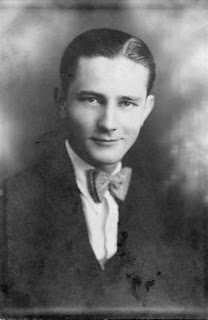
Above, Melton Holliman as a Shades Cahaba High School senior in a natty bow tie.  After graduating in 1927, he began clerking in his Uncle Floyd Caine's drug store.  There he learned the pharmaceutical trade, and made a successful career as a major salesman for Wyeth.  His career was interrupted from 1943 to 1945 with service in the Army and medic duty in England, France and Mississippi.

Robert W. Daly, Sr. was a third generation Irishman, his immediate ancestors only six decades in the States by 1940.  His grandfather, a civil engineer, had helped construct the Alabama Central Railroad.  His father, Karl Daly, had been an Irondale, Alabama farmer.  By the 21st Century, the Daly fields had long been subdivided into large housing tracts for suburban commuters, but the highway bears his name.  Robert left the farm and become a banker in the early 1920s.  

Vena and Robert Daly fishing along the Coosa River in 1938.  Although Vena wore a bandana to protect herself from the Deep South sun, Robert fished in a white dress shirt and tie.  It was indeed a more formal era in the decade prior to the War. 

In 1931 Robert built two brick houses in the 2300 3rd Avenue North block of Irondale, on the steep hill overlooking the railroad switching yard.  Vena, his wife, had come of age in the house next door, the home of Ulyss and Pearl Caine Holliman since 1921. 


Of the seven children, Vena Vivian Holliman Daly was the first to marry in 1928.  Husband Robert, born 1901, wise and full of mischievous good will, managed a bank in Woodlawn, Alabama.
Ulyss moved his growing family from Fayette, Alabama in 1917, seeking employment in the bustling, hard-nosed, blue collar steel city of Birmingham during an earlier World War. He found his carpentry skills in demand by the Birmingham Electric Company that ran the street car line.  From that year until his retirement in 1949, he repaired the wooden trolleys.  In 1953, the last street car ran in Birmingham and an era closed.  But Ulyss had earned enough to support his family during Depression and World Wars. 
By 1939, a new World War had already engulfed both Asia and Europe.  The military government of Japan invaded China in 1937, a snake trying to swallow an elephant.  On September 1, 1939, a half-mad, anti-Semitic dictator of a resurgent Germany ordered a Blitzkrieg, a lighting war, on Poland.  In the name of reclaiming lands lost by the 1919 Versailles Treaty, Adolph Hitler, (pictured) who came to power in 1933, vigorously pursued his dream of a Greater Germany that would dominate Europe.

In the autumn for 1939, for the second time in a generation, much of the world was at war.  What would the United States do?  Would it once again come to the rescue of the European democracies?  Would the country remain neutral while Japan extended its conquest of China? 

And how would it impact the Holliman family of Irondale, Alabama?
Next a County Divided....

Have questions about Holliman family history and associated families? You are invited to join the Hollyman Email List at Hollyman-Subscribe@yahoogroups.com and the Hollyman Family Facebook Page located on Facebook at "Hollyman Family". Post your questions and perhaps one of the dozens Holyman cousins on the list will have an answer. For more information contact Tina Peddie at desabla1@yahoo.com, the list and Facebook manager for Hollyman (and all our various spellings!).

Since early 2010, I have been publishing research and stories on the broad spectrum of Holliman (Holyman) family history at http://hollimanfamilyhistory.blogspot.com/ . For stories on my more immediate family since the early 20th Century, I have been posting articles since early 2011 at http://ulyssholliman.blogspot.com/ .

Let's save the past for the future! If you have photographs, letters, memorabilia or research you wish to share, please contact me directly at glennhistory@gmail.com. Several of us have an on-going program of scanning and preserving Holyman and related family records. Thanks to the Internet, we are able to scan, upload to the web (with your permission) and return the materials to you.


 Announcing also a "Seminar and Site" gathering October 18 and 19, 2013 in Fayette, Alabama for Hollimans and associated families whose ancestors are from that area. Space at the Rose House Inn is limited for the occasion due to a football weekend. For information, contact me at the above email. Hope to see some of you there. - GNH